• 文献检索
  • 文档翻译
  • 深度研究
  • 学术资讯
  • Suppr Zotero 插件Zotero 插件
  • 邀请有礼
  • 套餐&价格
  • 历史记录
应用&插件
Suppr Zotero 插件Zotero 插件浏览器插件Mac 客户端Windows 客户端微信小程序
定价
高级版会员购买积分包购买API积分包
服务
文献检索文档翻译深度研究API 文档MCP 服务
关于我们
关于 Suppr公司介绍联系我们用户协议隐私条款
关注我们

Suppr 超能文献

核心技术专利:CN118964589B侵权必究
粤ICP备2023148730 号-1Suppr @ 2026

文献检索

告别复杂PubMed语法,用中文像聊天一样搜索,搜遍4000万医学文献。AI智能推荐,让科研检索更轻松。

立即免费搜索

文件翻译

保留排版,准确专业,支持PDF/Word/PPT等文件格式,支持 12+语言互译。

免费翻译文档

深度研究

AI帮你快速写综述,25分钟生成高质量综述,智能提取关键信息,辅助科研写作。

立即免费体验

虚拟家庭助手的药物依从性提醒系统:混合方法评估研究

Medication Adherence Reminder System for Virtual Home Assistants: Mixed Methods Evaluation Study.

作者信息

Corbett Cynthia F, Combs Elizabeth M, Chandarana Peyton S, Stringfellow Isabel, Worthy Karen, Nguyen Thien, Wright Pamela J, O'Kane Jason M

机构信息

College of Nursing, University of South Carolina, Columbia, SC, United States.

Center for Advancing Chronic Care Outcomes through Research and Innovation, College of Nursing, University of South Carolina, Columbia, SC, United States.

出版信息

JMIR Form Res. 2021 Jul 13;5(7):e27327. doi: 10.2196/27327.

DOI:10.2196/27327
PMID:34255669
原文链接:https://pmc.ncbi.nlm.nih.gov/articles/PMC8317037/
Abstract

BACKGROUND

Medication nonadherence is a global public health challenge that results in suboptimal health outcomes and increases health care costs. Forgetting to take medicines is one of the most common reasons for unintentional medication nonadherence. Research findings indicate that voice-activated virtual home assistants, such as Amazon Echo and Google Home devices, may be useful in promoting medication adherence.

OBJECTIVE

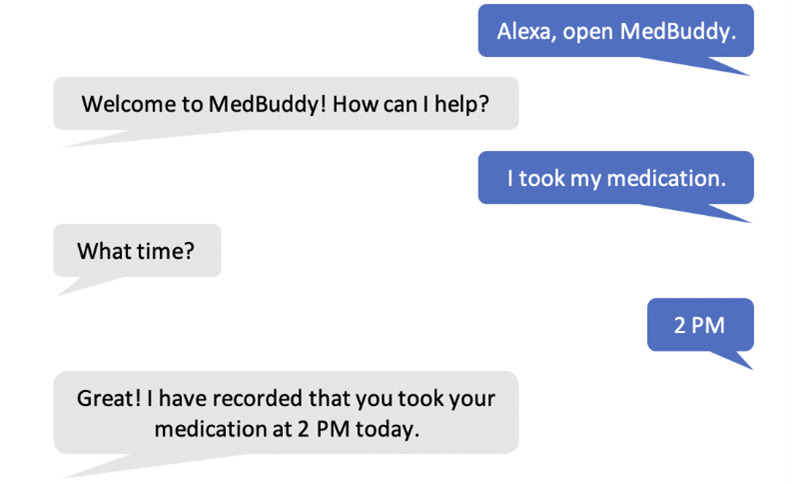
This study aims to create a medication adherence app (skill), MedBuddy, for Amazon Echo devices and measure the use, usability, and usefulness of this medication-taking reminder skill.

METHODS

A single-group, mixed methods, cohort feasibility study was conducted with women who took oral contraceptives (N=25). Participants were undergraduate students (age: mean 21.8 years, SD 6.2) at an urban university in the Southeast United States. Participants were given an Amazon Echo Dot with MedBuddy-a new medication reminder skill for Echo devices created by our team-attached to their study account, which they used for 60 days. Participants self-reported their baseline and poststudy medication adherence. MedBuddy use was objectively evaluated by tracking participants' interactions with MedBuddy through Amazon Alexa. The usability and usefulness of MedBuddy were evaluated through a poststudy interview in which participants responded to both quantitative and qualitative questions.

RESULTS

Participants' interactions with MedBuddy, as tracked through Amazon Alexa, only occurred on half of the study days (mean 50.97, SD 29.5). At study end, participants reported missing their medication less in the past 1 and 6 months compared with baseline (χ=0.9 and χ=0.4, respectively; McNemar test: P<.001 for both). However, there was no significant difference in participants' reported adherence to consistently taking medication within the same 2-hour time frame every day in the past 1 or 6 months at the end of the study compared with baseline (χ=3.5 and χ=0.4, respectively; McNemar test: P=.63 and P=.07, respectively). Overall feedback about usability was positive, and participants provided constructive feedback about the skill's features that could be improved. Participants' evaluation of MedBuddy's usefulness was overwhelmingly positive-most (15/23, 65%) said that they would continue using MedBuddy as a medication reminder if provided with the opportunity and that they would recommend it to others. MedBuddy features that participants enjoyed were an external prompt separate from their phone, the ability to hear the reminder prompt from a separate room, multiple reminders, and verbal responses to prompts.

CONCLUSIONS

The findings of this feasibility study indicate that the MedBuddy medication reminder skill may be useful in promoting medication adherence. However, the skill could benefit from further usability enhancements.
https://cdn.ncbi.nlm.nih.gov/pmc/blobs/6b40/8317037/61f23cff6b9e/formative_v5i7e27327_fig1.jpg
摘要

背景

药物治疗依从性不佳是一项全球性的公共卫生挑战,会导致健康结果不理想,并增加医疗成本。忘记服药是无意性药物治疗依从性不佳的最常见原因之一。研究结果表明,语音激活的虚拟家庭助手,如亚马逊Echo和谷歌Home设备,可能有助于提高药物治疗依从性。

目的

本研究旨在为亚马逊Echo设备创建一款药物治疗依从性应用程序(技能)MedBuddy,并评估这款服药提醒技能的使用情况、可用性和有用性。

方法

对服用口服避孕药的女性(N = 25)进行了一项单组、混合方法的队列可行性研究。参与者是美国东南部一所城市大学的本科生(年龄:平均21.8岁,标准差6.2)。为参与者提供了一个附带MedBuddy(我们团队为Echo设备创建的一种新的药物提醒技能)的亚马逊Echo Dot,并将其关联到他们的研究账户,他们使用该设备60天。参与者自行报告其基线和研究后的药物治疗依从性。通过亚马逊Alexa跟踪参与者与MedBuddy的交互,客观评估MedBuddy的使用情况。通过研究后的访谈评估MedBuddy的可用性和有用性,参与者在访谈中回答定量和定性问题。

结果

通过亚马逊Alexa跟踪发现,参与者与MedBuddy的交互仅在一半的研究日发生(平均50.97,标准差29.5)。在研究结束时,参与者报告在过去1个月和6个月中忘记服药的情况比基线时有所减少(χ分别为0.9和0.4;McNemar检验:两者P <.001)。然而,在研究结束时,与基线相比,参与者报告在过去1个月或6个月中每天在相同的2小时时间范围内持续服药的依从性没有显著差异(χ分别为3.5和0.4;McNemar检验:P分别为0.63和0.07)。关于可用性的总体反馈是积极的,参与者对该技能可改进的功能提供了建设性反馈。参与者对MedBuddy有用性的评价绝大多数是积极的——大多数人(15/23,65%)表示如果有机会,他们会继续使用MedBuddy作为服药提醒,并且会推荐给其他人。参与者喜欢的MedBuddy功能包括独立于手机的外部提醒、能在单独房间听到提醒提示、多次提醒以及对提示的语音回复。

结论

这项可行性研究的结果表明,MedBuddy服药提醒技能可能有助于提高药物治疗依从性。然而,该技能可从进一步提高可用性中受益。

相似文献

1
Medication Adherence Reminder System for Virtual Home Assistants: Mixed Methods Evaluation Study.虚拟家庭助手的药物依从性提醒系统:混合方法评估研究
JMIR Form Res. 2021 Jul 13;5(7):e27327. doi: 10.2196/27327.
2
Convenient Access to Expert-Reviewed Health Information via an Alexa Voice Assistant Skill for Patients With Multiple Myeloma: Development Study.通过适用于多发性骨髓瘤患者的Alexa语音助手技能便捷获取专家评审的健康信息:开发研究
JMIR Cancer. 2022 Jun 9;8(2):e35500. doi: 10.2196/35500.
3
Voice Assistant Reminders and the Latency of Scheduled Medication Use in Older Adults With Pain: Descriptive Feasibility Study.语音助手提醒与老年疼痛患者定时用药的延迟:描述性可行性研究
JMIR Form Res. 2021 Sep 28;5(9):e26361. doi: 10.2196/26361.
4
Patients' Experiences of Using Smartphone Apps to Support Self-Management and Improve Medication Adherence in Hypertension: Qualitative Study.患者使用智能手机应用程序支持自我管理和改善高血压药物依从性的体验:定性研究。
JMIR Mhealth Uhealth. 2020 Oct 28;8(10):e17470. doi: 10.2196/17470.
5
A Mobile Health App to Support Patients Receiving Medication-Assisted Treatment for Opioid Use Disorder: Development and Feasibility Study.一款支持阿片类药物使用障碍患者接受药物辅助治疗的移动健康应用程序:开发与可行性研究。
JMIR Form Res. 2021 Feb 23;5(2):e24561. doi: 10.2196/24561.
6
Health and Fitness Apps for Hands-Free Voice-Activated Assistants: Content Analysis.适用于免提语音激活助手的健康与健身应用程序:内容分析
JMIR Mhealth Uhealth. 2018 Sep 24;6(9):e174. doi: 10.2196/mhealth.9705.
7
Text Messaging Adherence Intervention for Adolescents and Young Adults with Chronic Kidney Disease: Pilot Randomized Controlled Trial and Stakeholder Interviews.短信依从性干预在青少年和慢性肾脏病的年轻成年人中的应用:初步随机对照试验和利益相关者访谈。
J Med Internet Res. 2020 Aug 14;22(8):e19861. doi: 10.2196/19861.
8
A Prospective Study of Usability and Workload of Electronic Medication Adherence Products by Older Adults, Caregivers, and Health Care Providers.老年人、护理人员和医疗保健提供者对电子药物依从性产品的可用性和工作量的前瞻性研究。
J Med Internet Res. 2020 Jun 2;22(6):e18073. doi: 10.2196/18073.
9
Medication Name Comprehension of Intelligent Virtual Assistants: A Comparison of Amazon Alexa, Google Assistant, and Apple Siri Between 2019 and 2021.智能虚拟助手对药物名称的理解:2019年至2021年亚马逊Alexa、谷歌助手和苹果Siri的比较
Front Digit Health. 2021 May 19;3:669971. doi: 10.3389/fdgth.2021.669971. eCollection 2021.
10
A Smartphone App to Support Adherence to Inhaled Corticosteroids in Young Adults With Asthma: Multi-Methods Feasibility Study.一款支持哮喘青年患者坚持使用吸入性糖皮质激素的智能手机应用程序:多方法可行性研究。
JMIR Form Res. 2021 Sep 1;5(9):e28784. doi: 10.2196/28784.

引用本文的文献

1
From Command to Care: A Scoping Review on Utilization of Smart Speakers by Patients and Providers.从指令到关怀:关于患者和医疗服务提供者对智能音箱使用情况的范围综述
Mayo Clin Proc Digit Health. 2024 Apr 11;2(2):207-220. doi: 10.1016/j.mcpdig.2024.03.002. eCollection 2024 Jun.
2
Identification of Use Cases, Target Groups, and Motivations Around Adopting Smart Speakers for Health Care and Social Care Settings: Scoping Review.识别医疗保健和社会护理环境中采用智能音箱的用例、目标群体及动机:范围综述
JMIR AI. 2025 Jan 13;4:e55673. doi: 10.2196/55673.
3
Public opinion on types of voice systems for older adults.

本文引用的文献

1
Virtual Home Assistant Use and Perceptions of Usefulness by Older Adults and Support Person Dyads.老年人及其照顾者对虚拟家庭助手的使用和感知有用性。
Int J Environ Res Public Health. 2021 Jan 27;18(3):1113. doi: 10.3390/ijerph18031113.
2
High Blood Pressure Medication Adherence Among Urban, African Americans in the Midwest United States.美国中西部城市中非洲裔美国人的高血压药物治疗依从性。
J Racial Ethn Health Disparities. 2021 Jun;8(3):607-617. doi: 10.1007/s40615-020-00819-2. Epub 2020 Jul 10.
3
Self-Reported Nonadherence Associated with Pharmacy and Home Medication Management Inconvenience Factors in a US Adult Population.
关于老年人语音系统类型的公众意见。
J Rehabil Assist Technol Eng. 2024 Oct 16;11:20556683241287414. doi: 10.1177/20556683241287414. eCollection 2024 Jan-Dec.
4
Cancer-related cognitive impairment in older adults with acute myeloid leukemia treated with hypomethylating agents and venetoclax chemotherapy: a longitudinal descriptive study.老年急性髓系白血病患者接受低甲基化药物和 venetoclax 化疗后与癌症相关的认知障碍:一项纵向描述性研究。
Support Care Cancer. 2024 Jul 3;32(7):485. doi: 10.1007/s00520-024-08673-2.
5
Redefining Virtual Assistants in Health Care: The Future With Large Language Models.重新定义医疗保健中的虚拟助手:大语言模型的未来。
J Med Internet Res. 2024 Jan 19;26:e53225. doi: 10.2196/53225.
6
Convenient Access to Expert-Reviewed Health Information via an Alexa Voice Assistant Skill for Patients With Multiple Myeloma: Development Study.通过适用于多发性骨髓瘤患者的Alexa语音助手技能便捷获取专家评审的健康信息:开发研究
JMIR Cancer. 2022 Jun 9;8(2):e35500. doi: 10.2196/35500.
7
"Hey Siri, Help Me Take Care of My Child": A Feasibility Study With Caregivers of Children With Special Healthcare Needs Using Voice Interaction and Automatic Speech Recognition in Remote Care Management.“嘿 Siri,帮我照顾我的孩子”:一项针对有特殊医疗需求儿童照顾者的可行性研究,使用语音交互和自动语音识别进行远程护理管理。
Front Public Health. 2022 Mar 3;10:849322. doi: 10.3389/fpubh.2022.849322. eCollection 2022.
美国成年人群中自我报告的不依从性与药房及家庭用药管理不便因素的相关性
Patient Prefer Adherence. 2020 Mar 9;14:529-539. doi: 10.2147/PPA.S223408. eCollection 2020.
4
Medication Adherence, Health Care Utilization, and Spending Among Privately Insured Adults With Chronic Conditions in the United States, 2010-2016.美国 2010-2016 年慢性疾病私人保险成年人的药物依从性、医疗保健利用率和支出。
Am J Med. 2020 Jun;133(6):690-704.e19. doi: 10.1016/j.amjmed.2019.12.021. Epub 2020 Jan 24.
5
The potential of placing a digital assistant in patients' homes.在患者家中安置数字助理的潜力。
Br J Gen Pract. 2019 Dec 26;70(690):8-9. doi: 10.3399/bjgp20X707273. Print 2020 Jan.
6
Telemedicine interventions for medication adherence in mental illness: A systematic review.远程医疗干预措施在改善精神疾病患者药物依从性中的应用:一项系统性综述。
Gen Hosp Psychiatry. 2020 Jan-Feb;62:28-36. doi: 10.1016/j.genhosppsych.2019.11.004. Epub 2019 Nov 13.
7
Medication management support in diabetes: a systematic assessment of diabetes self-management apps.糖尿病药物管理支持:糖尿病自我管理应用程序的系统评估。
BMC Med. 2019 Jul 17;17(1):127. doi: 10.1186/s12916-019-1362-1.
8
SMART-MEDS: Development of a Medication Adherence App for Acute Coronary Syndrome Patients based on a Gamified Behaviour Change Model.SMART-MEDS:基于游戏化行为改变模型为急性冠状动脉综合征患者开发的药物依从性应用程序。
AMIA Annu Symp Proc. 2018 Dec 5;2018:413-421. eCollection 2018.
9
Parent Preferences for Methods and Content of Mobile Technology-Based Asthma Medication Adherence Intervention.家长对基于移动技术的哮喘药物依从性干预方法和内容的偏好
Hosp Pediatr. 2019 Mar;9(3):209-215. doi: 10.1542/hpeds.2018-0122. Epub 2019 Feb 8.
10
A Multi-step Usability Evaluation of a Self-Management App to Support Medication Adherence in Persons Living with HIV.多步骤可用性评估一种自我管理应用程序以支持艾滋病毒感染者的药物依从性。
Int J Med Inform. 2019 Feb;122:37-44. doi: 10.1016/j.ijmedinf.2018.11.012. Epub 2018 Dec 3.