• 文献检索
  • 文档翻译
  • 深度研究
  • 学术资讯
  • Suppr Zotero 插件Zotero 插件
  • 邀请有礼
  • 套餐&价格
  • 历史记录
应用&插件
Suppr Zotero 插件Zotero 插件浏览器插件Mac 客户端Windows 客户端微信小程序
定价
高级版会员购买积分包购买API积分包
服务
文献检索文档翻译深度研究API 文档MCP 服务
关于我们
关于 Suppr公司介绍联系我们用户协议隐私条款
关注我们

Suppr 超能文献

核心技术专利:CN118964589B侵权必究
粤ICP备2023148730 号-1Suppr @ 2026

文献检索

告别复杂PubMed语法,用中文像聊天一样搜索,搜遍4000万医学文献。AI智能推荐,让科研检索更轻松。

立即免费搜索

文件翻译

保留排版,准确专业,支持PDF/Word/PPT等文件格式,支持 12+语言互译。

免费翻译文档

深度研究

AI帮你快速写综述,25分钟生成高质量综述,智能提取关键信息,辅助科研写作。

立即免费体验

测量患者使用移动医疗服务进行慢性病自我管理的持续使用效果:模型开发与验证。

Measuring Success of Patients' Continuous Use of Mobile Health Services for Self-management of Chronic Conditions: Model Development and Validation.

机构信息

Centre for Digital Transformation, School of Computing and Information Technology, Faculty of Engineering and Information Sciences, University of Wollongong, Wollongong, Australia.

Illawarra Health and Medical Research Institute, University of Wollongong, Wollongong, Australia.

出版信息

J Med Internet Res. 2021 Jul 13;23(7):e26670. doi: 10.2196/26670.

DOI:10.2196/26670
PMID:34255685
原文链接:https://pmc.ncbi.nlm.nih.gov/articles/PMC8317034/
Abstract

BACKGROUND

Mobile health services are gradually being introduced to support patients' self-management of chronic conditions. The success of these services is contingent upon patients' continuous use of them.

OBJECTIVE

This study aims to develop a model to measure the success of patients' continuous use of mobile health services for the self-management of chronic conditions.

METHODS

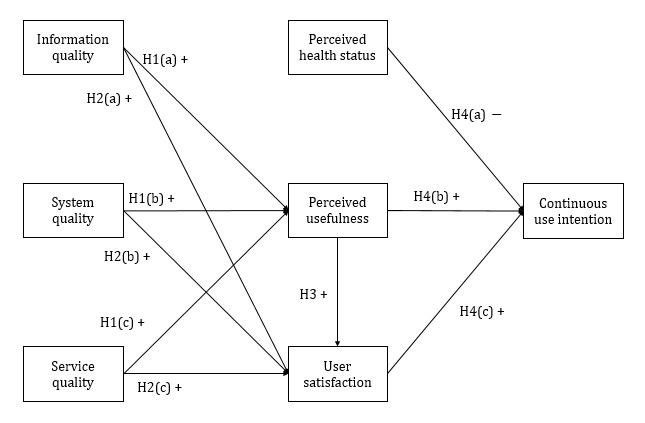
The proposed model was derived from the information systems continuance model and the information systems success model. This model contains 7 theoretical constructs: information quality, system quality, service quality, perceived usefulness, user satisfaction, perceived health status, and continuous use intention. A web-based questionnaire survey instrument was developed to test the model. The survey was conducted to collect data from 129 patients who used a mobile health app for hypertension management from 2017 to 2019. The questionnaire items were derived from validated instruments and were measured using a 5-point Likert scale. The partial least squares modelling method was used to test the theoretical model.

RESULTS

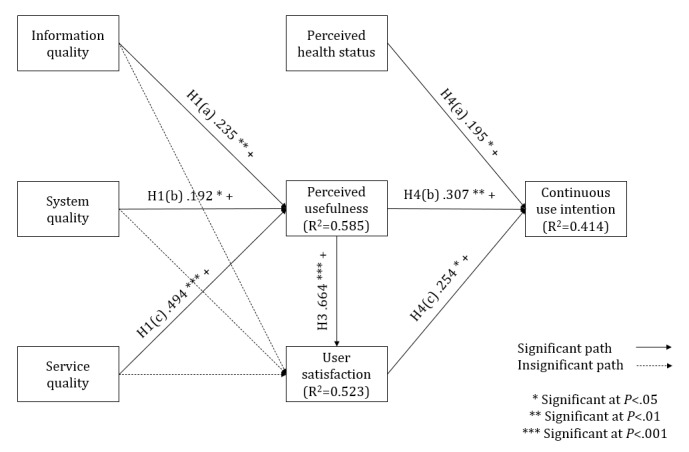
The model accounted for 58.5% of the variance in perceived usefulness (R=0.585), 52.3% of the variance in user satisfaction (R=0.523), and 41.4% of the variance in patients' intention to make continuous use of mobile health services (R=0.414). The continuous use intention was significantly influenced by their perceived health status (β=.195, P=.03), perceived usefulness (β=.307, P=.004), and user satisfaction (β=.254, P=.04) with the mobile health service. Information quality (β=.235, P=.005), system quality (β=.192, P=.02), and service quality (β=.494, P<.001) had a significantly positive influence on perceived usefulness but not on user satisfaction. Perceived usefulness had a significantly positive influence on user satisfaction (β=.664, P<.001). In a result opposite to the original hypothesis, perceived health status did not negatively influence patients' intention to continue using the mobile health service but showed a significantly positive correlation.

CONCLUSIONS

This study developed a theoretical model to predict and explain patients' continuous use of mobile health services for self-management of chronic conditions and empirically tested the model. Perceived usefulness, user satisfaction, and health status contributed to patients' intention to make continuous use of mobile health services for self-managing their chronic conditions.

摘要

背景

移动医疗服务正逐步引入,以支持患者对慢性病的自我管理。这些服务的成功与否取决于患者对其的持续使用。

目的

本研究旨在开发一种衡量患者对慢性病自我管理的移动医疗服务持续使用的成功模型。

方法

所提出的模型源自信息系统持续使用模型和信息系统成功模型。该模型包含 7 个理论结构:信息质量、系统质量、服务质量、感知有用性、用户满意度、感知健康状况和持续使用意向。开发了一个基于网络的问卷调查工具来测试该模型。该调查于 2017 年至 2019 年期间,从使用移动健康应用程序管理高血压的 129 名患者中收集数据。问卷项目来自经过验证的工具,并使用 5 点李克特量表进行测量。偏最小二乘建模方法用于测试理论模型。

结果

该模型解释了感知有用性(R2=0.585)的 58.5%、用户满意度(R2=0.523)的 52.3%和患者持续使用移动医疗服务意向(R2=0.414)的 41.4%的差异。连续使用意向受其感知健康状况(β=.195,P=.03)、感知有用性(β=.307,P=.004)和用户满意度(β=.254,P=.04)的显著影响。信息质量(β=.235,P=.005)、系统质量(β=.192,P=.02)和服务质量(β=.494,P<.001)对感知有用性有显著正向影响,但对用户满意度没有影响。感知有用性对用户满意度有显著正向影响(β=.664,P<.001)。与原始假设相反的结果是,感知健康状况并没有对患者继续使用移动医疗服务的意愿产生负面影响,而是表现出显著的正相关。

结论

本研究开发了一个理论模型来预测和解释患者对慢性病自我管理的移动医疗服务的持续使用,并对该模型进行了实证检验。感知有用性、用户满意度和健康状况有助于患者持续使用移动医疗服务来自我管理他们的慢性病。
https://cdn.ncbi.nlm.nih.gov/pmc/blobs/2cd0/8317034/7c1000ca677f/jmir_v23i7e26670_fig2.jpg
https://cdn.ncbi.nlm.nih.gov/pmc/blobs/2cd0/8317034/7f7055928ce1/jmir_v23i7e26670_fig1.jpg
https://cdn.ncbi.nlm.nih.gov/pmc/blobs/2cd0/8317034/7c1000ca677f/jmir_v23i7e26670_fig2.jpg
https://cdn.ncbi.nlm.nih.gov/pmc/blobs/2cd0/8317034/7f7055928ce1/jmir_v23i7e26670_fig1.jpg
https://cdn.ncbi.nlm.nih.gov/pmc/blobs/2cd0/8317034/7c1000ca677f/jmir_v23i7e26670_fig2.jpg

相似文献

1
Measuring Success of Patients' Continuous Use of Mobile Health Services for Self-management of Chronic Conditions: Model Development and Validation.测量患者使用移动医疗服务进行慢性病自我管理的持续使用效果:模型开发与验证。
J Med Internet Res. 2021 Jul 13;23(7):e26670. doi: 10.2196/26670.
2
Continuous usage intention of mobile health services: model construction and validation.移动医疗服务的持续使用意愿:模型构建与验证。
BMC Health Serv Res. 2023 May 5;23(1):442. doi: 10.1186/s12913-023-09393-9.
3
The Impact of Gamification-Induced Users' Feelings on the Continued Use of mHealth Apps: A Structural Equation Model With the Self-Determination Theory Approach.游戏化引发的用户情感对移动医疗应用持续使用的影响:基于自我决定理论的结构方程模型。
J Med Internet Res. 2021 Aug 12;23(8):e24546. doi: 10.2196/24546.
4
Patients' Acceptance of Smartphone Health Technology for Chronic Disease Management: A Theoretical Model and Empirical Test.患者对用于慢性病管理的智能手机健康技术的接受度:一个理论模型与实证检验
JMIR Mhealth Uhealth. 2017 Dec 6;5(12):e177. doi: 10.2196/mhealth.7886.
5
A scale to measure the perceived quality of mHealth by elderly patients with hypertension in China.用于测量中国高血压老年患者对移动医疗感知质量的量表。
BMC Health Serv Res. 2023 Apr 10;23(1):351. doi: 10.1186/s12913-023-09357-z.
6
Effects of User Experience in Automated Information Processing on Perceived Usefulness of Digital Contact-Tracing Apps: Cross-Sectional Survey Study.自动化信息处理中的用户体验对数字接触追踪应用程序感知有用性的影响:横断面调查研究。
JMIR Hum Factors. 2024 Jun 25;11:e53940. doi: 10.2196/53940.
7
Investigating Patients' Continuance Intention Toward Conversational Agents in Outpatient Departments: Cross-sectional Field Survey.调查门诊患者对会话代理的持续意向:横断面现场调查。
J Med Internet Res. 2022 Nov 7;24(11):e40681. doi: 10.2196/40681.
8
Factors Influencing Patients' Intentions to Use Diabetes Management Apps Based on an Extended Unified Theory of Acceptance and Use of Technology Model: Web-Based Survey.基于扩展的技术接受与使用统一理论模型探讨影响患者使用糖尿病管理应用程序意愿的因素:网络调查
J Med Internet Res. 2019 Aug 13;21(8):e15023. doi: 10.2196/15023.
9
Does "hospital loyalty" matter? Factors related to the intention of using a mobile app.“医院忠诚度”重要吗?与使用移动应用程序意愿相关的因素。
Patient Prefer Adherence. 2019 Jul 31;13:1283-1294. doi: 10.2147/PPA.S207031. eCollection 2019.
10
Understanding the Role of Mobile Internet-Based Health Services on Patient Satisfaction and Word-of-Mouth.理解移动互联网医疗服务对患者满意度和口碑的作用。
Int J Environ Res Public Health. 2018 Sep 10;15(9):1972. doi: 10.3390/ijerph15091972.

引用本文的文献

1
Affordance Types and Their Determinants in Patient Mobile Health Portals Use: An Empirical Investigation.患者移动健康门户使用中的可供性类型及其决定因素:一项实证研究。
J Med Internet Res. 2025 Aug 27;27:e74351. doi: 10.2196/74351.
2
Effect of patient satisfaction on the utilization of mHealth services by patients with chronic disease.患者满意度对慢性病患者移动健康服务利用情况的影响。
Digit Health. 2025 Apr 15;11:20552076251333983. doi: 10.1177/20552076251333983. eCollection 2025 Jan-Dec.
3
Diabetic neuropathy: cutting-edge research and future directions.

本文引用的文献

1
A Comprehensive 6A Framework for Improving Patient Self-Management of Hypertension Using mHealth Services: Qualitative Thematic Analysis.利用移动医疗服务提高高血压患者自我管理的综合 6A 框架:定性主题分析。
J Med Internet Res. 2021 Jun 21;23(6):e25522. doi: 10.2196/25522.
2
Exploring Patients' Intentions for Continuous Usage of mHealth Services: Elaboration-Likelihood Perspective Study.探索患者对移动医疗服务持续使用意愿:详尽可能性视角研究。
JMIR Mhealth Uhealth. 2020 Apr 6;8(4):e17258. doi: 10.2196/17258.
3
Do mobile device apps designed to support medication adherence demonstrate efficacy? A systematic review of randomised controlled trials, with meta-analysis.
糖尿病神经病变:前沿研究与未来方向
Signal Transduct Target Ther. 2025 Apr 25;10(1):132. doi: 10.1038/s41392-025-02175-1.
4
An Actor-Partner Interdependence Mediation Model for Assessing the Association Between Health Literacy and mHealth Use Intention in Dyads of Patients With Chronic Heart Failure and Their Caregivers: Cross-Sectional Study.一种用于评估慢性心力衰竭患者及其照顾者二元组中健康素养与移动健康使用意愿之间关联的行为者-伙伴相互依赖中介模型:横断面研究。
JMIR Mhealth Uhealth. 2025 Mar 6;13:e63805. doi: 10.2196/63805.
5
Comparing the Quality of Direct-to-Consumer Telemedicine Dominated and Delivered by Public and Private Sector Platforms in China: Standardized Patient Study.中国直接面向消费者的远程医疗主导和提供方(公立和私立部门平台)的质量比较:标准化患者研究。
J Med Internet Res. 2024 Nov 14;26:e55400. doi: 10.2196/55400.
6
Impact of a Nationwide Medication History Sharing Program on the Care Process and End-User Experience in a Tertiary Teaching Hospital: Cohort Study and Cross-Sectional Study.全国用药史共享计划对一家三级教学医院护理流程及终端用户体验的影响:队列研究与横断面研究
JMIR Med Inform. 2024 Mar 20;12:e53079. doi: 10.2196/53079.
7
Mobile Apps for Common Noncommunicable Disease Management: Systematic Search in App Stores and Evaluation Using the Mobile App Rating Scale.移动应用程序用于常见非传染性疾病管理:在应用商店中的系统搜索和使用移动应用程序评级量表进行评估。
JMIR Mhealth Uhealth. 2024 Mar 12;12:e49055. doi: 10.2196/49055.
8
Efficacy of an mHealth App to Support Patients' Self-Management of Hypertension: Randomized Controlled Trial.移动医疗应用支持高血压患者自我管理的疗效:随机对照试验。
J Med Internet Res. 2023 Dec 19;25:e43809. doi: 10.2196/43809.
9
Factors affecting the willingness of patients with type 2 diabetes to use digital disease management applications: a cross-sectional study.影响 2 型糖尿病患者使用数字疾病管理应用意愿的因素:一项横断面研究。
Front Public Health. 2023 Oct 23;11:1259158. doi: 10.3389/fpubh.2023.1259158. eCollection 2023.
10
A WeChat applet-based national remote emergency system for malignant hyperthermia in China: a usability study.基于微信小程序的中国恶性高热全国远程急救系统:一项可用性研究。
BMC Med Inform Decis Mak. 2023 Sep 5;23(1):175. doi: 10.1186/s12911-023-02275-4.
移动设备应用程序旨在支持药物依从性,它们是否有效?一项随机对照试验的系统评价,包括荟萃分析。
BMJ Open. 2020 Jan 30;10(1):e032045. doi: 10.1136/bmjopen-2019-032045.
4
Features, outcomes, and challenges in mobile health interventions for patients living with chronic diseases: A review of systematic reviews.移动医疗干预在慢性病患者中的特点、结果和挑战:系统评价综述。
Int J Med Inform. 2019 Dec;132:103984. doi: 10.1016/j.ijmedinf.2019.103984. Epub 2019 Oct 5.
5
A Fall Risk mHealth App for Older Adults: Development and Usability Study.一款针对老年人的跌倒风险移动健康应用程序:开发与可用性研究。
JMIR Aging. 2018 Nov 20;1(2):e11569. doi: 10.2196/11569.
6
The Continued Use of Mobile Health Apps: Insights From a Longitudinal Study.移动医疗应用的持续使用:一项纵向研究的新发现。
JMIR Mhealth Uhealth. 2019 Aug 29;7(8):e12983. doi: 10.2196/12983.
7
The Use of Theory in Mobile Health Interventions for Patient Self-Management of Chronic Diseases.理论在慢性病患者自我管理的移动健康干预中的应用。
Stud Health Technol Inform. 2019 Aug 21;264:1982-1983. doi: 10.3233/SHTI190745.
8
Mobile health applications for chronic diseases: A systematic review of features for lifestyle improvement.用于慢性病的移动健康应用程序:对改善生活方式功能的系统评价。
Diabetes Metab Syndr. 2019 Jul-Aug;13(4):2507-2512. doi: 10.1016/j.dsx.2019.07.016. Epub 2019 Jul 9.
9
The mHealth App Usability Questionnaire (MAUQ): Development and Validation Study.移动医疗应用可用性问卷(MAUQ):开发与验证研究。
JMIR Mhealth Uhealth. 2019 Apr 11;7(4):e11500. doi: 10.2196/11500.
10
How habit affects continuous use: evidence from Jordan's national health information system.习惯如何影响持续使用:来自约旦国家卫生信息系统的证据。
Inform Health Soc Care. 2020 Jan;45(1):43-56. doi: 10.1080/17538157.2018.1540423. Epub 2018 Nov 20.