National Korányi Institute of Pulmonology, Budapest, Hungary.
MSD Pharma Hungary Ltd, Budapest, Hungary.
Pathol Oncol Res. 2021 Apr 30;27:603937. doi: 10.3389/pore.2021.603937. eCollection 2021.
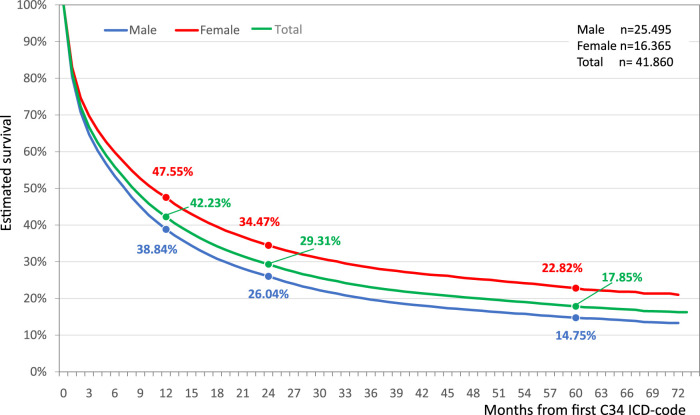
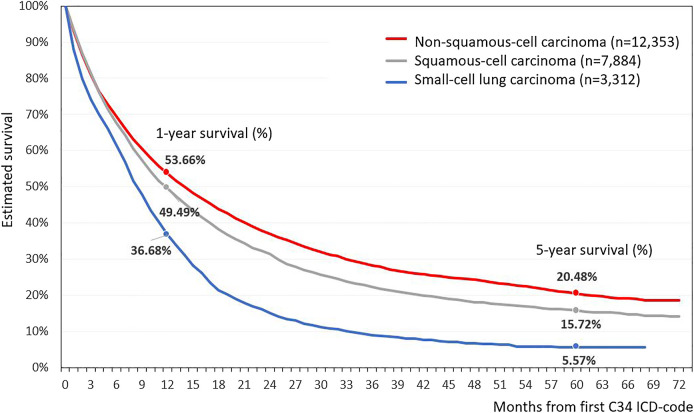
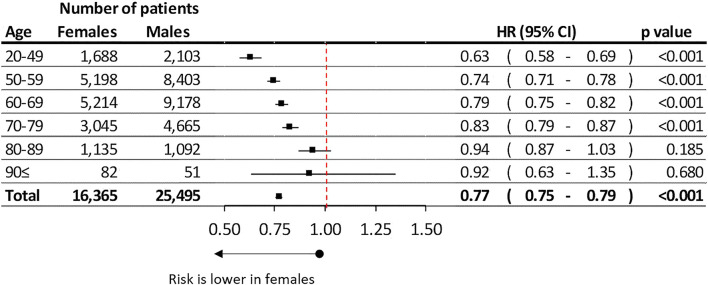
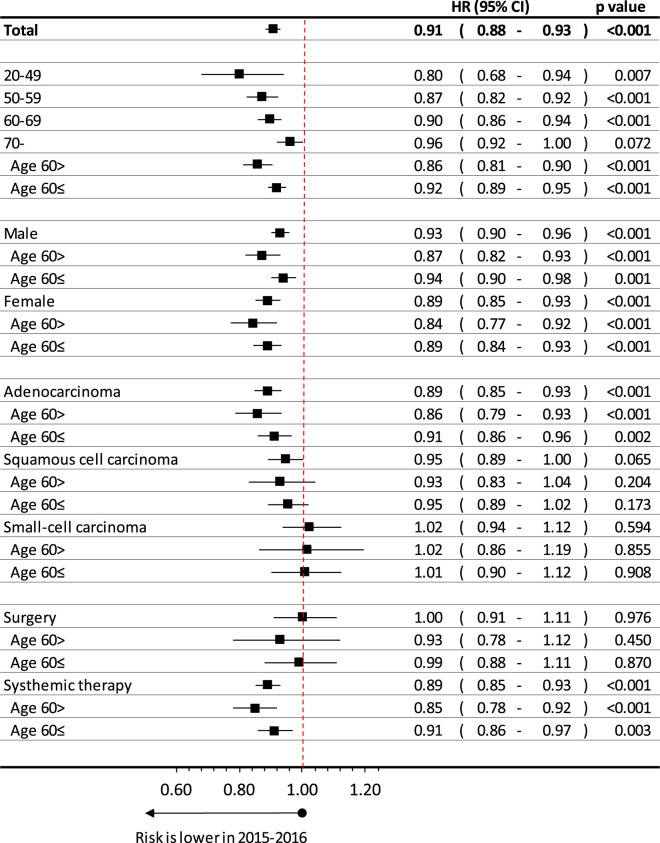
Lung cancer is one of the most common cancers worldwide and its survival is still poor. The objective of our study was to estimate long-term survival of Hungarian lung cancer patients at first time based on a nationwide review of the National Health Insurance Fund database. Our retrospective, longitudinal study included patients aged ≥20 years who were diagnosed with lung cancer (ICD-10 C34) between January 1, 2011 and December 31, 2016. Survival rates were evaluated by year of diagnosis, patient gender and age, and morphology of lung cancer. 41,854 newly diagnosed lung cancer patients were recorded. Mean age at diagnosis varied between 64.7 and 65.9 years during study period. One- and 5-year overall survival rates for the total population were 42.2 and 17.9%, respectively. Survival was statistically associated with gender, age and type of lung cancer. Female patients ( = 16,362) had 23% better survival (HR: 0.77, 95% confidence interval (CI): 0.75-0.79; < 0.001) than males ( = 25,492). The highest survival rates were found in the 20-49 age cohort (5Y = 31.3%) and if the cancer type was adenocarcinoma (5Y = 20.5%). We measured 5.3% improvement (9.2% adjusted) in lung cancer survival comparing the period 2015-2016 to 2011-2012 (HR: 0.95 95% CI: 0.92-0.97; = 0.003), the highest at females <60 year (0.86 (adjusted HR was 0.79), interaction analysis was significant for age and histology types. Our study provided long-term Lung cancer survival data in Hungary for the first time. We found a 5.3% improvement in 5-year survival in 4 years. Women and young patients had better survival. Survival rates were comparable to-and at the higher end of-rates registered in other East-Central European countries (7.7%-15.7%).
肺癌是全球最常见的癌症之一,其生存率仍然较低。我们的研究目的是基于对国家健康保险基金数据库的全国性审查,首次估计匈牙利肺癌患者的长期生存率。我们的回顾性纵向研究包括年龄≥20 岁的患者,他们在 2011 年 1 月 1 日至 2016 年 12 月 31 日期间被诊断患有肺癌(ICD-10 C34)。通过诊断年份、患者性别和年龄以及肺癌形态评估生存率。共记录了 41854 例新诊断的肺癌患者。在研究期间,诊断时的平均年龄在 64.7 岁至 65.9 岁之间。总人群的 1 年和 5 年总生存率分别为 42.2%和 17.9%。生存与性别、年龄和肺癌类型有统计学关联。女性患者(=16362 例)的生存率比男性(=25492 例)高 23%(HR:0.77,95%置信区间(CI):0.75-0.79;<0.001)。在 20-49 岁年龄组发现了最高的生存率(5Y=31.3%),如果癌症类型是腺癌(5Y=20.5%)。与 2011-2012 年相比,2015-2016 年期间肺癌生存率提高了 5.3%(9.2%调整)(HR:0.95 95%CI:0.92-0.97;=0.003),60 岁以下女性的增幅最高(0.86(调整后的 HR 为 0.79),年龄和组织学类型的交互分析具有统计学意义。我们的研究首次提供了匈牙利肺癌长期生存数据。我们发现,4 年内 5 年生存率提高了 5.3%。女性和年轻患者的生存率更好。生存率与其他中东欧国家(7.7%-15.7%)登记的生存率相当,且处于较高水平。