Department of Orthopaedics, Union Hospital, Tongji Medical College, Huazhong University of Science and Technology, Jiefang Road. 1277#, Wuhan, 430022 Hubei, China.
Tongji Medical College, Huazhong University of Science and Technology, Wuhan 430022, China.
Biomed Res Int. 2021 Jun 22;2021:9930524. doi: 10.1155/2021/9930524. eCollection 2021.
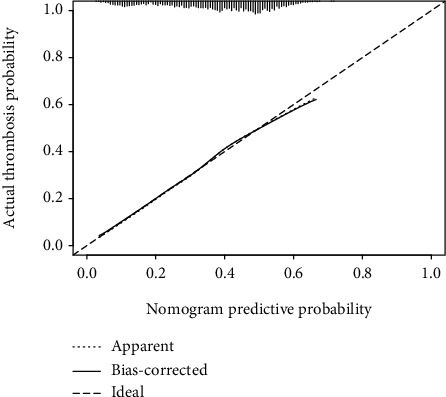
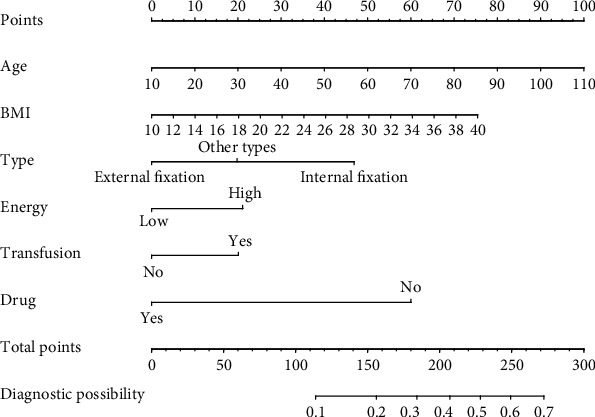
Deep venous thrombosis (DVT) is a common complication in patients with lower extremity fractures, causing delays in recovery short-term and possible impacts on quality of life long-term. Early prediction and prevention of thrombosis can effectively reduce patient pain while improving outcomes. Although research on the risk factors for thrombosis is prevalent, there is a stark lack of clinical predictive models for DVT occurrence specifically in patients with lower limb fractures. In this study, we aim to propose a new thrombus prediction model for lower extremity fracture patients. Data from 3300 patients with lower limb fractures were collected from Wuhan Union Hospital and Hebei Third Hospital, China. Patients who met our inclusion criteria were divided into a thrombosis and a nonthrombosis group. A multivariate logistic regression analysis was carried out to identify predictors with obvious effects, and the corresponding formulas were used to establish the model. Model performance was evaluated using a discrimination and correction curve. 2662 patients were included in the regression analysis, with 1666 in the thrombosis group and 996 in the nonthrombosis group. Predictive factors included age, Body Mass Index (BMI), fracture-fixation types, energy of impact at the time of injury, blood transfusion during hospitalization, and use of anticoagulant drugs. The discriminative ability of the model was verified using the C-statistic (0.676). For the convenience of clinical use, a score table and nomogram were compiled. Data from two centers were used to establish a novel thrombus prediction model specific for patients with lower limb fractures, with verified predictive ability.
深静脉血栓形成(DVT)是下肢骨折患者的常见并发症,导致短期康复延迟,并可能对长期生活质量产生影响。早期预测和预防血栓可以有效减轻患者的痛苦,同时改善治疗效果。尽管对血栓形成的危险因素的研究很普遍,但针对下肢骨折患者 DVT 发生的临床预测模型却很少。本研究旨在为下肢骨折患者提出一种新的血栓预测模型。我们收集了来自中国武汉协和医院和河北医科大学第三医院的 3300 例下肢骨折患者的数据。符合纳入标准的患者被分为血栓组和非血栓组。我们进行了多变量逻辑回归分析,以确定具有明显影响的预测因素,并使用相应的公式建立模型。我们使用判别和校正曲线评估模型性能。在回归分析中纳入了 2662 例患者,其中血栓组 1666 例,非血栓组 996 例。预测因素包括年龄、体重指数(BMI)、骨折固定类型、受伤时的能量冲击、住院期间输血和抗凝药物的使用。模型的判别能力通过 C 统计量(0.676)进行验证。为了便于临床应用,我们编制了评分表和诺模图。我们使用来自两个中心的数据建立了一种针对下肢骨折患者的新型血栓预测模型,具有验证的预测能力。