Department of Endocrinology, The First Affiliated Hospital of Shantou University Medical College, Shantou, China.
Shenzhen Huada Gene Technology Service Co., Ltd, Shenzhen, China.
J Diabetes Res. 2021 Jun 28;2021:9946874. doi: 10.1155/2021/9946874. eCollection 2021.
To investigate the natural history and related factors of the pancreatic -cell function in Chinese type 1 diabetic patients from 3C study Shantou center.
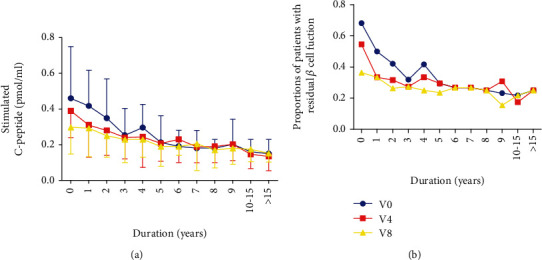
Stimulated C-peptide levels from follow-up data of 201 individuals in 3C study Shantou subgroup starting in 2012 were used. Residual -cell function was defined as stimulated C - peptide level ≥ 0.2 pmol/mL, on the basis of cut-points derived from the Diabetes Control and Complications Trial (DCCT).
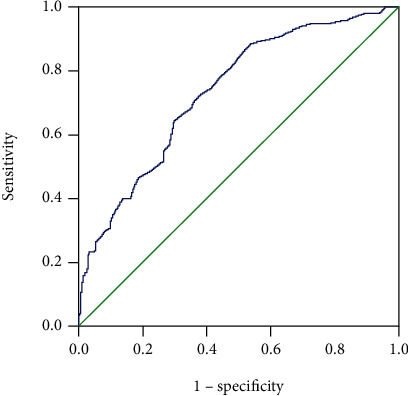
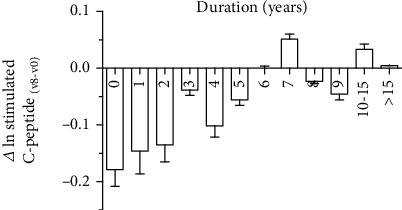
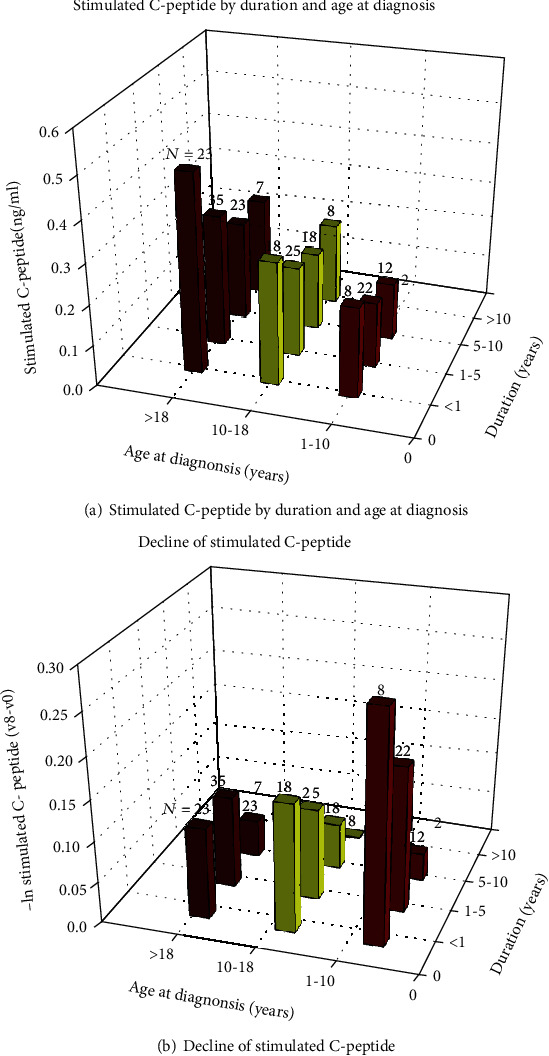
36.8% of patients had residual -cell function, and the percentage was 68.2% in newly diagnosed diabetic patients. COX regression analysis indicated that the age of diagnosis, HbA1C level, and duration were independent factors of residual -cell function in individuals with ≤5 years duration, but in those with duration ≥5 years, only the age of diagnosis was a predictor. The pancreatic -cell function mainly declined in the first 5 years of the duration, and the rate of decline was correlated negatively with the duration and age of diagnosis. Receiver operating characteristic (ROC) analysis indicated that the cut-off point of stimulated C-peptide was 0.615 pmol/mL in patients with <5 years duration to have 7% HbA1c.
Age at diagnosis was the strongest predictor for residual C-peptide. There was a more rapid decline of stimulated C-peptide in duration ≤5 years and younger patients. Therefore, intervention therapies of -cells should start from the early stage, and the recommended target goal of stimulated C-peptide is 0.615 pmol/mL or above.
探讨中国 3C 研究汕头中心 1 型糖尿病患者胰岛β细胞功能的自然史及其相关因素。
利用 2012 年开始的 3C 研究汕头亚组 201 名个体的随访数据中的刺激 C 肽水平。基于糖尿病控制与并发症试验(DCCT)得出的切点,将残余β细胞功能定义为刺激 C 肽水平≥0.2 pmol/mL。
36.8%的患者存在残余β细胞功能,新诊断糖尿病患者的这一比例为 68.2%。COX 回归分析表明,对于病程≤5 年的个体,诊断年龄、HbA1C 水平和病程是残余β细胞功能的独立影响因素,但对于病程≥5 年的个体,只有诊断年龄是预测因素。β细胞功能主要在病程的前 5 年下降,下降速度与病程和诊断年龄呈负相关。受试者工作特征(ROC)分析表明,病程<5 年的患者,刺激 C 肽的截断值为 0.615 pmol/mL 时,HbA1c 为 7%。
诊断年龄是预测残余 C 肽的最强因素。病程≤5 年和年龄较小的患者,刺激 C 肽的下降速度更快。因此,β细胞的干预治疗应从早期开始,推荐的刺激 C 肽目标值为 0.615 pmol/mL 或更高。