Tamogami Shigeru, Agrawal Ganesh K, Rakwal Randeep
Laboratory of Biologically Active Compounds, Department of Biological Production, Akita Prefectural University, Akita 010-0195, Japan.
Research Laboratory for Biotechnology and Biochemistry (RLABB), Kathmandu, Nepal.
Biochem Biophys Rep. 2021 Jun 29;27:101063. doi: 10.1016/j.bbrep.2021.101063. eCollection 2021 Sep.
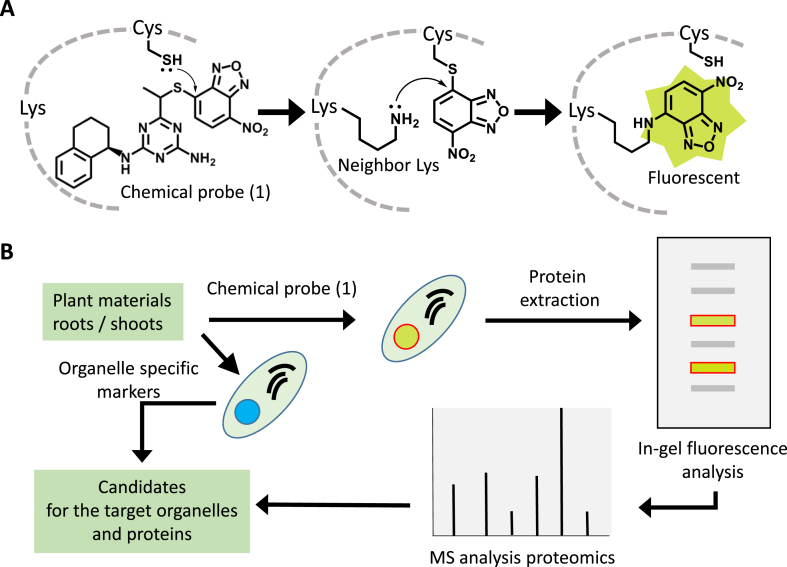
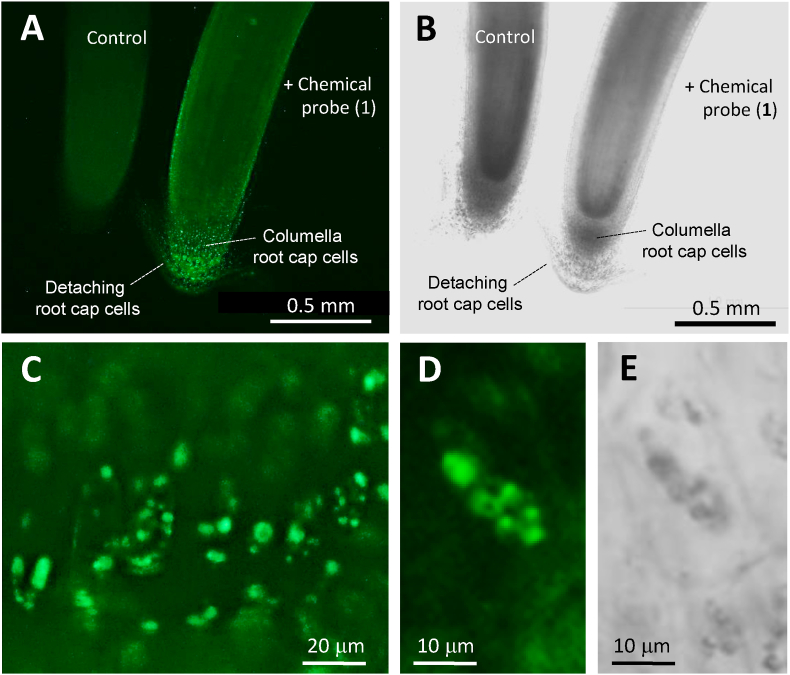
Development of the methods to examine the molecular targets of biologically active compounds is one of the most important subjects in experimental biology/biochemistry. To evaluate the usability of the (7-nitro-2,1,3-benzoxadiazole)-thioether (NBD-S) probe for this purpose, bioactive chemical probe (1) as the cellulose biosynthesis (CB) inhibitor was synthesized and tested. As a result, a variety of fluorescently-labeled particles and organelles were found in the columella root cap cells of radish plants. Of note, well-defined cellular organelles were clearly recognized in the detaching root cap cells (border-like cells). These results imply that the bioactive NBD-S chemical probe could be a valuable direct-labeling reagent. Analysis of these fluorescent substances would be helpful in providing new information on defined molecular targets and events.
研究生物活性化合物分子靶点方法的开发是实验生物学/生物化学中最重要的课题之一。为了评估(7-硝基-2,1,3-苯并恶二唑)-硫醚(NBD-S)探针在此方面的可用性,合成并测试了作为纤维素生物合成(CB)抑制剂的生物活性化学探针(1)。结果,在萝卜植株的根冠柱细胞中发现了多种荧光标记的颗粒和细胞器。值得注意的是,在分离的根冠细胞(边界样细胞)中清晰地识别出了明确的细胞器。这些结果表明,生物活性NBD-S化学探针可能是一种有价值的直接标记试剂。对这些荧光物质的分析将有助于提供有关特定分子靶点和事件的新信息。