ETH Zurich, Leonhardstrasse 21, 8092, Zurich, Switzerland.
Behav Res Methods. 2022 Feb;54(1):493-507. doi: 10.3758/s13428-021-01652-z. Epub 2021 Jul 13.
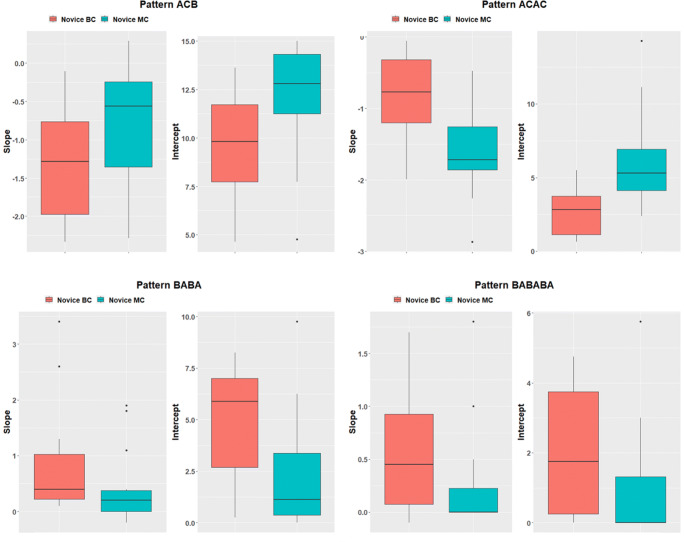
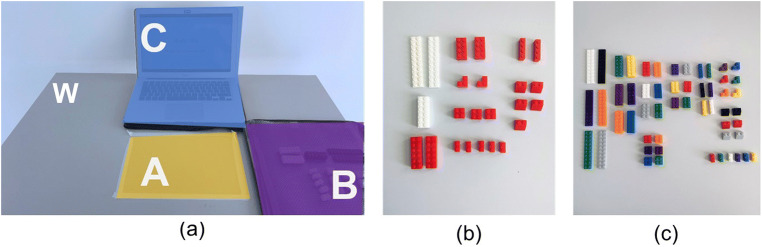
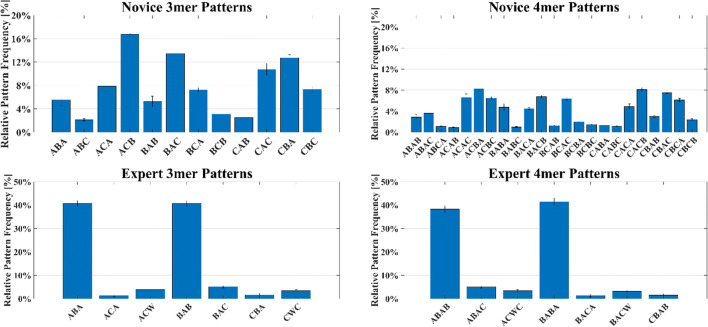
Eye tracking (ET) technology is increasingly utilized to quantify visual behavior in the study of the development of domain-specific expertise. However, the identification and measurement of distinct gaze patterns using traditional ET metrics has been challenging, and the insights gained shown to be inconclusive about the nature of expert gaze behavior. In this article, we introduce an algorithmic approach for the extraction of object-related gaze sequences and determine task-related expertise by investigating the development of gaze sequence patterns during a multi-trial study of a simplified airplane assembly task. We demonstrate the algorithm in a study where novice (n = 28) and expert (n = 2) eye movements were recorded in successive trials (n = 8), allowing us to verify whether similar patterns develop with increasing expertise. In the proposed approach, AOI sequences were transformed to string representation and processed using the k-mer method, a well-known method from the field of computational biology. Our results for expertise development suggest that basic tendencies are visible in traditional ET metrics, such as the fixation duration, but are much more evident for k-mers of k > 2. With increased on-task experience, the appearance of expert k-mer patterns in novice gaze sequences was shown to increase significantly (p < 0.001). The results illustrate that the multi-trial k-mer approach is suitable for revealing specific cognitive processes and can quantify learning progress using gaze patterns that include both spatial and temporal information, which could provide a valuable tool for novice training and expert assessment.
眼动追踪(ET)技术越来越多地用于量化特定领域专业知识发展研究中的视觉行为。然而,使用传统的 ET 指标来识别和测量独特的注视模式一直具有挑战性,并且所获得的见解表明,关于专家注视行为的本质尚无定论。在本文中,我们介绍了一种用于提取与对象相关的注视序列的算法方法,并通过研究简化飞机组装任务的多次试验中注视序列模式的发展来确定与任务相关的专业知识。我们在一项研究中展示了该算法,在该研究中,新手(n=28)和专家(n=2)的眼动在连续试验(n=8)中被记录下来,这使我们能够验证是否随着专业知识的增加而发展出相似的模式。在提出的方法中,AOI 序列被转换为字符串表示,并使用 k-mer 方法进行处理,这是计算生物学领域中众所周知的方法。我们对专业知识发展的研究结果表明,在传统的 ET 指标中可以看到基本趋势,例如注视持续时间,但对于 k>2 的 k-mer 则更为明显。随着与任务相关的经验增加,在新手注视序列中出现专家 k-mer 模式的情况明显增加(p<0.001)。结果表明,多试验 k-mer 方法适合揭示特定的认知过程,并可以使用包括空间和时间信息的注视模式来量化学习进展,这可能为新手培训和专家评估提供有价值的工具。