RSPCA Queensland, 139 Wacol Station Road, Wacol, Queensland, 4076, Australia.
Australian Registry of Wildlife Health, Taronga Conservation Society, Bradleys Head Rd., Mosman, New South Wales, 2088, Australia.
Aust Vet J. 2021 Oct;99(10):432-444. doi: 10.1111/avj.13107. Epub 2021 Jul 13.
To report the temporal and spatial distribution of rainbow lorikeets presenting with lorikeet paralysis syndrome (LPS) and their clinicopathologic and pathologic findings, exposure to toxins, and response to treatment.
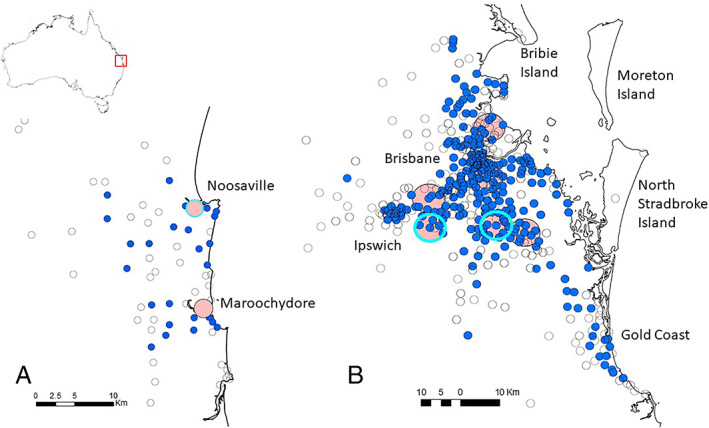
Records of lorikeets admitted in 2017 and 2018 to facilities in south-east Queensland (QLD) were reviewed and LPS and non-LPS cases were mapped and their distribution compared. Plasma biochemistries and complete blood counts were done on 20 representative lorikeets from south-east QLD and Grafton, New South Wales (NSW). Tissues from 28 lorikeets were examined histologically. Samples were tested for pesticides (n = 19), toxic elements (n = 23), botulism (n = 15) and alcohol (n = 5).
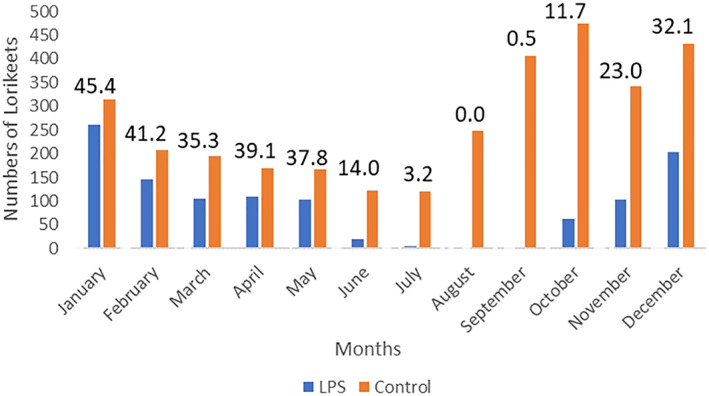
LPS occurred in warmer months. Affected lorikeets were found across south-east QLD. Hotspots were identified in Brisbane and the Sunshine Coast. Lorikeets had a heterophilic leucocytosis, elevated muscle enzymes, uric acid and sodium and chloride. Specific lesions were not found. Exposure to cadmium was common in LPS and non-LPS lorikeets. Treated lorikeets had a 60-93% See Table 2 depending on severity of signs.
The primary differential diagnosis for lorikeets presenting with lower motor neuron signs during spring, summer and autumn in northern NSW and south-east Queensland should be LPS. With supportive care, prognosis is fair to good.
报告呈现虹彩吸蜜鹦鹉麻痹综合征(LPS)的虹彩吸蜜鹦鹉的时间和空间分布,以及它们的临床病理和病理发现、接触毒素情况以及对治疗的反应。
回顾了 2017 年和 2018 年在昆士兰东南部(QLD)设施中入院的虹彩吸蜜鹦鹉的记录,并对 LPS 和非 LPS 病例进行了绘图,比较了它们的分布情况。对来自昆士兰东南部和新南威尔士州格拉夫顿的 20 只代表性虹彩吸蜜鹦鹉进行了血浆生化和全血细胞计数。对 28 只虹彩吸蜜鹦鹉的组织进行了组织学检查。对 19 份样本进行了农药检测(n=19),23 份样本进行了有毒元素检测(n=23),15 份样本进行了肉毒梭菌检测(n=15),5 份样本进行了酒精检测(n=5)。
LPS 发生在温暖的月份。受影响的虹彩吸蜜鹦鹉在昆士兰东南部随处可见。在布里斯班和阳光海岸发现了热点。虹彩吸蜜鹦鹉出现嗜中性白细胞增多、肌肉酶、尿酸和钠氯升高。未发现特定病变。LPS 和非 LPS 虹彩吸蜜鹦鹉都普遍接触到镉。根据症状严重程度的不同,接受治疗的虹彩吸蜜鹦鹉的存活率为 60-93%,具体见表 2。
在新南威尔士州北部和昆士兰东南部,春季、夏季和秋季出现下运动神经元体征的虹彩吸蜜鹦鹉的主要鉴别诊断应该是 LPS。经过支持性治疗,预后良好。