Department of Equine and Small Animal Medicine, Faculty of Veterinary Medicine, University of Helsinki, Helsinki, Finland.
Department of Nutrition and Clinical Nutrition, Faculty of Veterinary Medicine, Beni-Suef University, Beni-Suef, Egypt.
J Vet Intern Med. 2021 Sep;35(5):2374-2383. doi: 10.1111/jvim.16211. Epub 2021 Jul 14.
The increased prevalence of atopic dermatitis (AD) in dogs necessitates research in its disease etiology.
To explore the association between puppyhood dietary exposures and prevalence of owner-reported allergy/atopy skin signs (AASS) after the age of 1 year.
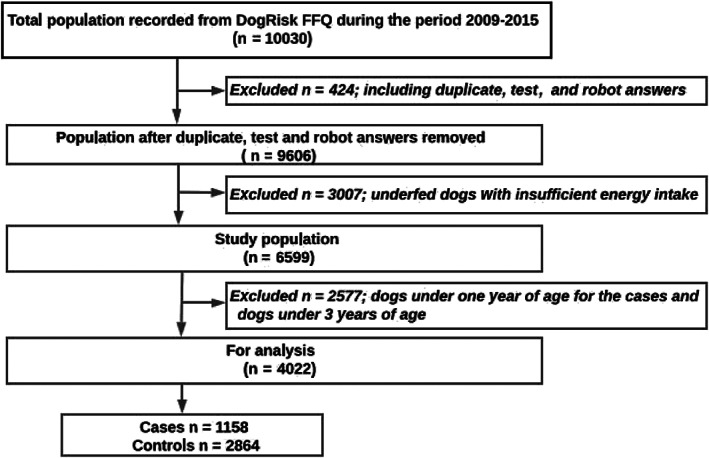
Four thousand and twenty-two dogs were eligible, 1158 cases, and 2864 controls.
This cross-sectional hypothesis-driven observational study was extracted from the DogRisk food frequency questionnaire. Forty-six food items and the ratio of 4 major diet types were tested for their association with AASS incidence later in life. Potential puppyhood dietary risk factors for AASS incidence were specified using binary multivariable logistic regression. The model was adjusted for age and sex.
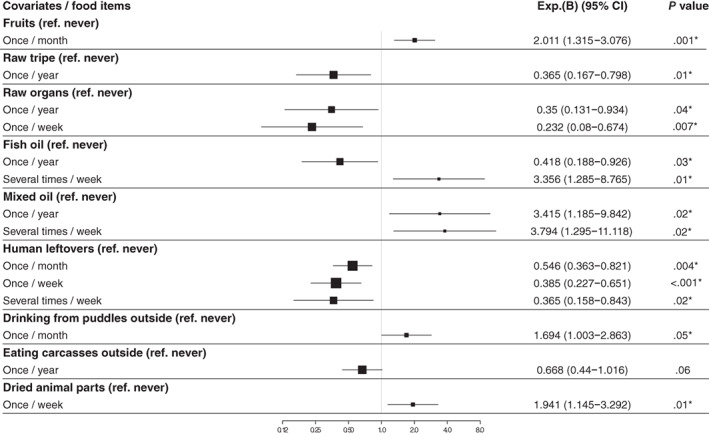
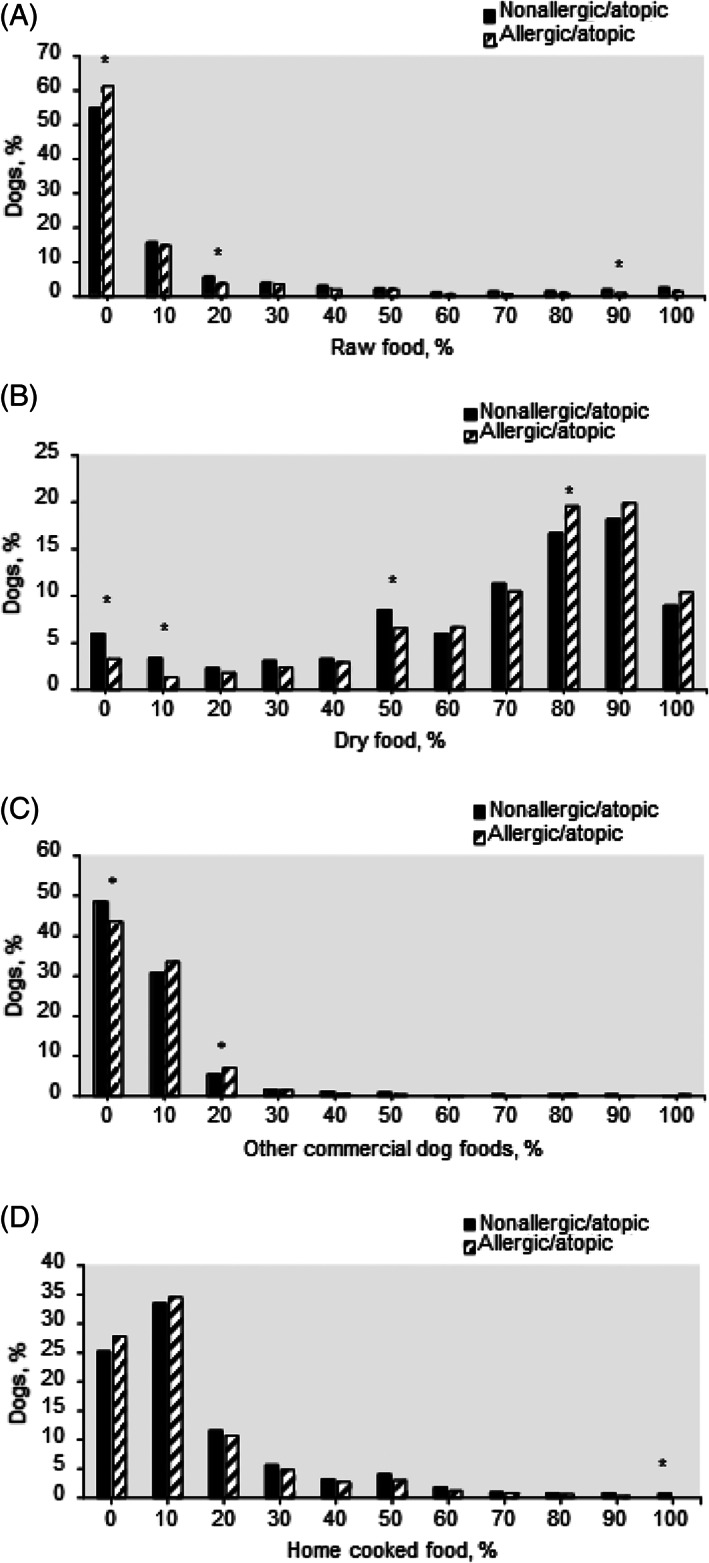
Eating raw tripe (odds ratio, 95% confidence intervals OR, 95% CI = 0.36, 0.16-0.79; P = .01), raw organ meats (OR, 95% CI = 0.23, 0.08-0.67; P = .007), human meal leftovers, and fish oil supplements as well as eating more that 20% of the diet as raw and/or <80% of the diet as dry, in general, were associated with significantly lower AASS incidence in adulthood. In contrast, dogs fed fruits (OR, 95% CI = 2.01, 1.31-3.07; P = .001), mixed-oil supplements, dried animal parts, and dogs that drank from puddles showed significantly higher AASS incidence in adulthood.
Puppyhood exposure to raw animal-based foods might have a protective influence on AASS incidence in adulthood, while puppyhood exposure to mixed oils, heat processed foods and sugary fruits might be a potential risk factor of AASS incidence later. The study suggests a causal relationship but does not prove it.
犬特应性皮炎(AD)的患病率增加,需要对其疾病病因进行研究。
探讨幼犬期饮食暴露与 1 岁后主人报告的过敏/特应性皮肤症状(AASS)患病率之间的关系。
4022 只狗符合条件,1158 例为病例,2864 例为对照。
本病例对照观察性研究是从 DogRisk 食物频率问卷中提取出来的。对 46 种食物和 4 种主要饮食类型的比例与生命后期 AASS 发病率进行了关联测试。使用二项多变量逻辑回归指定了 AASS 发病的潜在幼犬期饮食危险因素。该模型调整了年龄和性别。
食用生牛肚(比值比,95%置信区间 OR,95%CI=0.36,0.16-0.79;P=0.01)、生器官肉(OR,95%CI=0.23,0.08-0.67;P=0.007)、人类剩菜和鱼油补充剂,以及饮食中更多地以生肉和/或<80%的干食为主,与成年后 AASS 发病率显著降低相关。相比之下,以水果(OR,95%CI=2.01,1.31-3.07;P=0.001)、混合油补充剂、干燥动物部分和喝水坑水为主食的狗,成年后 AASS 发病率明显升高。
幼犬期暴露于生的动物源性食物可能对成年后 AASS 的发病率有保护作用,而幼犬期暴露于混合油、热处理食品和含糖水果可能是 AASS 发病率增加的潜在危险因素。该研究提示了一种因果关系,但并未证明这一点。