Department of International Health, International Vaccine Access Center, Johns Hopkins Bloomberg School of Public Health, Baltimore, Maryland, USA.
Diagnostic Virology Group, ICMR-National Institute of Virology, Pune, Maharashtra, India.
mSphere. 2021 Aug 25;6(4):e0133020. doi: 10.1128/mSphere.01330-20. Epub 2021 Jul 14.
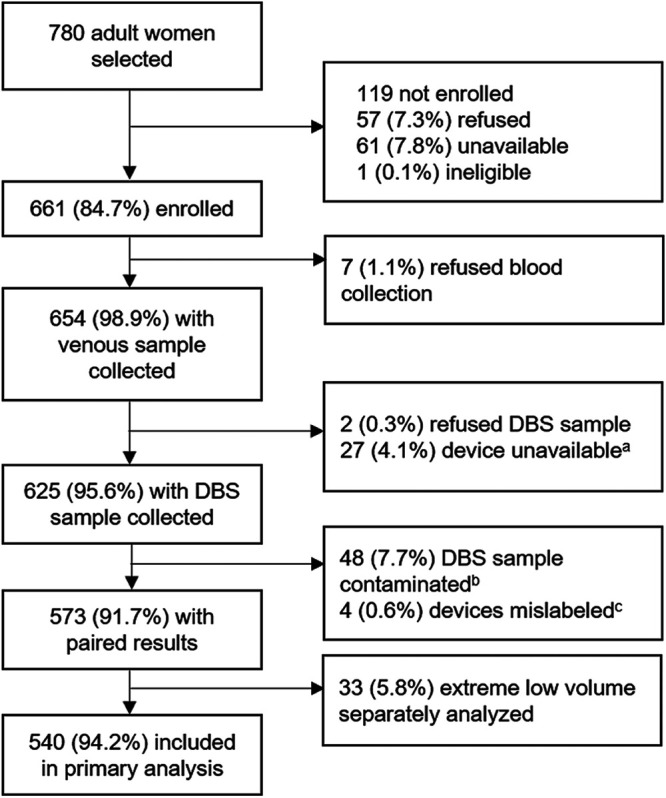
Fingerprick blood spotted onto filter paper offers an alternative to venous blood for use in population-based surveillance because it is comparatively inexpensive, acceptable, and easy to manage in the field. Prior studies have shown excellent agreement for immunoglobulin G (IgG) antibody detection from dried blood spots (DBS) and venous blood samples. However, much of this evidence is from high-income settings or laboratories where the samples were unlikely to be exposed to extreme temperatures and humidity, factors known to degrade DBS. We report the diagnostic accuracy of DBS collected using HemaSpot HF devices against venous sera in measuring measles- and rubella-specific IgG antibodies in a household serosurvey conducted in two districts in India. Paired serum and DBS samples collected by fingerprick were collected from women aged 15 to 50 years enrolled in a serosurvey in Palghar District of Maharashtra and Kanpur Nagar District of Uttar Pradesh in India. Specimen quality and volume were assessed in the laboratory. Samples were tested for antimeasles and antirubella IgG antibodies by an enzyme-linked immunosorbent assay (ELISA) (Euroimmun). Sensitivity of antibody detection by DBS was greater than 98%, and specificity was 90% and 98%, for measles and rubella IgG, respectively. Antibody concentrations were strongly correlated between paired specimens with adequate volume (measles = 0.94; rubella = 0.89). Although correlation was poor if DBS specimens had lower volumes, impact on qualitative results was minimal. This study showed DBS collected with HemaSpot HF devices can generate highly accurate results of measles- and rubella-specific IgG compared to sera in community-based surveys when protocols are optimized for DBS specimens. Dried blood spot (DBS) collection provides an easy, practical, and acceptable alternative to venous blood collection, especially for community-based studies, provided that results from DBS are accurate. We demonstrated high sensitivity and specificity for measles- and rubella-specific immunoglobulin G (IgG) with DBS collected via HemaSpot HF devices compared to serum samples. This is one of the largest community-based diagnostic accuracy studies of measles and rubella antibody testing with DBS and the first application we are aware of using HemaSpot HF device for measles and rubella serology. Results support the use of DBS in community-based serosurveillance.
指尖采血点样于滤纸片上,为基于人群的监测提供了一种替代静脉血的方法,因为它相对便宜、可接受且易于现场管理。先前的研究表明,从干血斑 (DBS) 和静脉血样本中检测免疫球蛋白 G (IgG) 抗体具有极好的一致性。然而,这些证据大多来自高收入环境或实验室,在这些环境或实验室中,样本不太可能暴露于极端温度和湿度下,而这些因素已知会降低 DBS 的质量。我们报告了在印度两个地区进行的家庭血清学调查中,使用 HemaSpot HF 设备采集的 DBS 与静脉血清相比,在测量麻疹和风疹特异性 IgG 抗体方面的诊断准确性。在印度马哈拉施特拉邦的帕尔加尔区和北方邦的坎普尔纳加尔区进行的血清学调查中,采集了年龄在 15 至 50 岁的女性的配对血清和指尖采集的 DBS 样本。实验室评估了标本质量和体积。使用酶联免疫吸附试验 (ELISA)(Euroimmun)检测样本中的抗麻疹和抗风疹 IgG 抗体。DBS 检测抗体的敏感性均大于 98%,麻疹和风疹 IgG 的特异性分别为 90%和 98%。具有足够体积的配对标本中抗体浓度具有很强的相关性(麻疹为 0.94;风疹为 0.89)。如果 DBS 标本体积较小,相关性较差,但对定性结果的影响最小。本研究表明,在针对 DBS 标本优化方案的情况下,与血清相比,使用 HemaSpot HF 设备采集的 DBS 可生成麻疹和风疹特异性 IgG 的高度准确结果,从而可用于社区为基础的调查。与静脉血采集相比,干血斑 (DBS) 采集为静脉血采集提供了一种简单、实用和可接受的替代方法,特别是对于社区为基础的研究而言,只要 DBS 结果准确。与血清样本相比,我们通过 HemaSpot HF 设备采集的 DBS 对麻疹和风疹特异性免疫球蛋白 G (IgG) 显示出高灵敏度和特异性。这是 DBS 进行麻疹和风疹抗体检测的最大规模的基于社区的诊断准确性研究之一,也是我们首次在麻疹和风疹血清学中使用 HemaSpot HF 设备的应用。结果支持在基于社区的血清监测中使用 DBS。