4th Department of Internal Medicine, National and Kapodistrian University of Athens, Medical School, Athens, Greece.
Institute for Infectious Diseases and Infection Control, Jena University Hospital, Jena, Germany.
Crit Care Med. 2021 Dec 1;49(12):2042-2057. doi: 10.1097/CCM.0000000000005195.
Coronavirus disease 2019 is a heterogeneous disease most frequently causing respiratory tract infection, which can induce respiratory failure and multiple organ dysfunction syndrome in its severe forms. The prevalence of coronavirus disease 2019-related sepsis is still unclear; we aimed to describe this in a systematic review.
MEDLINE (PubMed), Cochrane, and Google Scholar databases were searched based on a prespecified protocol (International Prospective Register for Systematic Reviews: CRD42020202018).
Studies reporting on patients with confirmed coronavirus disease 2019 diagnosed with sepsis according to sepsis-3 or according to the presence of infection-related organ dysfunctions necessitating organ support/replacement were included in the analysis. The primary end point was prevalence of coronavirus disease 2019-related sepsis among adults hospitalized in the ICU and the general ward. Among secondary end points were the need for ICU admission among patients initially hospitalized in the general ward and the prevalence of new onset of organ dysfunction in the ICU. Outcomes were expressed as proportions with respective 95% CI.
Two reviewers independently screened and reviewed existing literature and assessed study quality with the Newcastle-Ottawa Scale and the Methodological index for nonrandomized studies.
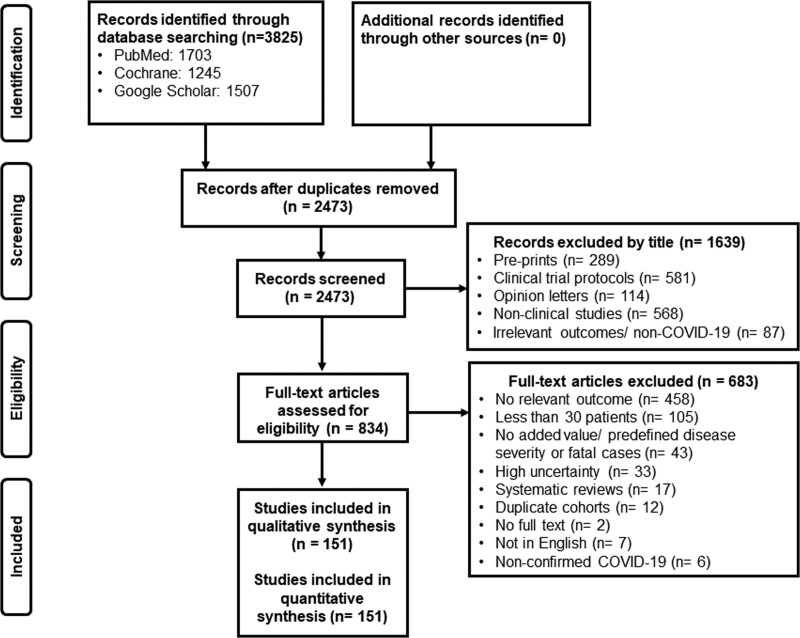
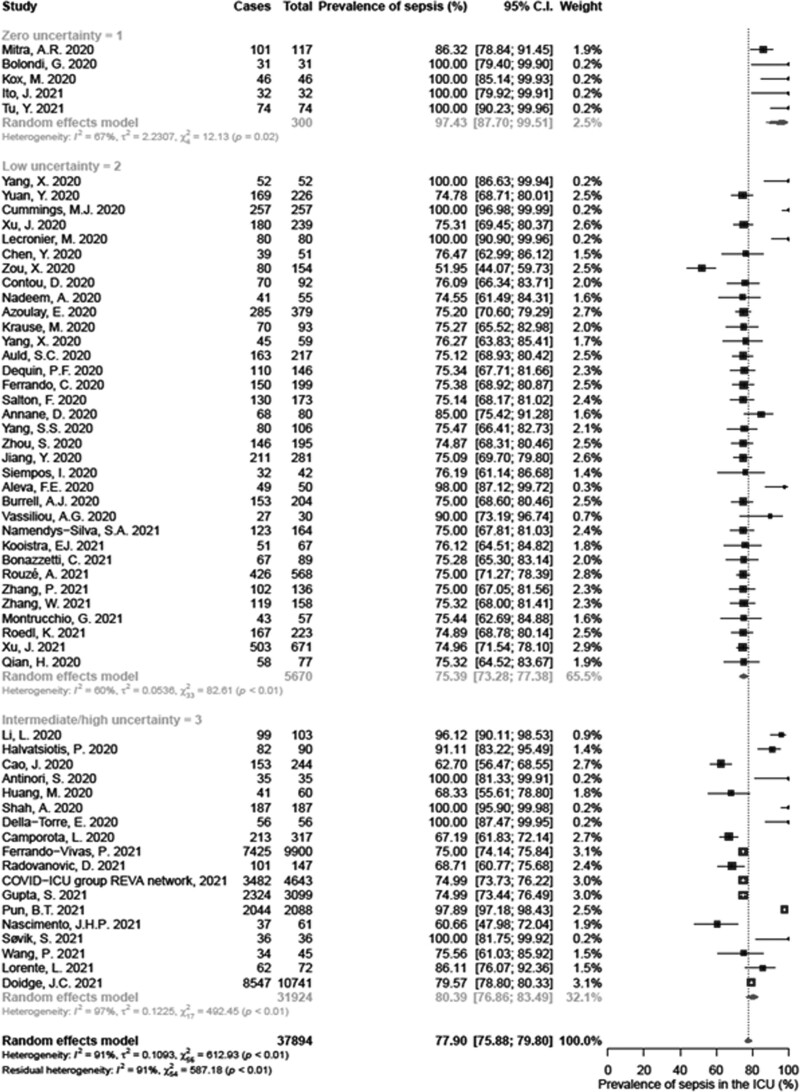
Of 3,825 articles, 151 were analyzed, only five of which directly reported sepsis prevalence. Noting the high heterogeneity observed, coronavirus disease 2019-related sepsis prevalence was 77.9% (95% CI, 75.9-79.8; I2 = 91%; 57 studies) in the ICU, and 33.3% (95% CI, 30.3-36.4; I2 = 99%; 86 studies) in the general ward. ICU admission was required for 17.7% (95% CI, 12.9-23.6; I2 = 100%) of ward patients. Acute respiratory distress syndrome was the most common organ dysfunction in the ICU (87.5%; 95% CI, 83.3-90.7; I2 = 98%).
The majority of coronavirus disease 2019 patients hospitalized in the ICU meet Sepsis-3 criteria and present infection-associated organ dysfunction. The medical and scientific community should be aware and systematically report viral sepsis for prognostic and treatment implications.
2019 年冠状病毒病是一种异质性疾病,最常引起呼吸道感染,在严重形式下可导致呼吸衰竭和多器官功能障碍综合征。2019 年冠状病毒病相关脓毒症的患病率仍不清楚;我们旨在通过系统评价对此进行描述。
根据预设方案,在 MEDLINE(PubMed)、Cochrane 和 Google Scholar 数据库中进行了检索(国际前瞻性系统评价登记处:CRD42020202018)。
符合 2019 年冠状病毒病诊断标准且根据脓毒症-3 或存在需要器官支持/替代的感染相关器官功能障碍的患者纳入分析。主要终点是 ICU 和普通病房住院成人中 2019 年冠状病毒病相关脓毒症的患病率。次要终点包括最初在普通病房住院的患者需要入住 ICU 以及 ICU 中新发器官功能障碍的患病率。结果表示为相应 95%CI 的比例。
两名审查员独立筛选并审查了现有文献,并使用纽卡斯尔-渥太华量表和非随机研究方法学指数评估研究质量。
在 3825 篇文章中,分析了 151 篇,其中只有 5 篇直接报告了脓毒症的患病率。鉴于观察到的高度异质性,ICU 中 2019 年冠状病毒病相关脓毒症的患病率为 77.9%(95%CI,75.9-79.8;I2=91%;57 项研究),普通病房中为 33.3%(95%CI,30.3-36.4;I2=99%;86 项研究)。需要入住 ICU 的患者比例为 17.7%(95%CI,12.9-23.6;I2=100%)。在 ICU 中,急性呼吸窘迫综合征是最常见的器官功能障碍(87.5%;95%CI,83.3-90.7;I2=98%)。
大多数 ICU 住院的 2019 年冠状病毒病患者符合脓毒症-3 标准,并存在感染相关的器官功能障碍。医疗和科学界应该意识到并系统地报告病毒性脓毒症,以了解预后和治疗意义。