Department of Epidemiology, Biostatistics, and Occupational Health, School of Population and Global Health, Faculty of Medicine, McGill University, Montréal, Quebec, Canada.
MRC Centre for Global Infectious Disease Analysis, School of Public Health, Imperial College London, London, UK.
AIDS. 2021 Nov 15;35(14):2383-2388. doi: 10.1097/QAD.0000000000003021.
Measuring recent HIV infections from routine surveillance systems could allow timely and granular monitoring of HIV incidence patterns. We evaluated the relationship of two recent infection indicators with alternative denominators to true incidence patterns.
We used a mathematical model of HIV testing behaviours, calibrated to population-based surveys and HIV testing services programme data, to estimate the number of recent infections diagnosed annually from 2010 to 2019 in Côte d'Ivoire, Malawi, and Mozambique. We compared two different denominators to interpret recency data: those at risk of HIV acquisition (HIV-negative tests and recent infections) and all people testing HIV positive. Sex and age-specific longitudinal trends in both interpretations were then compared with modelled trends in HIV incidence, testing efforts and HIV positivity among HIV testing services clients.
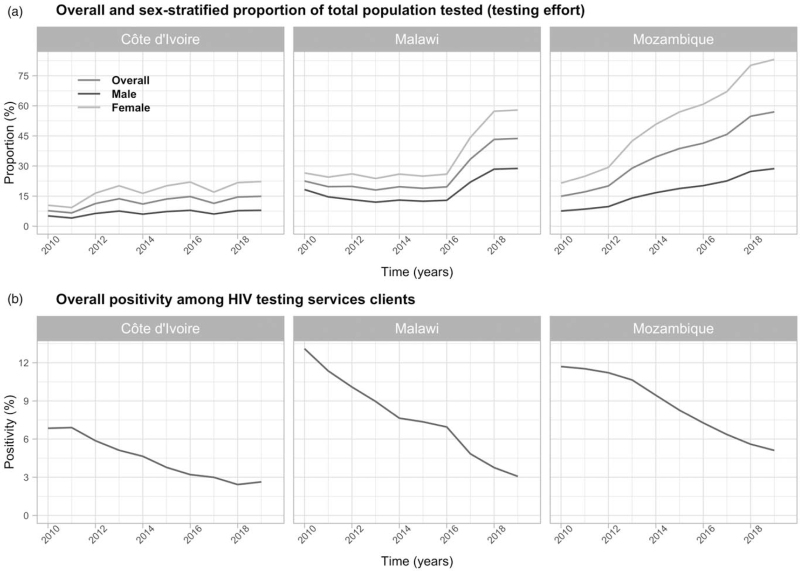
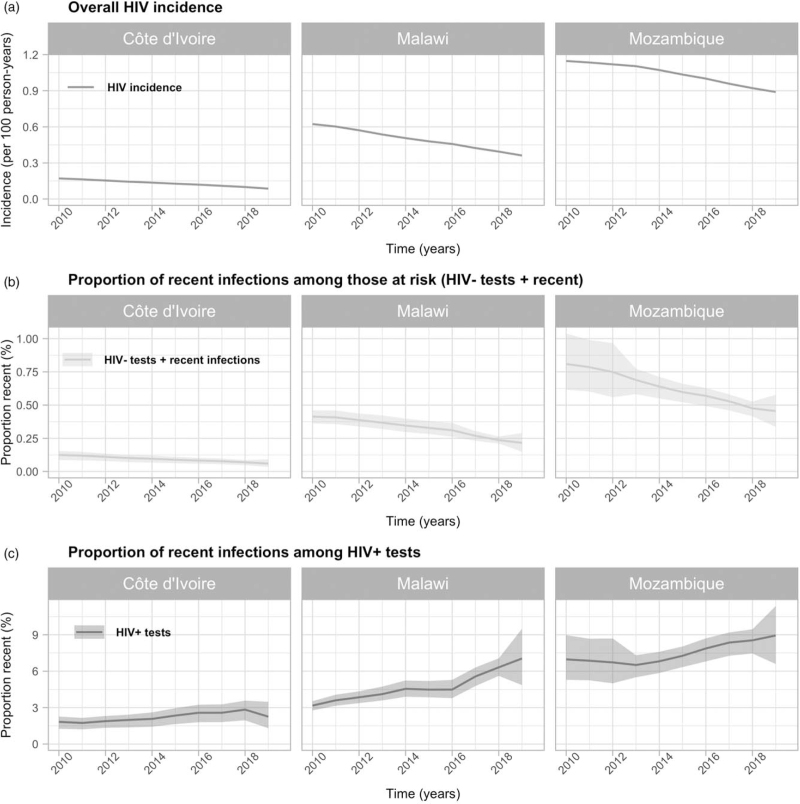
Over 2010-2019, the annual proportion of the eligible population tested increased in all countries, while positivity decreased. The proportion of recent infections among those at risk of HIV acquisition decreased, similar to declines in HIV incidence among adults (≥15 years old). Conversely, the proportion of recent infections among HIV-positive tests increased. The female-to-male ratio of the proportion testing recent among those at risk was closer to 1 than the true incidence sex ratio.
The proportion of recent infections among those at risk of HIV acquisition is more indicative of HIV incidence than the proportion among HIV-positive tests. However, interpreting the observed patterns as surrogate measures for incidence patterns may still be confounded by different HIV testing rates between population groups or over time.
从常规监测系统中测量近期 HIV 感染情况,可以及时、详细地监测 HIV 发病率模式。我们评估了两种近期感染指标与替代分母与真实发病模式的关系。
我们使用了一种 HIV 检测行为的数学模型,该模型经过人口普查和 HIV 检测服务项目数据的校准,以估计 2010 年至 2019 年期间科特迪瓦、马拉维和莫桑比克每年诊断出的新感染人数。我们比较了两种不同的分母来解释最近的数据:感染 HIV 的风险人群(HIV 阴性检测和近期感染)和所有 HIV 阳性检测者。然后,比较了这两种解释的性别和年龄特异性纵向趋势与 HIV 发病率模型、检测工作和 HIV 检测服务客户 HIV 阳性率的趋势。
在 2010 年至 2019 年期间,所有国家的合格人口接受检测的比例都有所增加,而阳性率则有所下降。感染 HIV 风险人群中近期感染的比例下降,与成年人(≥15 岁)的 HIV 发病率下降相似。相反,HIV 阳性检测中近期感染的比例增加。感染 HIV 风险人群中检测到的近期感染比例的女性与男性之比更接近 1,而真实的发病率性别比。
感染 HIV 风险人群中近期感染的比例比 HIV 阳性检测者中近期感染的比例更能反映 HIV 发病率。然而,将观察到的模式解释为发病率模式的替代指标,仍可能受到不同人群或随时间推移的 HIV 检测率的影响。