Centre Population et Développement (Ceped), Institut de Recherche pour le Développement (IRD), Université Paris Cité, Inserm, Paris, France.
Institut National d'Etudes Démographiques (INED), Aubervilliers, France.
BMC Infect Dis. 2023 Sep 25;22(Suppl 1):972. doi: 10.1186/s12879-023-08626-w.
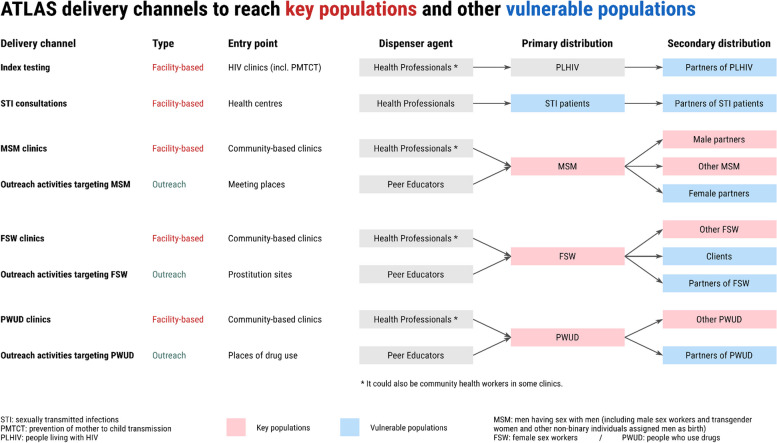
Coverage of HIV testing remains sub-optimal in West Africa. Between 2019 and 2022, the ATLAS program distributed ~400 000 oral HIV self-tests (HIVST) in Côte d'Ivoire, Mali, and Senegal, prioritising female sex workers (FSW) and men having sex with men (MSM), and relying on secondary redistribution of HIVST to partners, peers and clients to reach individuals not tested through conventional testing. This study assesses the proportion of first-time testers among HIVST users and the associated factors.
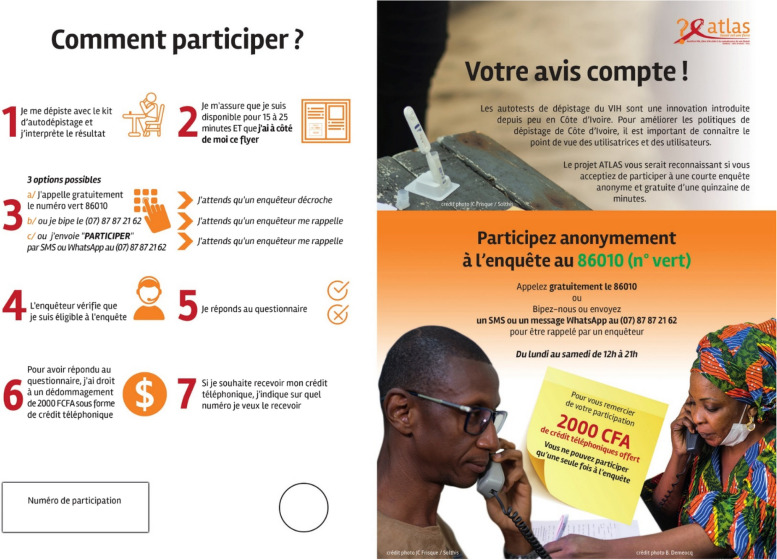
A phone-based survey was implemented among HIVST users recruited using dedicated leaflets inviting them to anonymously call a free phone number. We collected socio-demographics, sexual behaviours, HIV testing history, HIVST use, and satisfaction with HIVST. We reported the proportion of first-time testers and computed associated factors using logistic regression.
Between March and June 2021, 2 615 participants were recruited for 50 940 distributed HIVST (participation rate: 5.1%). Among participants, 30% received their HIVST kit through secondary distribution (from a friend, sexual partner, family member, or colleague). The proportion who had never tested for HIV before HIVST (first-time testers) was 41%. The main factors associated with being a first-time tester were sex, age group, education level, condom use, and secondary distribution. A higher proportion was observed among those aged 24 years or less (55% vs 32% for 25-34, aOR: 0.37 [95%CI: 0.30-0.44], and 26% for 35 years or more, aOR: 0.28 [0.21-0.37]); those less educated (48% for none/primary education vs 45% for secondary education, aOR: 0.60 [0.47-0.77], and 29% for higher education, aOR: 0.33 [0.25-0.44]). A lower proportion was observed among women (37% vs 43%, aOR: 0.49 [0.40-0.60]); those reporting always using a condom over the last year (36% vs 51% for those reporting never using them, aOR: 2.02 [1.59-2.56]); and those who received their HISVST kit through primary distribution (39% vs 46% for secondary distribution, aOR: 1.32 [1.08-1.60]).
ATLAS HIVST strategy, including secondary distribution, successfully reached a significant proportion of first-time testers. HIVST has the potential to reach underserved populations and contribute to the expansion of HIV testing services in West Africa.
在西非,艾滋病毒检测的覆盖率仍然不理想。在 2019 年至 2022 年期间,ATLAS 项目在科特迪瓦、马里和塞内加尔分发了约 40 万份口腔艾滋病毒自检(HIVST),重点关注女性性工作者(FSW)和男男性行为者(MSM),并依靠 HIVST 的二次分发将其提供给伴侣、同行和客户,以接触到未通过常规检测进行检测的个人。本研究评估了 HIVST 用户中首次检测者的比例及其相关因素。
使用专门的传单招募 HIVST 用户,邀请他们匿名拨打免费电话号码,对其进行基于电话的调查。我们收集了社会人口统计学、性行为、艾滋病毒检测史、HIVST 使用情况和对 HIVST 的满意度。我们报告了首次检测者的比例,并使用逻辑回归计算了相关因素。
2021 年 3 月至 6 月期间,共招募了 2615 名参与者,分发了 50940 份 HIVST(参与率:5.1%)。在参与者中,30%的人通过二次分发(从朋友、性伴侣、家庭成员或同事)收到他们的 HIVST 试剂盒。在 HIVST 之前从未进行过艾滋病毒检测的人(首次检测者)比例为 41%。与首次检测者相关的主要因素是性别、年龄组、教育程度、 condom 使用情况和二次分发。在年龄为 24 岁或以下的人群中,首次检测者的比例较高(55%比 25-34 岁的 32%,aOR:0.37[95%CI:0.30-0.44],而 35 岁或以上的为 26%,aOR:0.28[0.21-0.37]);受教育程度较低的人群比例较高(无/小学教育的 48%比中学教育的 45%,aOR:0.60[0.47-0.77],高等教育的 29%,aOR:0.33[0.25-0.44])。女性的比例较低(37%比 43%,aOR:0.49[0.40-0.60]);过去一年中始终使用 condom 的人群比例较低(从不使用 condom 的为 36%,从不使用 condom 的为 51%,aOR:2.02[1.59-2.56]);通过初级分发获得 HISVST 试剂盒的人群比例较低(39%比二级分发的 46%,aOR:1.32[1.08-1.60])。
ATLAS HIVST 战略,包括二次分发,成功地接触到了相当数量的首次检测者。HIVST 有可能接触到服务不足的人群,并有助于扩大西非的艾滋病毒检测服务。