Department of Orthopaedic Surgery, König-Ludwig-Haus, University of Würzburg, Würzburg, Germany.
California Northstate University, Elk Grove, USA.
Arch Orthop Trauma Surg. 2021 Dec;141(12):2287-2294. doi: 10.1007/s00402-021-04054-0. Epub 2021 Jul 15.
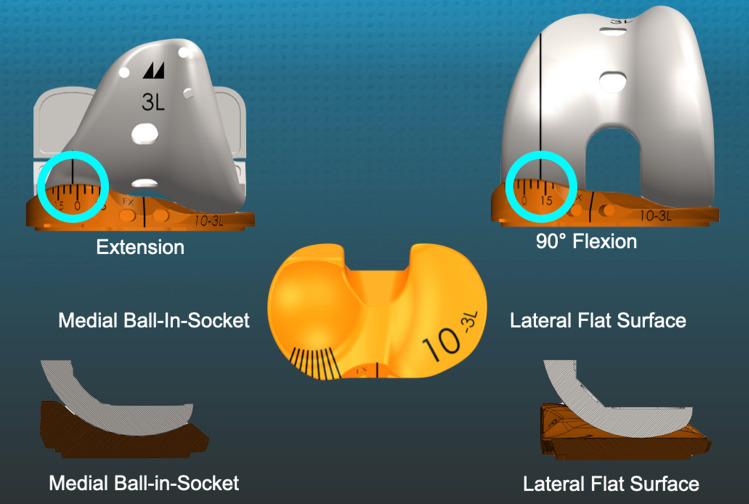
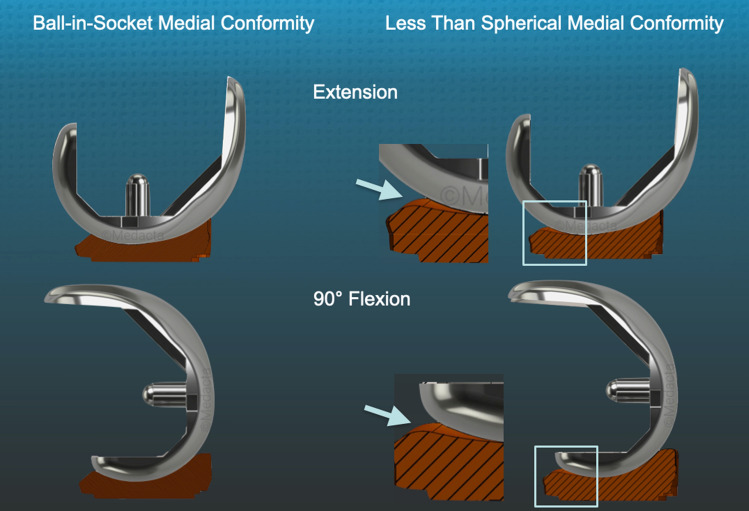
In total knee arthroplasty (TKA), the level of conformity, a medial stabilized (MS) implant, needs to restore native (i.e., healthy) knee kinematics without over-tensioning the flexion space when the surgeon chooses to retain the posterior cruciate ligament (PCL) is unknown. Whether an insert with a medial ball-in-socket conformity and lateral flat surface like the native knee or a less than spherical medial conformity restores higher and closer to native internal tibial rotation without anterior lift-off, an over-tension indicator, when implanted with calipered kinematic alignment (KA), is unknown.
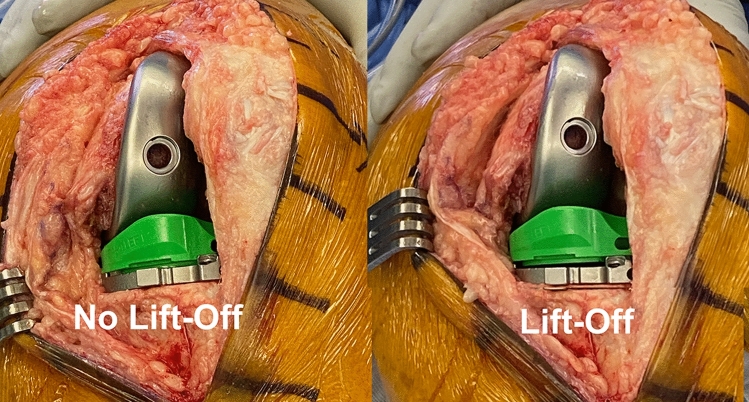
Two surgeons treated 21 patients with calipered KA and a PCL retaining MS implant. Validated verification checks that restore native tibial compartment forces in passive flexion without release of healthy ligaments were used to select the optimal insert thickness. A goniometer etched onto trial inserts with the ball-in-socket and the less than spherical medial conformity measured the tibial rotation relative to the femoral component at extension and 90° and 120° flexion. The surgeon recorded the incidence of anterior lift-off of the insert.
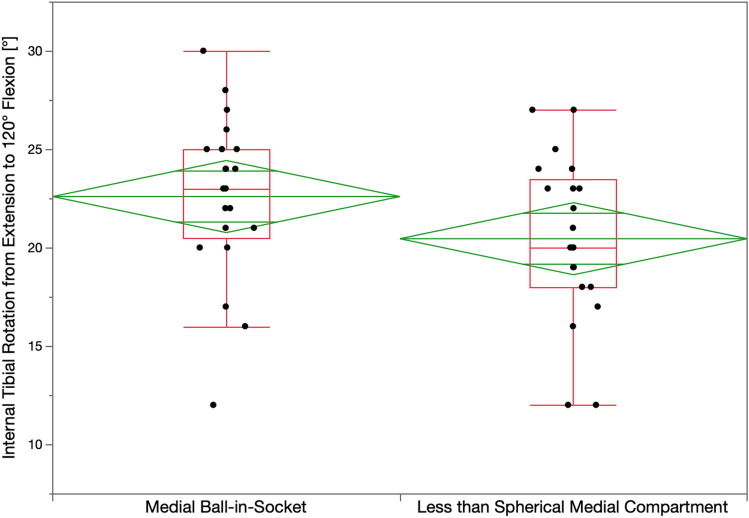
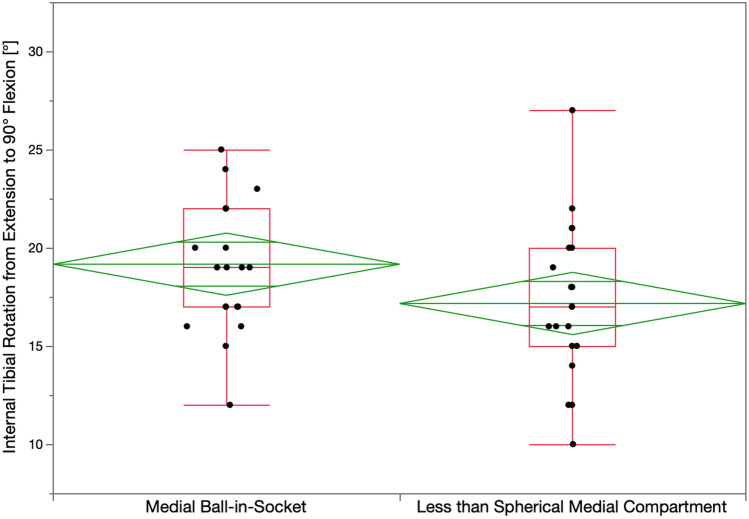
The insert with the medial ball-in-socket and lateral flat surface restored more internal tibial rotation than the one with less than spherical medial conformity, with mean values of 19° vs. 17° from extension to 90° flexion (p < 0.01), and 23° vs. 20°-120° flexion (p < 0.002), respectively. There was no anterior lift-off of the insert at 90° and 120° flexion.
An MS insert with a medial ball-in-socket and lateral flat surface that matches the native knee's spherical conformity restores native tibial internal rotation when implanted with calipered KA and PCL retention without over-tensioning the flexion space.
在全膝关节置换术(TKA)中,为了恢复膝关节的正常运动,当外科医生选择保留后交叉韧带(PCL)时,需要使内侧稳定(MS)植入物达到完全匹配,同时避免在屈曲过程中过度紧张。目前尚不清楚,当使用卡尺测量的运动学对线(KA)植入时,是具有类似健康膝关节球形匹配的内侧球窝贴合和外侧平面的插入物,还是具有非球形内侧贴合的插入物,能够在不产生前脱位(一种过度紧张的指标)的情况下,恢复更高且更接近正常的胫骨内旋。
两位外科医生对 21 例采用卡尺测量 KA 和保留 PCL 的 MS 植入物的患者进行了治疗。使用验证性检查来选择最佳的插入物厚度,这些检查可在不释放健康韧带的情况下,恢复被动屈曲时胫骨间室的正常力。在试验插入物上刻有一个量角器,具有球窝贴合和非球形内侧贴合,可测量胫骨相对于股骨组件在伸展和 90°和 120°屈曲时的旋转。外科医生记录了插入物的前脱位发生率。
与具有非球形内侧贴合的插入物相比,内侧球窝贴合和外侧平面的插入物恢复了更多的胫骨内旋,从伸展到 90°屈曲的平均角度为 19° vs. 17°(p<0.01),从 90°到 120°屈曲的平均角度为 23° vs. 20°-120°屈曲(p<0.002)。在 90°和 120°屈曲时,插入物没有发生前脱位。
在使用卡尺测量的 KA 和保留 PCL 的情况下,内侧球窝贴合和外侧平面的 MS 插入物可以恢复正常的胫骨内旋,而不会过度紧张屈曲间隙,这种插入物具有类似健康膝关节的球形贴合。