Nedopil Alexander J, Howell Stephen M, Hull Maury L
Orthopädische Klinik König-Ludwig-Haus, Lehrstuhl für Orthopädie der Universität Würzburg, 97074 Wurzburg, Germany.
Department of Biomedical Engineering, University of California, Davis, CA 95616, USA.
J Pers Med. 2022 Aug 3;12(8):1274. doi: 10.3390/jpm12081274.
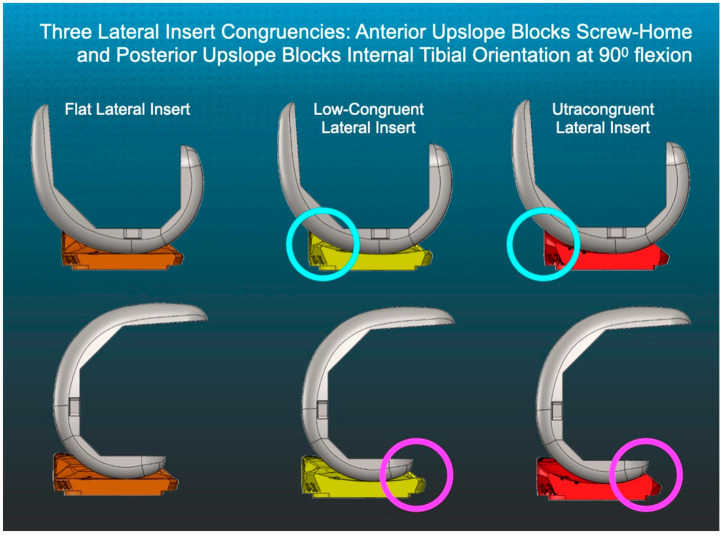
Background: In total knee arthroplasty (TKA), inserts can have different levels of medial and lateral congruency determined by the acuteness of the upslopes of the anterior and posterior articular surfaces. The present study evaluated an insert with different levels of lateral congruency and a medial ball-in-socket congruency to test the hypothesis that a lateral flat (F) insert maximizes external tibial orientation at extension and internal orientation at 90° flexion and lowers the incidence of anterior lift-off relative to low-congruent (LC) and ultracongruent (UC) lateral inserts. Methods: Two surgeons treated 23 patients with unrestricted caliper-verified kinematic alignment (KA) and posterior cruciate ligament (PCL) retention. They randomly trialed inserts with a medial radial dial that functioned as a built-in goniometer by measuring the tibial orientation relative to a sagittal line on the femoral trial component. Anterior lift-off of the insert from the baseplate indicated PCL tightness. Results: The F insert’s mean of 9° of external tibial orientation was higher than that of the LC (5°, p < 0.0001) and UC inserts (2°, p < 0.0001). The −13° of internal tibial orientation at 90° flexion was higher than that of the LC (−9°, p < 0.0001) and UC inserts (−7°, p < 0.0001). The 0% incidence of anterior lift-off was less than that of the LC (26%) and UC inserts (57%) (p < 0.0001). Conclusions: Surgeons and implant manufacturers should know that adding congruency to the lateral articular surface limits external tibial orientation in extension and internal tibial orientation at 90° flexion and overtightens the PCL. These rotational limitations and flexion space tightness can adversely affect patellofemoral tracking and knee flexion.
在全膝关节置换术(TKA)中,根据前后关节面上升斜率的锐度,垫片可具有不同程度的内外侧匹配度。本研究评估了一种具有不同外侧匹配度和内侧球窝匹配度的垫片,以检验以下假设:相对于低匹配度(LC)和超匹配度(UC)外侧垫片,外侧扁平(F)垫片在伸直位可使胫骨外旋最大化,在90°屈曲位可使胫骨内旋最大化,并降低前脱位发生率。方法:两名外科医生对23例患者进行了不受限的卡尺验证运动学对线(KA)和后交叉韧带(PCL)保留手术。他们通过测量胫骨相对于股骨试验组件矢状线的方向,使用内侧径向刻度盘随机试验垫片,该刻度盘用作内置测角仪。垫片从基板上的前脱位表明PCL紧张度。结果:F垫片的胫骨平均外旋角度为9°,高于LC垫片(5°,p < 0.0001)和UC垫片(2°,p < 0.0001)。在90°屈曲位时,F垫片的胫骨内旋角度为−13°,高于LC垫片(−9°,p < 0.0001)和UC垫片(−7°,p < 0.0001)。F垫片的前脱位发生率为0%,低于LC垫片(26%)和UC垫片(57%)(p < 0.0001)。结论:外科医生和植入物制造商应了解,增加外侧关节面的匹配度会限制伸直位的胫骨外旋和90°屈曲位的胫骨内旋,并使PCL过度紧张。这些旋转限制和屈曲间隙紧张会对髌股关节轨迹和膝关节屈曲产生不利影响。