Chowański Szymon, Walkowiak-Nowicka Karolina, Winkiel Magdalena, Marciniak Pawel, Urbański Arkadiusz, Pacholska-Bogalska Joanna
Department of Animal Physiology and Development, Faculty of Biology, Adam Mickiewicz University, Poznań, Poland.
HiProMine S.A., Robakowo, Poland.
Front Physiol. 2021 Jun 29;12:701203. doi: 10.3389/fphys.2021.701203. eCollection 2021.
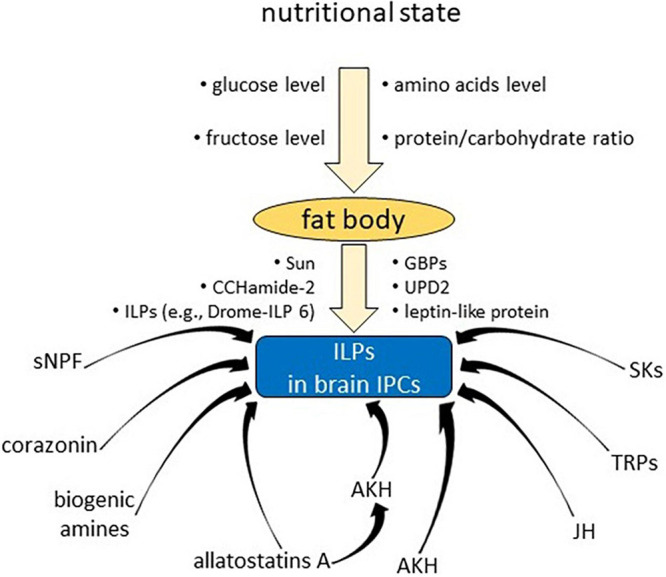
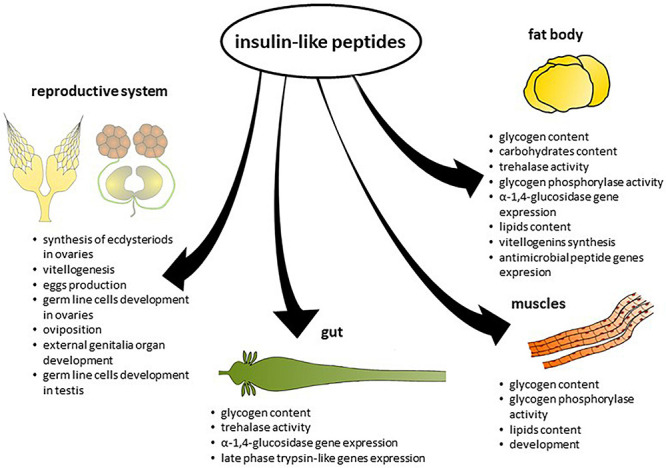
The insulin-like peptide (ILP) and insulin-like growth factor (IGF) signalling pathways play a crucial role in the regulation of metabolism, growth and development, fecundity, stress resistance, and lifespan. ILPs are encoded by multigene families that are expressed in nervous and non-nervous organs, including the midgut, salivary glands, and fat body, in a tissue- and stage-specific manner. Thus, more multidirectional and more complex control of insect metabolism can occur. ILPs are not the only factors that regulate metabolism. ILPs interact in many cross-talk interactions of different factors, for example, hormones (peptide and nonpeptide), neurotransmitters and growth factors. These interactions are observed at different levels, and three interactions appear to be the most prominent/significant: (1) coinfluence of ILPs and other factors on the same target cells, (2) influence of ILPs on synthesis/secretion of other factors regulating metabolism, and (3) regulation of activity of cells producing/secreting ILPs by various factors. For example, brain insulin-producing cells co-express sulfakinins (SKs), which are cholecystokinin-like peptides, another key regulator of metabolism, and express receptors for tachykinin-related peptides, the next peptide hormones involved in the control of metabolism. It was also shown that ILPs in can directly and indirectly regulate AKH. This review presents an overview of the regulatory role of insulin-like peptides in insect metabolism and how these factors interact with other players involved in its regulation.
胰岛素样肽(ILP)和胰岛素样生长因子(IGF)信号通路在代谢、生长发育、繁殖力、抗逆性和寿命的调节中起着关键作用。ILP由多基因家族编码,这些家族以组织和阶段特异性的方式在神经和非神经器官中表达,包括中肠、唾液腺和脂肪体。因此,可以对昆虫代谢进行更具多向性和更复杂的控制。ILP不是调节代谢的唯一因素。ILP在不同因子的许多相互作用中相互作用,例如激素(肽类和非肽类)、神经递质和生长因子。这些相互作用在不同水平上都能观察到,其中三种相互作用似乎最为突出/显著:(1)ILP和其他因子对同一靶细胞的共同影响,(2)ILP对调节代谢的其他因子合成/分泌的影响,以及(3)各种因子对产生/分泌ILP的细胞活性的调节。例如,脑内产生胰岛素的细胞共表达磺酰基激肽(SKs),它是一种胆囊收缩素样肽,是另一种关键的代谢调节因子,并且表达速激肽相关肽的受体,速激肽相关肽是参与代谢控制的下一类肽激素。研究还表明,ILP可以直接和间接调节脂动激素(AKH)。本文综述了胰岛素样肽在昆虫代谢中的调节作用,以及这些因子如何与参与代谢调节的其他因素相互作用。