Lancet Glob Health. 2021 Aug;9(8):e1129-e1144. doi: 10.1016/S2214-109X(21)00164-9. Epub 2021 Jul 14.
A systematic understanding of the burden of neurological disorders at the subnational level is not readily available for India. We present a comprehensive analysis of the disease burden and trends of neurological disorders at the state level in India.
Using all accessible data from multiple sources, we estimated the prevalence or incidence and disability-adjusted life-years (DALYs) for neurological disorders from 1990 to 2019 for all states of India as part of the Global Burden of Diseases, Injuries, and Risk Factors Study 2019. We assessed the contribution of each neurological disorder to deaths and DALYs in India in 2019, their trends in prevalence or incidence and DALY rates over time, and heterogeneity between the states of India. We also assessed the Pearson correlation coefficient between Socio-demographic Index (SDI) of the states and the prevalence or incidence and DALY rates of each neurological disorder. Additionally, we estimated the contribution of known risk factors to DALYs from neurological disorders. We calculated 95% uncertainty intervals (UIs) for the mean estimates.
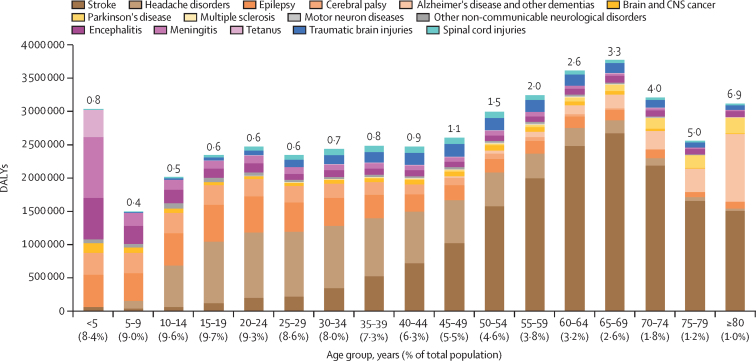
The contribution of non-communicable neurological disorders to total DALYs in India doubled from 4·0% (95% UI 3·2-5·0) in 1990 to 8·2% (6·6-10·2) in 2019, and the contribution of injury-related neurological disorders increased from 0·2% (0·2-0·3) to 0·6% (0·5-0·7). Conversely, the contribution of communicable neurological disorders decreased from 4·1% (3·5-4·8) to 1·1% (0·9-1·5) during the same period. In 2019, the largest contributors to the total neurological disorder DALYs in India were stroke (37·9% [29·9-46·1]), headache disorders (17·5% [3·6-32·5]), epilepsy (11·3% [9·0-14·3]), cerebral palsy (5·7% [4·2-7·7]), and encephalitis (5·3% [3·7-8·9]). The crude DALY rate of several neurological disorders had considerable heterogeneity between the states in 2019, with the highest variation for tetanus (93·2 times), meningitis (8·3 times), and stroke (5·5 times). SDI of the states had a moderate significant negative correlation with communicable neurological disorder DALY rate and a moderate significant positive correlation with injury-related neurological disorder DALY rate in 2019. For most of the non-communicable neurological disorders, there was an increase in prevalence or incidence from 1990 to 2019. Substantial decreases were evident in the incidence and DALY rates of communicable neurological disorders during the same period. Migraine and multiple sclerosis were more prevalent among females than males and traumatic brain injuries were more common among males than females in 2019. Communicable diseases contributed to the majority of total neurological disorder DALYs in children younger than 5 years, and non-communicable neurological disorders were the highest contributor in all other age groups. In 2019, the leading risk factors contributing to DALYs due to non-communicable neurological disorders in India included high systolic blood pressure, air pollution, dietary risks, high fasting plasma glucose, and high body-mass index. For communicable disorders, the identified risk factors with modest contributions to DALYs were low birthweight and short gestation and air pollution.
The increasing contribution of non-communicable and injury-related neurological disorders to the overall disease burden in India, and the substantial state-level variation in the burden of many neurological disorders highlight the need for state-specific health system responses to address the gaps in neurology services related to awareness, early identification, treatment, and rehabilitation.
Bill & Melinda Gates Foundation; and Indian Council of Medical Research, Department of Health Research, Ministry of Health and Family Welfare, Government of India.
对于印度来说,在次国家级层面上系统地了解神经障碍的负担尚不容易。我们呈现了一项针对印度各邦神经障碍疾病负担和趋势的综合分析。
我们使用来自多个来源的所有可获得数据,根据 2019 年全球疾病、伤害和危险因素研究(GBD 2019),估算了印度所有邦的神经障碍患病率或发病率以及伤残调整生命年(DALY)。我们评估了 2019 年印度神经障碍造成的死亡和 DALY 以及神经障碍患病率或发病率和 DALY 率随时间的变化趋势,以及印度各邦之间的差异。我们还评估了各州社会人口指数(SDI)与每种神经障碍的患病率或发病率和 DALY 率之间的 Pearson 相关系数。此外,我们估计了已知危险因素对神经障碍 DALY 的贡献。我们计算了每个神经障碍的患病率或发病率和 DALY 率的 95%置信区间(UI)。
非传染性神经障碍导致印度总 DALY 的占比从 1990 年的 4.0%(95%UI 3.2-5.0)增加到 2019 年的 8.2%(6.6-10.2),而与伤害有关的神经障碍的占比从 0.2%(0.2-0.3)增加到 0.6%(0.5-0.7)。相反,传染性神经障碍的占比从 1990 年的 4.1%(3.5-4.8)下降到 2019 年的 1.1%(0.9-1.5)。2019 年,印度神经障碍总 DALY 的最大贡献者为中风(37.9%[29.9-46.1])、头痛障碍(17.5%[3.6-32.5])、癫痫(11.3%[9.0-14.3])、脑瘫(5.7%[4.2-7.7])和脑炎(5.3%[3.7-8.9])。2019 年,印度各邦之间许多神经障碍的粗 DALY 率存在相当大的差异,破伤风(93.2 倍)、脑膜炎(8.3 倍)和中风(5.5 倍)的差异最大。2019 年,各州的 SDI 与传染性神经障碍 DALY 率呈中度显著负相关,与伤害性神经障碍 DALY 率呈中度显著正相关。对于大多数非传染性神经障碍,从 1990 年到 2019 年,患病率或发病率都有所增加。同期,传染性神经障碍的发病率和 DALY 率显著下降。偏头痛和多发性硬化症在女性中的发病率高于男性,创伤性脑损伤在男性中的发病率高于女性。2019 年,传染病是 5 岁以下儿童总神经障碍 DALY 的主要原因,而非传染性神经障碍则是所有其他年龄组的最大贡献者。2019 年,导致印度非传染性神经障碍 DALY 的主要危险因素包括收缩压高、空气污染、饮食风险、空腹血糖高和体重指数高。对于传染性疾病,低出生体重和早产以及空气污染等因素对 DALY 有一定的影响。
非传染性和伤害性神经障碍对印度整体疾病负担的贡献不断增加,以及许多神经障碍在各邦之间的负担存在显著差异,这突显了需要针对特定州的卫生系统反应,以解决与意识、早期识别、治疗和康复相关的神经科服务差距。
比尔及梅琳达·盖茨基金会;以及印度医学研究理事会,印度卫生部,印度政府。