Kawatake-Kuno Ayako, Murai Toshiya, Uchida Shusaku
SK Project, Medical Innovation Center, Kyoto University Graduate School of Medicine, Kyoto, Japan.
Department of Psychiatry, Kyoto University Graduate School of Medicine, Kyoto, Japan.
Front Mol Neurosci. 2021 Jul 1;14:708004. doi: 10.3389/fnmol.2021.708004. eCollection 2021.
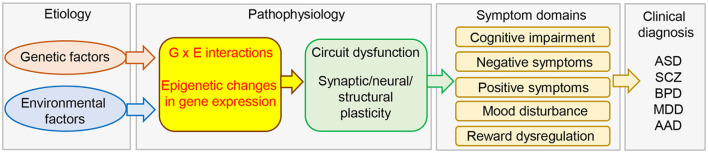
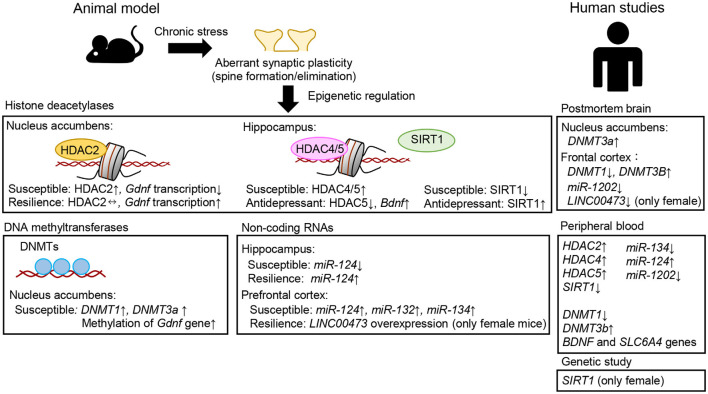
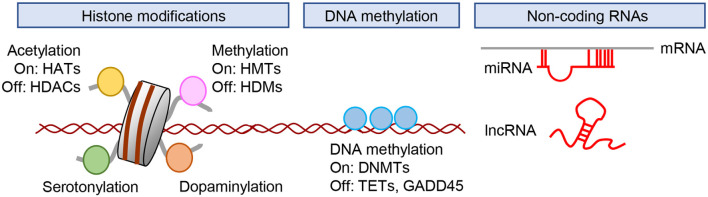
Major depressive disorder (MDD) is a leading cause of disability worldwide. Although the etiology and pathophysiology of MDD remain poorly understood, aberrant neuroplasticity mediated by the epigenetic dysregulation of gene expression within the brain, which may occur due to genetic and environmental factors, may increase the risk of this disorder. Evidence has also been reported for sex-related differences in the pathophysiology of MDD, with female patients showing a greater severity of symptoms, higher degree of functional impairment, and more atypical depressive symptoms. Males and females also differ in their responsiveness to antidepressants. These clinical findings suggest that sex-dependent molecular and neural mechanisms may underlie the development of depression and the actions of antidepressant medications. This review discusses recent advances regarding the role of epigenetics in stress and depression. The first section presents a brief introduction of the basic mechanisms of epigenetic regulation, including histone modifications, DNA methylation, and non-coding RNAs. The second section reviews their contributions to neural plasticity, the risk of depression, and resilience against depression, with a particular focus on epigenetic modulators that have causal relationships with stress and depression in both clinical and animal studies. The third section highlights studies exploring sex-dependent epigenetic alterations associated with susceptibility to stress and depression. Finally, we discuss future directions to understand the etiology and pathophysiology of MDD, which would contribute to optimized and personalized therapy.
重度抑郁症(MDD)是全球致残的主要原因。尽管MDD的病因和病理生理学仍知之甚少,但由大脑内基因表达的表观遗传失调介导的异常神经可塑性,可能因遗传和环境因素而发生,这可能会增加患这种疾病的风险。也有证据表明MDD的病理生理学存在性别差异,女性患者表现出更严重的症状、更高程度的功能损害以及更多非典型抑郁症状。男性和女性对抗抑郁药的反应也有所不同。这些临床发现表明,性别依赖性分子和神经机制可能是抑郁症发生发展及抗抑郁药物作用的基础。本综述讨论了表观遗传学在应激和抑郁症中作用的最新进展。第一部分简要介绍了表观遗传调控的基本机制,包括组蛋白修饰、DNA甲基化和非编码RNA。第二部分回顾了它们对神经可塑性、抑郁症风险和抗抑郁能力的贡献,特别关注在临床和动物研究中与应激和抑郁症存在因果关系的表观遗传调节剂。第三部分重点介绍了探索与应激和抑郁症易感性相关的性别依赖性表观遗传改变的研究。最后,我们讨论了未来理解MDD病因和病理生理学的方向,这将有助于优化和个性化治疗。