Song Huiyin, Chen Yang, Liu Feng, Chen Nansheng
CAS Key Laboratory of Marine Ecology and Environmental Sciences, Institute of Oceanology, Chinese Academy of Sciences, Qingdao, China.
Laboratory of Marine Ecology and Environmental Science, Qingdao National Laboratory for Marine Science and Technology, Qingdao, China.
Front Microbiol. 2021 Jul 2;12:676447. doi: 10.3389/fmicb.2021.676447. eCollection 2021.
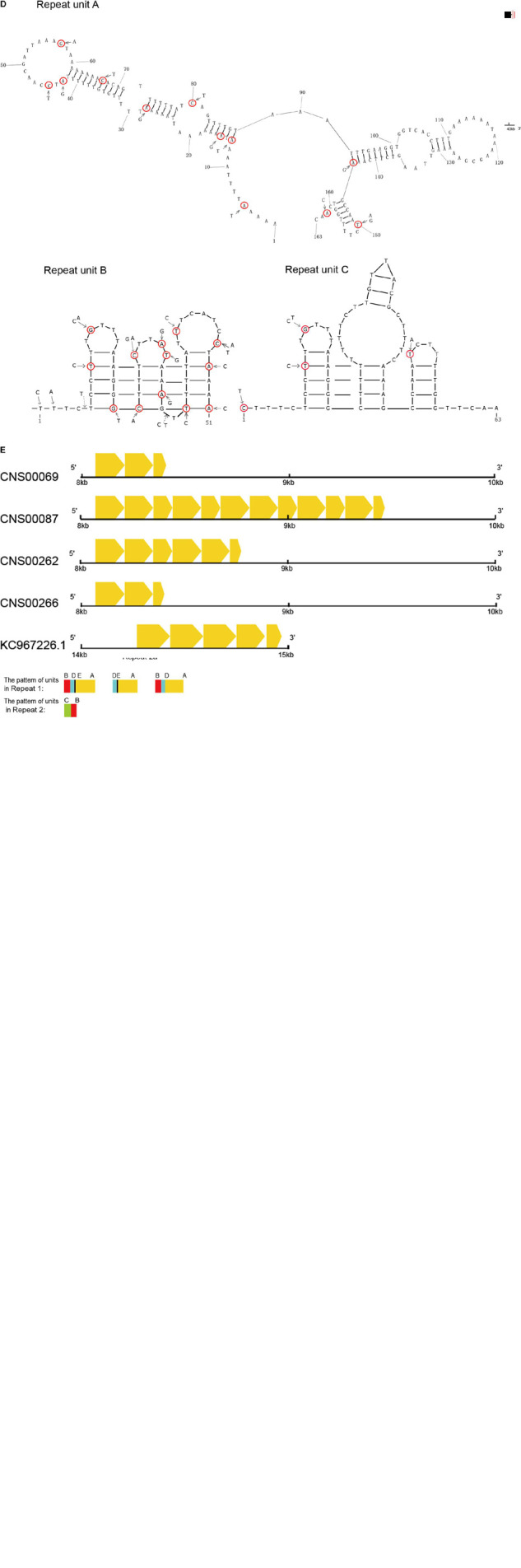
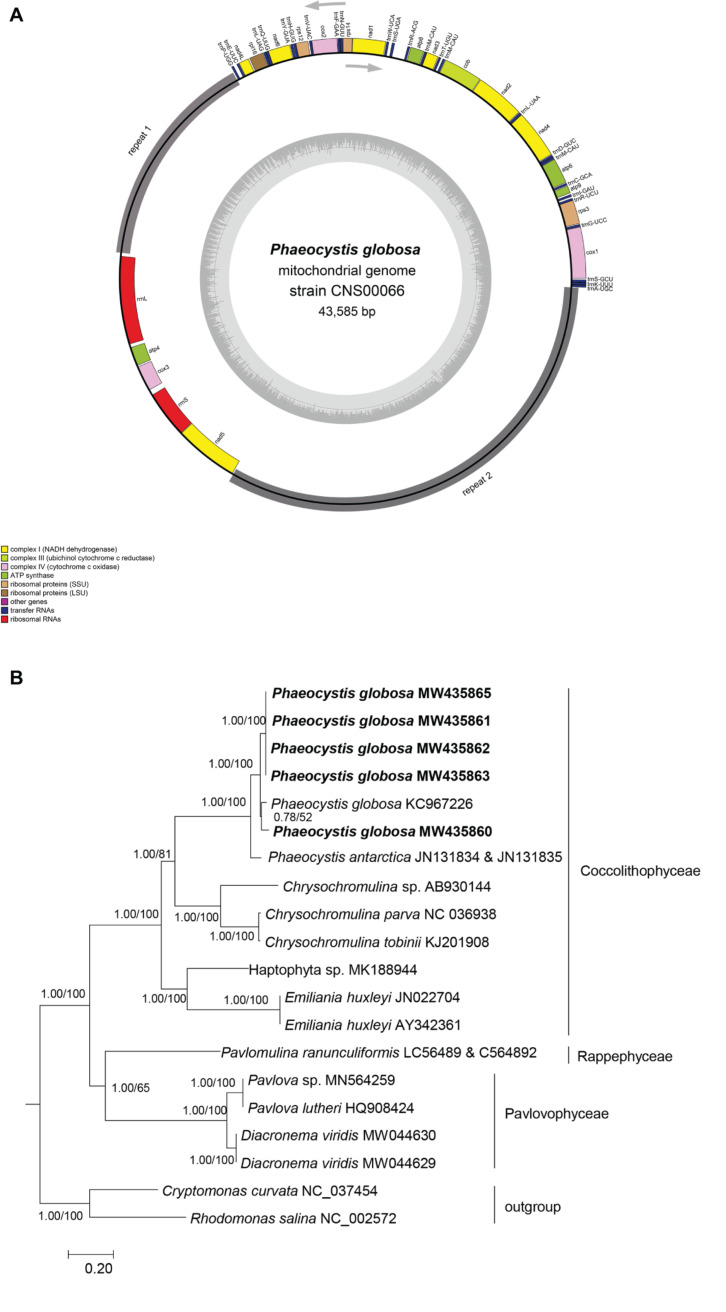
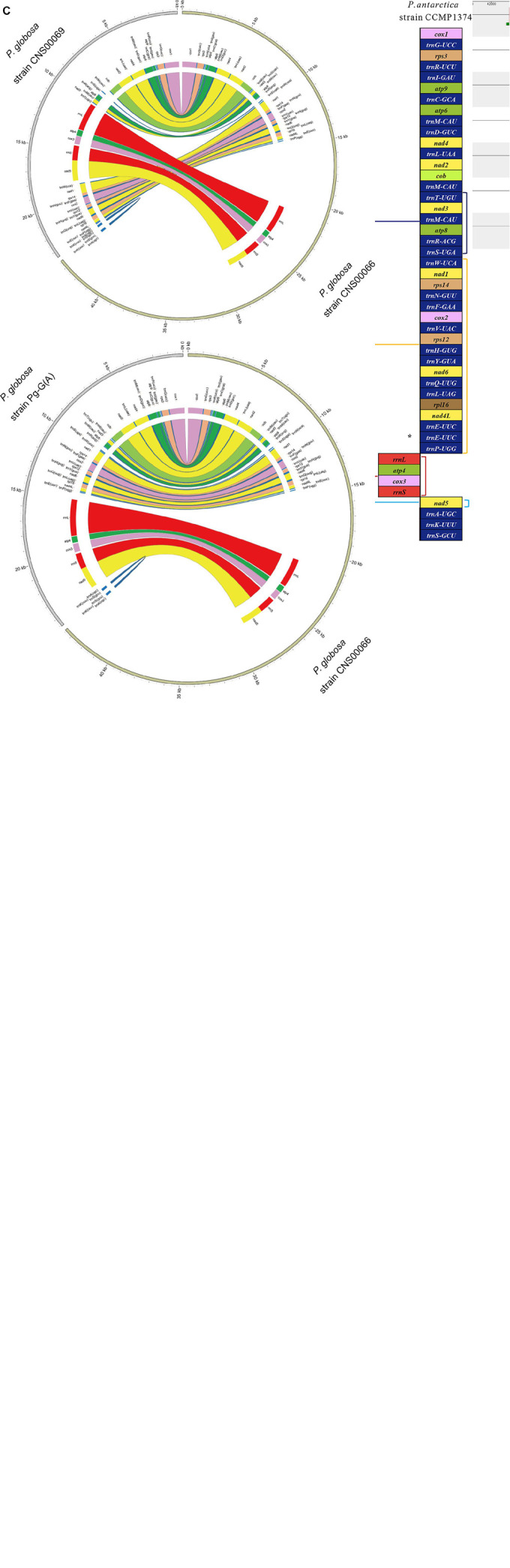
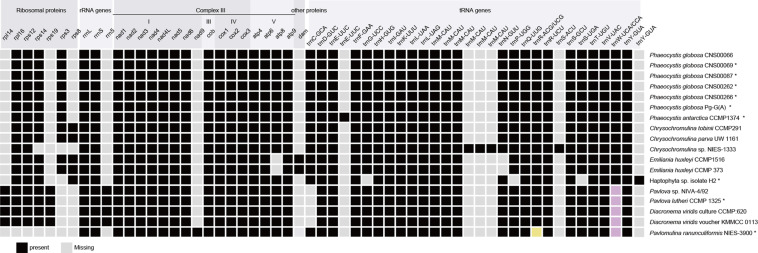
The haptophyte is a well-known species for its pivotal role in global carbon and sulfur cycles and for its capability of forming harmful algal blooms (HABs) with serious ecological consequences. Its mitochondrial genome (mtDNA) sequence has been reported in 2014 but it remains incomplete due to its long repeat sequences. In this study, we constructed the first full-length mtDNA of , which was a circular genome with a size of 43,585 bp by applying the PacBio single molecular sequencing method. The mtDNA of this strain (CNS00066), which was isolated from the Beibu Gulf, China, encoded 19 protein-coding genes (PCGs), 25 tRNA genes, and two rRNA genes. It contained two large repeat regions of 6.7 kb and ∼14.0 kb in length, respectively. The combined length of these two repeat regions, which were missing from the previous mtDNA assembly, accounted for almost half of the entire mtDNA and represented the longest repeat region among all sequenced haptophyte mtDNAs. In this study, we tested the hypothesis that repeat unit amplification is a driving force for different mtDNA sizes. Comparative analysis of mtDNAs of five additional strains (four strains obtained in this study, and one strain previously published) revealed that all six mtDNAs shared identical numbers of genes but with dramatically different repeat regions. A homologous repeat unit was identified but with hugely different numbers of copies in all strains. Thus, repeat amplification may represent an important driving force of mtDNA evolution in .
定鞭藻因其在全球碳和硫循环中的关键作用以及形成具有严重生态后果的有害藻华(HABs)的能力而成为一种著名的物种。其线粒体基因组(mtDNA)序列已于2014年报道,但由于其长重复序列,该序列仍然不完整。在本研究中,我们通过应用PacBio单分子测序方法构建了首个完整的定鞭藻mtDNA,其为一个大小为43,585 bp的环状基因组。从中国北部湾分离得到的该定鞭藻菌株(CNS00066)的mtDNA编码19个蛋白质编码基因(PCGs)、25个tRNA基因和两个rRNA基因。它包含两个分别长度为6.7 kb和约14.0 kb的大重复区域。这两个重复区域的总长度在之前的mtDNA组装中缺失,几乎占整个mtDNA的一半,并且代表了所有已测序定鞭藻mtDNA中最长的重复区域。在本研究中,我们检验了重复单元扩增是不同mtDNA大小的驱动力这一假设。对另外五个定鞭藻菌株(本研究获得的四个菌株和之前发表的一个菌株)的mtDNA进行比较分析发现,所有六个mtDNA共享相同数量的基因,但具有显著不同的重复区域。鉴定出一个同源重复单元,但在所有定鞭藻菌株中其拷贝数差异巨大。因此,重复扩增可能代表了定鞭藻中mtDNA进化的一个重要驱动力。