da Costa Ricardo M F, Winters Ana, Hauck Barbara, Martín Daniel, Bosch Maurice, Simister Rachael, Gomez Leonardo D, Batista de Carvalho Luís A E, Canhoto Jorge M
Centre for Functional Ecology, Department of Life Sciences, University of Coimbra, Coimbra, Portugal.
Molecular Physical-Chemistry R&D Unit, Department of Chemistry, University of Coimbra, Coimbra, Portugal.
Front Plant Sci. 2021 Jul 2;12:679966. doi: 10.3389/fpls.2021.679966. eCollection 2021.
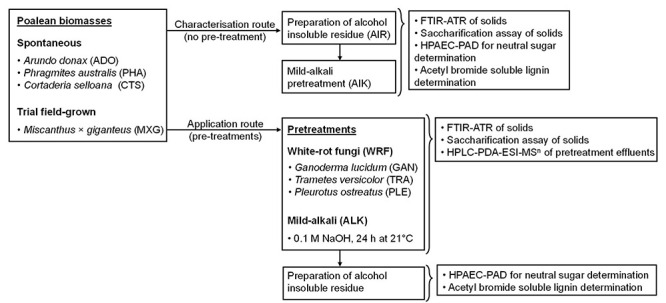
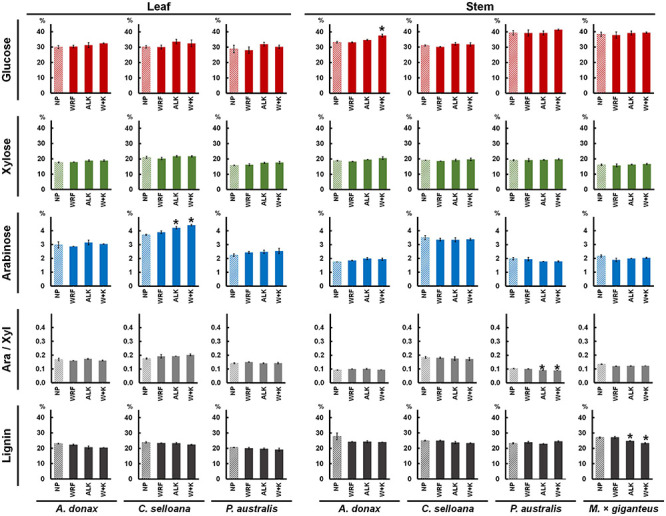
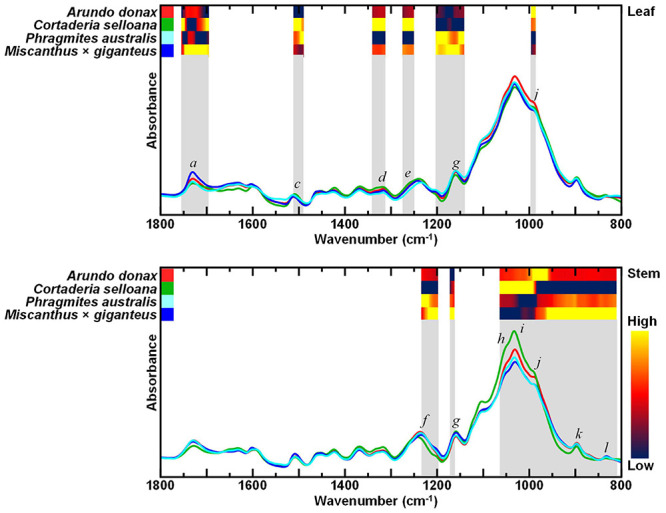
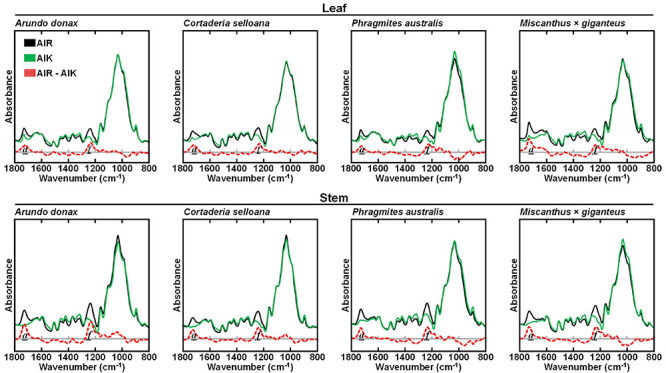
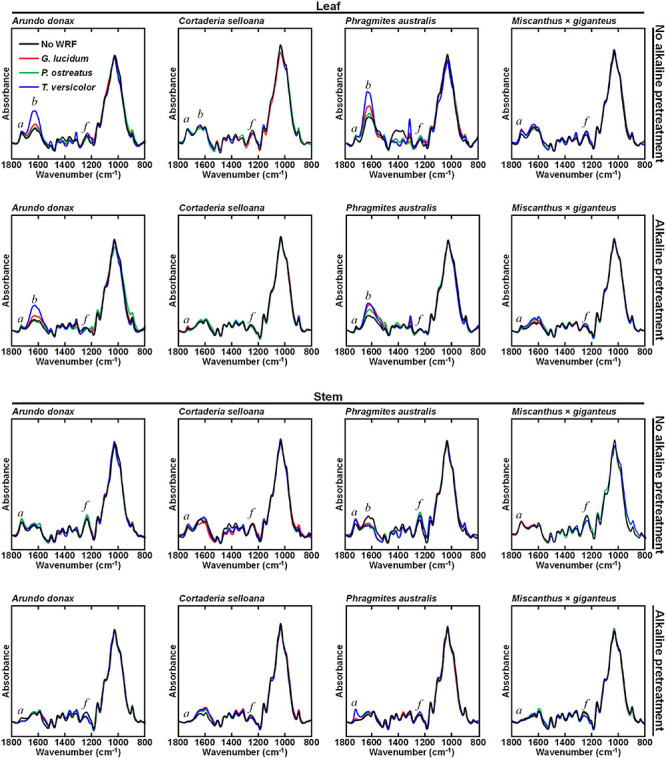
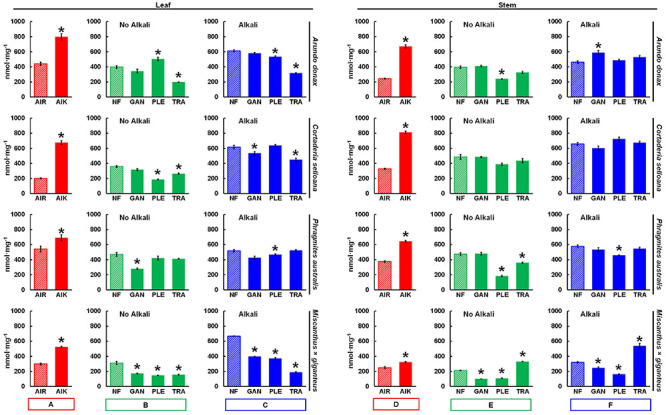
, and are high-biomass-producing perennial Poalean species that grow abundantly and spontaneously in warm temperate regions, such as in Mediterranean-type climates, like those of Southern Europe, Western United States coastal areas, or in regions of South America, South Africa and Australia. Given their vigorous and spontaneous growth, biomass from the studied grasses often accumulates excessively in unmanaged agro-forestry areas. Nonetheless, this also creates the demand and opportunity for the valorisation of these biomass sources, particularly their cell wall polymers, for biorefining applications. By contrast, a related crop, × , is a perennial grass that has been extensively studied for lignocellulosic biomass production, as it can grow on low-input agricultural systems in colder climates. In this study Fourier transform mid-infrared spectroscopy (FTIR), high-performance anion-exchange chromatography (HPAEC) and lignin content determinations were used for a comparative compositional characterisation of . , . and . harvested from the wild, in relation to a trial field-grown . × high-yielding genotype. A high-throughput saccharification assay showed relatively high sugar release values from the wild-grown grasses, even with a 0.1M NaOH mild alkali pretreatment. In addition to this alkaline pretreatment, biomass was treated with white-rot fungi (WRF), which preferentially degrade lignin more readily than holocellulose. Three fungal species were used: , and . Our results showed that neutral sugar contents are not significantly altered, while some lignin is lost during the pretreatments. Furthermore, sugar release upon enzymatic saccharification was enhanced, and this was dependent on the plant biomass and fungal species used in the treatment. To maximise the potential for lignocellulose valorisation, the liquid fractions from the pretreatments were analysed by high performance liquid chromatography - photodiode array detection - electrospray ionisation tandem mass spectrometry (HPLC-PDA-ESI-MS ). This study is one of the first to report on the composition of WRF-treated grass biomass, while assessing the potential relevance of breakdown products released during the treatments, beyond more traditional sugar-for-energy applications. Ultimately, we expect that our data will help promote the valorisation of unused biomass resources, create economic value, while contributing to the implementation of sustainable biorefining systems.
[物种名称1]、[物种名称2]和[物种名称3]是多年生禾本科高生物量生产物种,在地中海型气候等暖温带地区大量自然生长,如南欧、美国西部沿海地区,或南美洲、南非和澳大利亚的部分地区。鉴于其生长旺盛且自然生长,研究的草类生物质常在未管理的农林地区过度积累。尽管如此,这也为这些生物质来源,特别是其细胞壁聚合物,在生物精炼应用中的增值创造了需求和机会。相比之下,一种相关作物[杂交物种名称]是一种多年生草本植物,因其能在较寒冷气候下的低投入农业系统中生长,已被广泛研究用于木质纤维素生物质生产。在本研究中,使用傅里叶变换中红外光谱(FTIR)、高效阴离子交换色谱(HPAEC)和木质素含量测定,对从野外收获的[物种名称1]、[物种名称2]和[物种名称3],与试验田种植的[杂交物种名称]高产基因型进行比较成分表征。高通量糖化试验表明,即使经过0.1M NaOH温和碱预处理,野生草类也有相对较高的糖释放值。除了这种碱性预处理外,生物质还用白腐真菌(WRF)处理,白腐真菌优先降解木质素而非全纤维素。使用了三种真菌物种:[真菌物种名称1]、[真菌物种名称2]和[真菌物种名称3]。我们的结果表明,中性糖含量没有显著变化,而在预处理过程中一些木质素损失了。此外,酶促糖化后的糖释放增加,这取决于处理中使用的植物生物质和真菌物种。为了最大限度地提高木质纤维素增值潜力,通过高效液相色谱 - 光电二极管阵列检测 - 电喷雾电离串联质谱(HPLC - PDA - ESI - MS)分析预处理的液体部分。本研究是首批报道白腐真菌处理的草类生物质组成的研究之一,同时评估了处理过程中释放的分解产物的潜在相关性,超越了更传统的糖转化为能源的应用。最终,我们期望我们的数据将有助于促进未使用生物质资源的增值,创造经济价值,同时有助于可持续生物精炼系统的实施。