Pancaldi Francesco, Trindade Luisa M
Plant Breeding, Wageningen University & Research, Wageningen, Netherlands.
Front Plant Sci. 2020 Mar 3;11:227. doi: 10.3389/fpls.2020.00227. eCollection 2020.
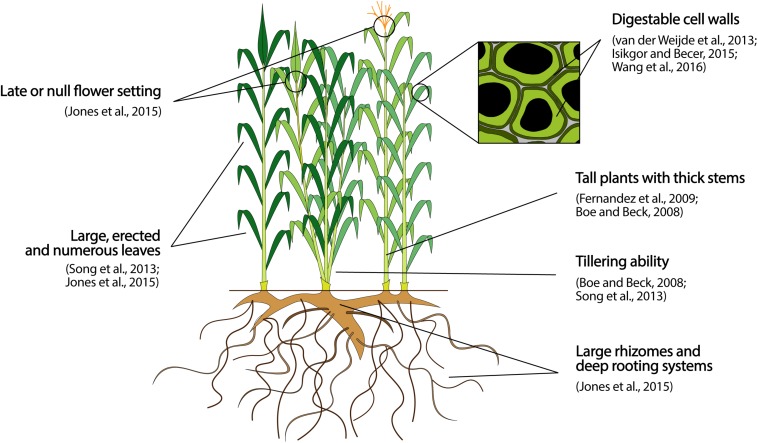
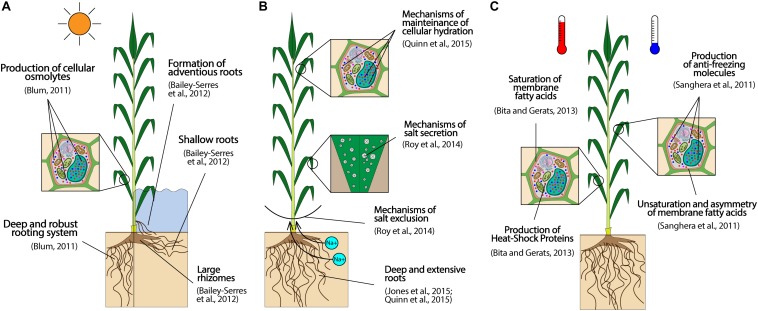
The biomass demand to fuel a growing global bio-based economy is expected to tremendously increase over the next decades, and projections indicate that dedicated biomass crops will satisfy a large portion of it. The establishment of dedicated biomass crops raises huge concerns, as they can subtract land that is required for food production, undermining food security. In this context, perennial biomass crops suitable for cultivation on marginal lands (MALs) raise attraction, as they could supply biomass without competing for land with food supply. While these crops withstand marginal conditions well, their biomass yield and quality do not ensure acceptable economic returns to farmers and cost-effective biomass conversion into bio-based products, claiming genetic improvement. However, this is constrained by the lack of genetic resources for most of these crops. Here we first review the advantages of cultivating novel perennial biomass crops on MALs, highlighting management practices to enhance the environmental and economic sustainability of these agro-systems. Subsequently, we discuss the preeminent breeding targets to improve the yield and quality of the biomass obtainable from these crops, as well as the stability of biomass production under MALs conditions. These targets include crop architecture and phenology, efficiency in the use of resources, lignocellulose composition in relation to bio-based applications, and tolerance to abiotic stresses. For each target trait, we outline optimal ideotypes, discuss the available breeding resources in the context of (orphan) biomass crops, and provide meaningful examples of genetic improvement. Finally, we discuss the available tools to breed novel perennial biomass crops. These comprise conventional breeding methods (recurrent selection and hybridization), molecular techniques to dissect the genetics of complex traits, speed up selection, and perform transgenic modification (genetic mapping, QTL and GWAS analysis, marker-assisted selection, genomic selection, transformation protocols), and novel high-throughput phenotyping platforms. Furthermore, novel tools to transfer genetic knowledge from model to orphan crops (i.e., universal markers) are also conceptualized, with the belief that their development will enhance the efficiency of plant breeding in orphan biomass crops, enabling a sustainable use of MALs for biomass provision.
为推动全球生物基经济的增长,预计未来几十年对生物质的需求将大幅增加,预测表明专用生物质作物将满足其中很大一部分需求。专用生物质作物的种植引发了巨大担忧,因为它们会占用粮食生产所需的土地,从而损害粮食安全。在这种背景下,适合在边际土地(MALs)上种植的多年生生物质作物引起了人们的关注,因为它们可以提供生物质,而不会与粮食供应争夺土地。虽然这些作物能很好地适应边际条件,但其生物质产量和质量并不能确保农民获得可接受的经济回报,也无法实现将生物质经济高效地转化为生物基产品,因此需要进行基因改良。然而,大多数这类作物缺乏遗传资源,这限制了改良工作。在此,我们首先回顾在边际土地上种植新型多年生生物质作物的优势,强调提高这些农业系统的环境和经济可持续性的管理措施。随后,我们讨论提高这些作物生物质产量和质量以及在边际土地条件下生物质生产稳定性的首要育种目标。这些目标包括作物架构和物候、资源利用效率、与生物基应用相关的木质纤维素组成以及对非生物胁迫的耐受性。对于每个目标性状,我们概述了理想型,在(孤儿)生物质作物的背景下讨论了可用的育种资源,并提供了基因改良的有意义实例。最后,我们讨论了培育新型多年生生物质作物的可用工具。这些工具包括传统育种方法(轮回选择和杂交)、剖析复杂性状遗传、加速选择以及进行转基因修饰的分子技术(遗传图谱绘制、QTL和GWAS分析、标记辅助选择、基因组选择、转化方案),以及新型高通量表型分析平台。此外,还构思了将遗传知识从模式作物转移到孤儿作物的新型工具(即通用标记),相信其开发将提高孤儿生物质作物的植物育种效率,实现可持续利用边际土地提供生物质。