Xu Lin, Qin Hao, Tan Jia, Cheng Zhilin, Luo Xiang, Tan Haitao, Huang Wenhua
Guangxi Medical University, Guangxi Zhuang Autonomous Region, Nanning 530021, China.
Department of Orthopedics, Guigang City People's Hospital, Guangxi Digital Medicine and 3D Printing Clinical Research Center, Guangxi Zhuang Autonomous Region, Guigang 537100, China.
J Orthop Translat. 2021 Jun 30;29:163-169. doi: 10.1016/j.jot.2021.05.007. eCollection 2021 Jul.
/Objective: In recent years, prostheses have been widely used for limb reconstruction after pelvic tumour resection. However, prostheses are associated with problems leading to tumour recurrence, poor implant matching, defects after tumour resection, and easy implant looseness or failure. To achieve a precise preoperative design, complete tumour resection, and better anatomical structure matching and prosthesis stability, this study used three-dimensionally (3D)-printed osteotomy guides and personalised prostheses for reconstruction after pelvic tumour resection. This study aimed to explore the early clinical efficacy of 3D printed personalised prostheses for the reconstruction of bone defects after pelvic tumour resection.
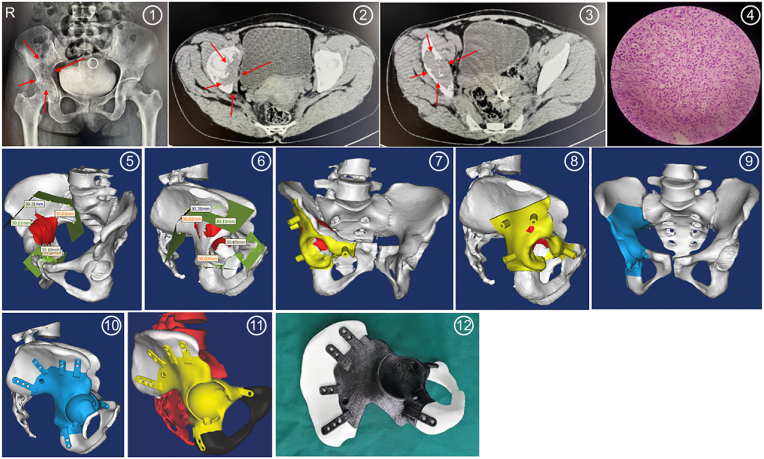
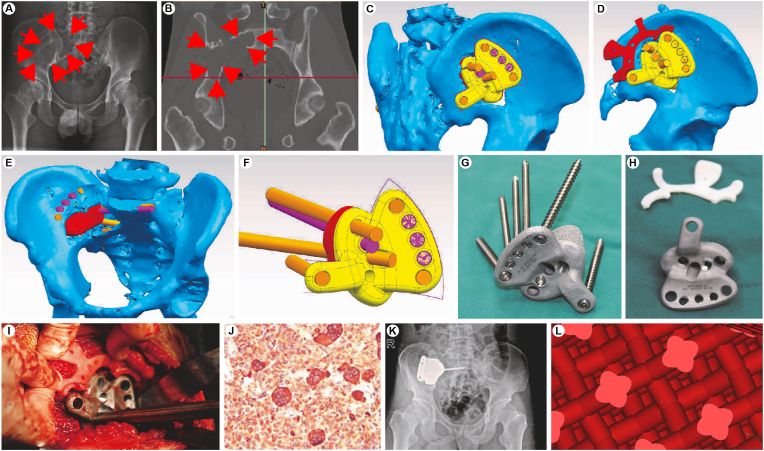
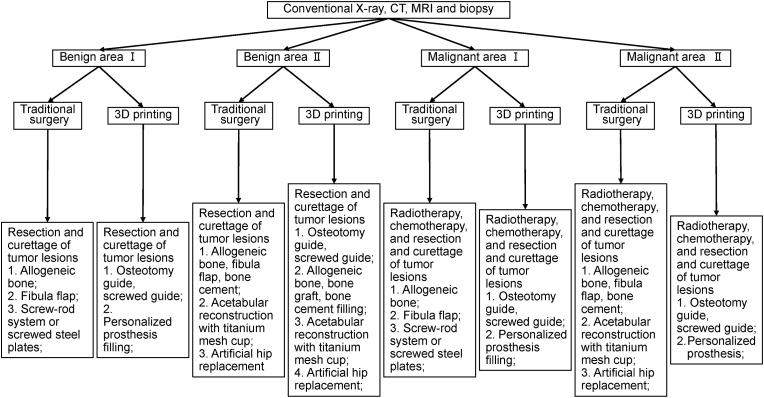
A total of 20 patients (12 males, 8 females) with pelvic tumours surgically treated at our hospital between October 2014 and October 2019 were selected. There were 10 cases each of giant cell bone tumours and osteochondrosarcomas. According to Enneking zoning, there were 11 and 9 cases with tumours located in zones I and II, respectively. All cases were equally divided into conventional and 3D printing groups. For repair and reconstruction, a nail rod system or a steel plate was used in the conventional group while individualised 3D-printed prostheses were used in the 3D printing group. The surgical incision, duration of surgery, intraoperative blood loss, and the negative rate of resection margins in postoperative tumour specimens were examined. The follow-up focused on tumour recurrence, complications, and the Musculoskeletal Tumor Society (MSTS) score.
All cases were followed-up for 6-24 months. The average incision length, duration of surgery, amount of intraoperative blood loss, and MSTS score of the 3D printing group were 10.0 ± 3.1 cm, 115.2 ± 25.3 min, 213.2 ± 104.6 mL, 23.8 ± 1.3, respectively, and those of the conventional group were 19.8 ± 8.4 cm, 156.8 ± 61.4 min, 361.4 ± 164.2 mL, and 18.3 ± 1.4, respectively. Histological tumour specimen examination showed nine and three cases with negative resection margins in the 3D printing group and the conventional group, respectively. The abovementioned indicators were significantly different between both groups ( < 0.05).
Applying 3D printed surgical guides and personalised prostheses for pelvic tumour resection, repair, and reconstruction, as well as preoperative planning and design, enables more accurate tumour resections and better prosthesis-patient matchings, possibly reducing surgical trauma, shortening the duration of surgery, and promoting the functional recovery of patients postoperatively.
Contrary to existing studies on 3D printed personalised prostheses, this study reports the clinical efficacy of the aforementioned technology in treating bone defects in a series of patients who underwent pelvic tumour resection. Moreover, it presents a comprehensive comparison of this technology with conventional procedures, thus strengthening its importance in treatment regimens for reconstructing bone defects.
/目的:近年来,假体已广泛应用于骨盆肿瘤切除术后的肢体重建。然而,假体存在导致肿瘤复发、植入物匹配不佳、肿瘤切除后缺损以及植入物易松动或失效等问题。为实现精确的术前设计、完整的肿瘤切除以及更好的解剖结构匹配和假体稳定性,本研究采用三维(3D)打印截骨导板和个性化假体进行骨盆肿瘤切除术后的重建。本研究旨在探讨3D打印个性化假体用于骨盆肿瘤切除术后骨缺损重建的早期临床疗效。
选取2014年10月至2019年10月在我院接受手术治疗的骨盆肿瘤患者20例(男12例,女8例)。骨巨细胞瘤和骨肉瘤各10例。根据Enneking分区,肿瘤位于Ⅰ区和Ⅱ区的分别有11例和9例。所有病例均分为传统组和3D打印组。修复重建时,传统组采用钉棒系统或钢板,3D打印组采用个体化3D打印假体。观察手术切口、手术时间、术中出血量以及术后肿瘤标本切除边缘阴性率。随访重点关注肿瘤复发、并发症以及肌肉骨骼肿瘤学会(MSTS)评分。
所有病例均随访6 - 24个月。3D打印组的平均切口长度、手术时间、术中出血量和MSTS评分分别为10.0 ± 3.1 cm、115.2 ± 25.3分钟、213.2 ± 104.6 mL、23.8 ± 1.3,传统组分别为19.8 ± 8.4 cm、156.8 ± 61.4分钟、361.4 ± 164.2 mL、18.3 ± 1.4。组织学肿瘤标本检查显示,3D打印组和传统组切除边缘阴性的病例分别为9例和3例。两组上述指标差异有统计学意义(<0.05)。
应用3D打印手术导板和个性化假体进行骨盆肿瘤切除、修复和重建以及术前规划和设计,可实现更精确的肿瘤切除和更好的假体与患者匹配,可能减少手术创伤,缩短手术时间,促进患者术后功能恢复。
与现有关于3D打印个性化假体的研究不同,本研究报告了上述技术在一系列接受骨盆肿瘤切除的患者中治疗骨缺损的临床疗效。此外,它对该技术与传统手术进行了全面比较,从而强化了其在骨缺损重建治疗方案中的重要性。