Lu Yujie, Tong Yiwei, Chen Xiaosong, Shen Kunwei
Department of General Surgery, Comprehensive Breast Health Center, Ruijin Hospital, Shanghai Jiao Tong University School of Medicine, Shanghai, China.
Front Oncol. 2021 Jul 1;11:638619. doi: 10.3389/fonc.2021.638619. eCollection 2021.
Biomarker discrepancy between primary and recurrent/metastatic breast cancer is well known, however its impact on prognosis and treatment after relapse is still unclear. Current study aims to evaluate biomarkers discrepancy between primary and recurrent/metastatic lesions as well as to investigate its association with following treatment pattern and disease outcome.
We retrospectively included consecutive breast cancer patients undergoing surgery in our center from Jan. 2009 to Dec. 2016 and reported disease recurrence. Patients with re-biopsy and paired biomarkers statuses on primary and recurrent/metastatic lesions were further analyzed. Kappa test was used to analyze the concordance rate of estrogen receptor (ER), progesterone receptor (PR) and human epidermal growth factor receptor-2 (HER2) status. Post-recurrence survival (PRS) was compared between subgroups by Kaplan-Meier curve. Cox regression model was applied to identify impact factors for PRS.
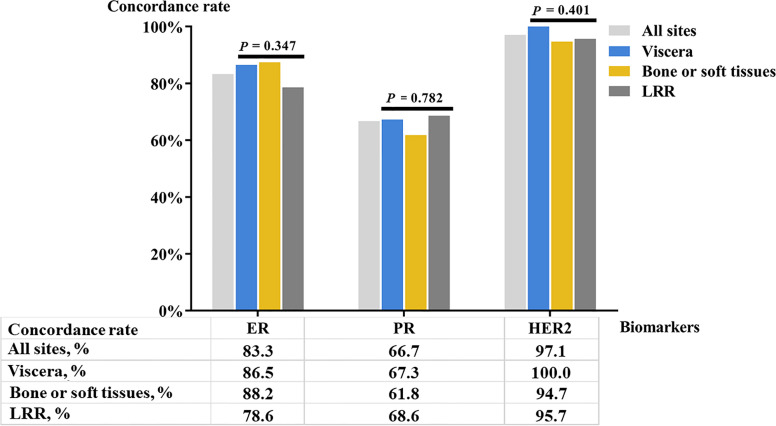
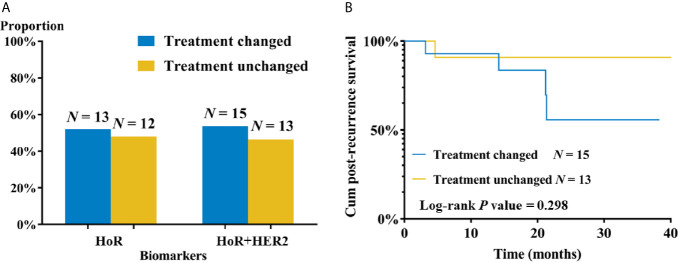
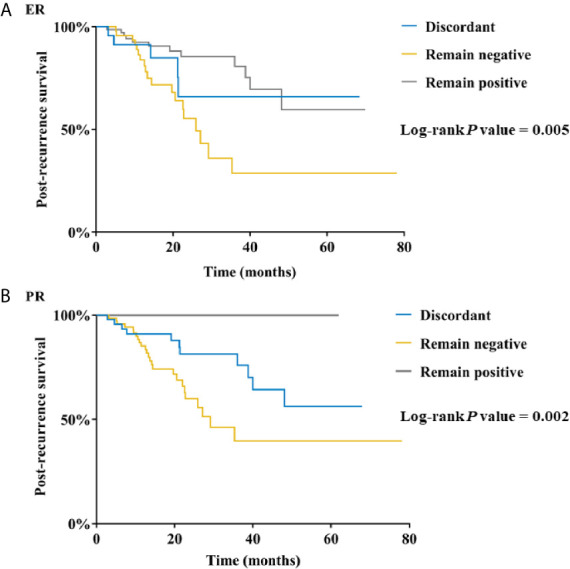
A total of 156 patients were finally included, of whom 70 and 86 had loco-regional and distant recurrence, respectively. Concordance rates of ER, PR and HER2 were 83.3%, 66.7%, and 97.1%, respectively, which was similarly distributed among different recurrent sites (all 0.05). Primary ER-positivity ( ER-negativity, = 0.014) and loco-regional recurrence ( distant metastasis, = 0.001) were independently associated with superior PRS, while patients with visceral metastasis ( < 0.001) had the worst disease outcome. Hormone receptor/HER2 status discrepancy was observed in 28 patients. Fifteen of them changed systemic treatment based on biomarker statuses of recurrent lesion, however, their PRS was not improved compared to those 13 patients who continued the same treatment according to primary biomarkers statuses ( = 0.298).
Biomarker discrepancy was observed between primary and recurrent/metastatic breast cancer lesions and had certain influence on treatment strategies after relapse. However, its impact on disease outcome wasn't established in the current study, which deserves further evaluation.
原发性与复发/转移性乳腺癌之间的生物标志物差异是众所周知的,然而其对复发后预后和治疗的影响仍不清楚。本研究旨在评估原发性与复发/转移性病变之间的生物标志物差异,并探讨其与后续治疗模式和疾病结局的关联。
我们回顾性纳入了2009年1月至2016年12月在本中心接受手术并报告疾病复发的连续性乳腺癌患者。对进行了再次活检且有原发性和复发/转移性病变配对生物标志物状态的患者进行进一步分析。采用Kappa检验分析雌激素受体(ER)、孕激素受体(PR)和人表皮生长因子受体2(HER2)状态的一致性率。通过Kaplan-Meier曲线比较亚组之间的复发后生存率(PRS)。应用Cox回归模型确定PRS的影响因素。
最终纳入156例患者,其中70例和86例分别发生局部区域复发和远处复发。ER、PR和HER2的一致性率分别为83.3%、66.7%和97.1%,在不同复发部位的分布相似(均P>0.05)。原发性ER阳性(与ER阴性相比,P = 0.014)和局部区域复发(与远处转移相比,P = 0.001)与较好的PRS独立相关,而内脏转移患者(P<0.001)的疾病结局最差。28例患者观察到激素受体/HER2状态差异。其中15例根据复发病变的生物标志物状态改变了全身治疗,然而,与根据原发性生物标志物状态继续相同治疗的13例患者相比,他们的PRS并未改善(P = 0.298)。
原发性与复发/转移性乳腺癌病变之间存在生物标志物差异,对复发后的治疗策略有一定影响。然而,其对疾病结局的影响在本研究中尚未明确,值得进一步评估。