Shahmirzalou Parviz, Khaledi Majid Jafari, Khayamzadeh Maryam, Rasekhi Aliakbar
Department of Biostatistics, Faculty of Medical Sciences, Tarbiat Modares University, Tehran, Iran.
Department of Statistics, Tarbiat Modares University, Tehran, Iran.
Heliyon. 2023 Sep 21;9(10):e20360. doi: 10.1016/j.heliyon.2023.e20360. eCollection 2023 Oct.
Breast cancer (BC) is the most common cancer among women. Iranians have an 11% BC recurrence rate, which lowers their survival rates. Few studies have investigated cancer recurrence survival rates. This study's major purpose is to use a mixed Bayesian network (BN) to analyze recurrent patients' survival.
This study aimed to evaluate the pathobiological features, age, gender, final status, and survival time of the patients. Bayesian imputation was used for missing data. The performance of BN was optimized through the utilization of a blacklist and prior probability. After structural and parametric learning, posterior conditional probabilities and mean survival periods for the node arcs were predicted. The hold-out technique based on the posterior classification error was used to investigate the model's validation.
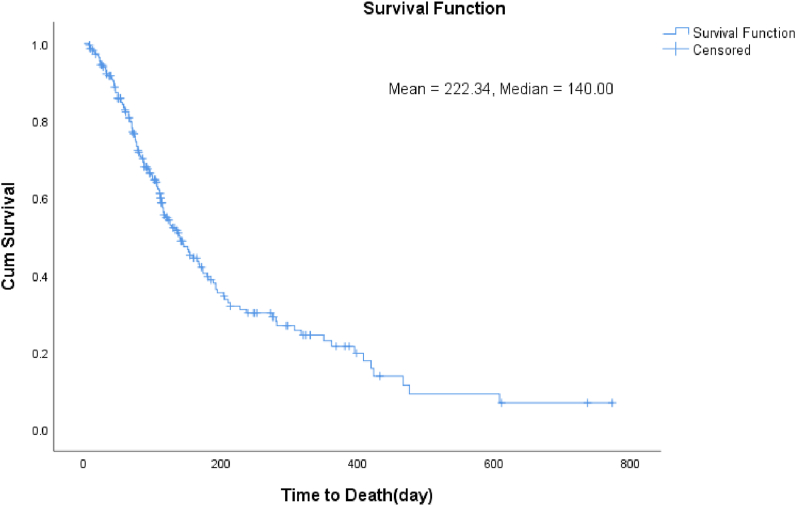
The study included 220 cancer recurrence patients. These patients averaged 47 years old. The BN with a blacklist and prior probability has a higher network score than other networks. The hold-out technique verified structural learning. The Directed Acyclic Graph showed a statistically significant relationship between cancer biomarkers (ER, PR, and HER2 receptors), cancer stage, and tumor grade and patient survival duration. Patient death was also significantly associated with education, ER, PR, HER2, and tumor grade. The BN reports that HER2 negative, ER positive, and PR positive patients had a higher survival rate.
Survival and death of relapsed patients depend on biomarkers. Based on the findings, patient survival can be predicted with their features.
乳腺癌(BC)是女性中最常见的癌症。伊朗人的乳腺癌复发率为11%,这降低了他们的生存率。很少有研究调查癌症复发后的生存率。本研究的主要目的是使用混合贝叶斯网络(BN)来分析复发患者的生存情况。
本研究旨在评估患者的病理生物学特征、年龄、性别、最终状态和生存时间。对缺失数据采用贝叶斯插补法。通过使用黑名单和先验概率来优化贝叶斯网络的性能。在进行结构和参数学习后,预测节点弧的后验条件概率和平均生存期。基于后验分类误差的留出法用于研究模型的验证。
该研究纳入了220例癌症复发患者。这些患者的平均年龄为47岁。带有黑名单和先验概率的贝叶斯网络比其他网络具有更高的网络得分。留出法验证了结构学习。有向无环图显示癌症生物标志物(雌激素受体、孕激素受体和人表皮生长因子受体2)、癌症分期和肿瘤分级与患者生存时间之间存在统计学上的显著关系。患者死亡也与教育程度、雌激素受体、孕激素受体、人表皮生长因子受体2和肿瘤分级显著相关。贝叶斯网络报告显示,人表皮生长因子受体2阴性、雌激素受体阳性和孕激素受体阳性的患者生存率较高。
复发患者的生存和死亡取决于生物标志物。基于这些发现,可以根据患者的特征预测其生存情况。