Regeer Hannah, Nieuwenhuijse Emma A, Vos Rimke C, Kiefte-de Jong Jessica C, van Empelen Pepijn, de Koning Eelco J P, Bilo Henk J G, Huisman Sasja D
Division of Endocrinology Department of Medicine Leiden University Medical Center Leiden The Netherlands.
Department of Public Health and Primary Care / LUMC-Campus The Hague Leiden University Medical Center Den Haag The Netherlands.
Endocrinol Diabetes Metab. 2021 May 5;4(3):e00249. doi: 10.1002/edm2.249. eCollection 2021 Jul.
To investigate changes in physical activity (PA) and psychological factors during societal lockdown in people with type 2 diabetes.
A cross-sectional study among Dutch adults with type 2 diabetes. Data were collected using online questionnaires. A multivariate multinomial logistic regression was performed with change in PA during societal lockdown as outcome and perceived change in stress, anxiety, perceived risk for COVID-19 infection, emotional well-being and former PA status as determinants.
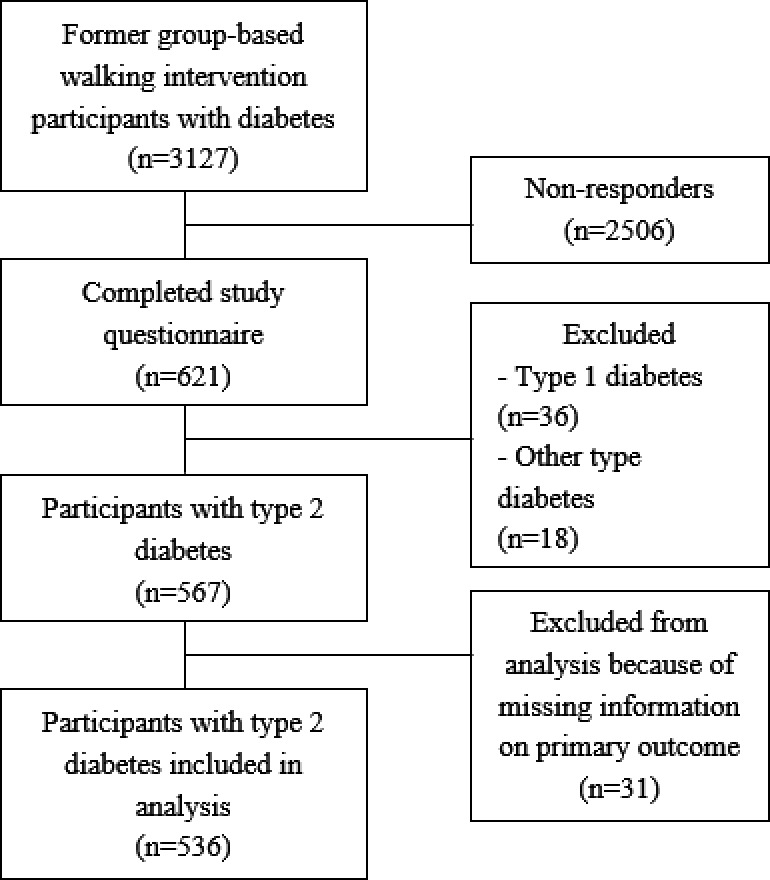
Five hundred and sixty seven respondents filled out the questionnaire, 536 were included in the final analysis: mean age of 65.9 ± 7.9 years; mean diabetes duration 13.3 ± 8 years; 54% men; 47% reported no change in PA, 27% became less active and 26% became more active during societal lockdown. Participants who were more likely to become less active were participants who experienced more stress (OR: 2.27; 95% CI 1.25-4.13) or less stress (OR: 2.20; 95% CI 1.03-4.71). Participants who were more likely to become more active were participants who experienced more stress (OR: 2.31; 95% CI 1.25, 4.26). Participants with higher emotional well-being (OR: 0.98; 95% CI 0.97, 0.99) were less likely to become less active than to report no change in PA.
Changes in PA in people with type 2 diabetes during societal lockdown are associated with changes in psychological factors such as perceived stress and emotional well-being. People with diabetes and their caregivers should be aware of these possible changes.
调查2型糖尿病患者在社会封锁期间身体活动(PA)和心理因素的变化。
对荷兰成年2型糖尿病患者进行横断面研究。通过在线问卷收集数据。以社会封锁期间PA的变化为结果,以感知到的压力、焦虑、COVID-19感染的感知风险、情绪健康和以前的PA状态的变化为决定因素,进行多变量多项逻辑回归分析。
567名受访者填写了问卷,536人纳入最终分析:平均年龄65.9±7.9岁;平均糖尿病病程13.3±8年;54%为男性;47%报告在社会封锁期间PA无变化,27%活动减少,26%活动增加。更有可能活动减少的参与者是经历更多压力(比值比:2.27;95%置信区间1.25 - 4.13)或压力较小(比值比:2.20;95%置信区间1.03 - 4.71)的参与者。更有可能活动增加的参与者是经历更多压力的参与者(比值比:2.31;95%置信区间1.25, 4.26)。情绪健康状况较高的参与者(比值比:0.98;95%置信区间0.97, 0.99)比报告PA无变化的参与者更不容易活动减少。
2型糖尿病患者在社会封锁期间PA的变化与心理因素如感知压力和情绪健康的变化有关。糖尿病患者及其护理人员应意识到这些可能的变化。