Department of Medicine, Division of Endocrinology, Leiden University Medical Center, Leiden, Zuid-Holland, The Netherlands.
Department of Clinical Chemistry and Laboratory Medicine, Leiden University Medical Center, Leiden, Zuid-Holland, The Netherlands.
BMJ Open Diabetes Res Care. 2021 Jan;9(1). doi: 10.1136/bmjdrc-2020-002035.
Lockdown measures have a profound effect on many aspects of daily life relevant for diabetes self-management. We assessed whether lockdown measures, in the context of the COVID-19 pandemic, differentially affect perceived stress, body weight, exercise and related this to glycemic control in people with type 1 and type 2 diabetes.
We performed a short-term observational cohort study at the Leiden University Medical Center. People with type 1 and type 2 diabetes ≥18 years were eligible to participate. Participants filled out online questionnaires, sent in blood for hemoglobin A1c (HbA1c) analysis and shared data of their flash or continuous glucose sensors. HbA1c during the lockdown was compared with the last known HbA1c before the lockdown.
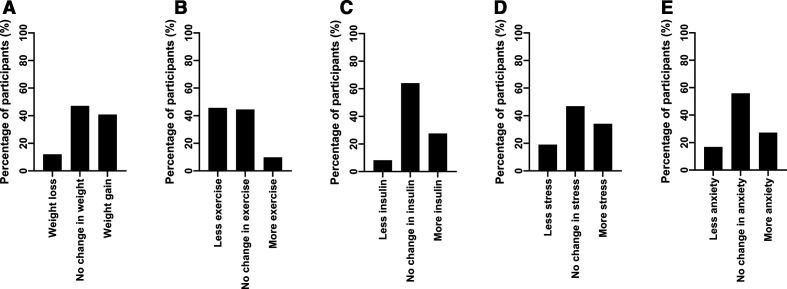
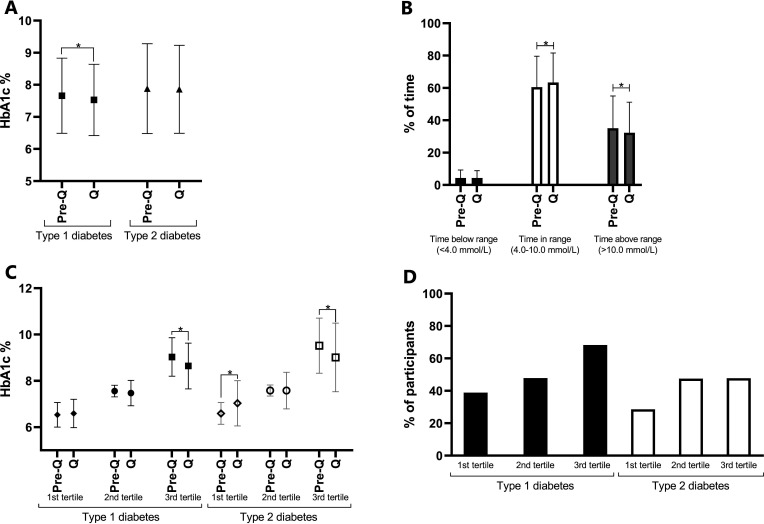
In total, 435 people were included (type 1 diabetes n=280, type 2 diabetes n=155). An increase in perceived stress and anxiety, weight gain and less exercise was observed in both groups. There was improvement in glycemic control in the group with the highest HbA1c tertile (type 1 diabetes: -0.39% (-4.3 mmol/mol) (p<0.0001 and type 2 diabetes: -0.62% (-6.8 mmol/mol) (p=0.0036). Perceived stress was associated with difficulty with glycemic control (p<0.0001).
An increase in perceived stress and anxiety, weight gain and less exercise but no deterioration of glycemic control occurs in both people with relatively well-controlled type 1 and type 2 diabetes during short-term lockdown measures. As perceived stress showed to be associated with glycemic control, this provides opportunities for healthcare professionals to put more emphasis on psychological aspects during diabetes care consultations.
封锁措施对与糖尿病自我管理相关的日常生活的许多方面都有深远的影响。我们评估了 COVID-19 大流行背景下的封锁措施是否会对 1 型和 2 型糖尿病患者的感知压力、体重、运动产生不同的影响,并将其与血糖控制相关联。
我们在莱顿大学医学中心进行了一项短期观察性队列研究。年龄≥18 岁的 1 型和 2 型糖尿病患者有资格参加。参与者填写在线问卷,发送血液进行血红蛋白 A1c(HbA1c)分析,并分享他们的闪存或连续血糖传感器的数据。将封锁期间的 HbA1c 与封锁前最后一次已知的 HbA1c 进行比较。
共有 435 人入选(1 型糖尿病 n=280,2 型糖尿病 n=155)。两组患者均观察到感知压力和焦虑增加、体重增加和运动减少。HbA1c 最高 tertile 组的血糖控制得到改善(1 型糖尿病:-0.39%(-4.3mmol/mol)(p<0.0001)和 2 型糖尿病:-0.62%(-6.8mmol/mol)(p=0.0036)。感知压力与血糖控制困难相关(p<0.0001)。
在短期封锁措施期间,血糖控制相对较好的 1 型和 2 型糖尿病患者均出现感知压力和焦虑增加、体重增加和运动减少,但血糖控制无恶化。由于感知压力与血糖控制相关,这为医疗保健专业人员在糖尿病护理咨询中更加注重心理方面提供了机会。