Bavalia Roisin, Bistervels Ingrid M, Boersma Wim G, Quere Isabelle, Brisot Dominique, Falvo Nicolas, Stephan Dominique, Couturaud Francis, Schellong Sebastian, Beyer-Westendorf Jan, Montaclair Karine, Ghanima Waleed, Ten Wolde Marije, Coppens Michiel, Ferrari Emile, Sanchez Olivier, Carroll Patrick, Roy Pierre-Marie, Kahn Susan R, Meijer Karina, Birocchi Simone, Kovacs Michael J, Hugman Amanda, Ten Cate Hugo, Wik Hilde, Pernod Gilles, Sevestre-Pietri Marie-Antoinette, Grosso Michael A, Shi Minggao, Lin Yong, Hutten Barbara A, Verhamme Peter, Middeldorp Saskia
Department of Vascular Medicine Amsterdam Cardiovascular Sciences Amsterdam UMC University of Amsterdam Amsterdam The Netherlands.
Department of Internal Medicine Flevo Hospital Almere The Netherlands.
Res Pract Thromb Haemost. 2021 Jul 14;5(5):e12566. doi: 10.1002/rth2.12566. eCollection 2021 Jul.
Long-term sequelae of acute pulmonary embolism (PE) include decreased quality of life (QoL). Evidence suggests that adequacy of initial anticoagulant treatment in the acute phase of venous thrombosis has a key impact on late postthrombotic complications. We hypothesize that patients with acute PE treated with edoxaban for acute PE experience have improved QoL compared to those treated with warfarin.
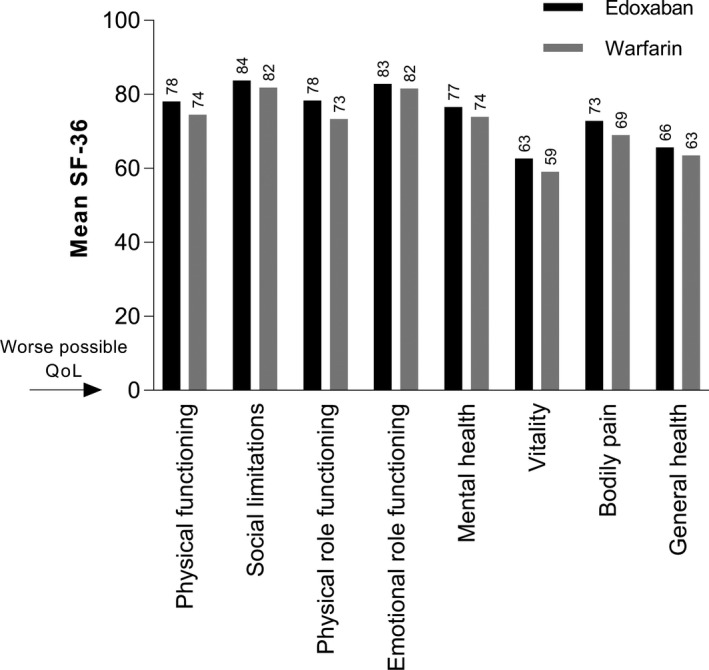
Patients with PE who participated in the Hokusai-VTE trial were contacted between June 2017 and September 2020 for a single long-term follow-up visit. Main outcomes were the generic and disease-specific QoL measured by the 36-Item Short Form Health Survey (SF-36) and Pulmonary Embolism Quality of Life questionnaire.
We included 251 patients from 26 centers in eight countries, of which 129 (51%) had been assigned to edoxaban and 122 (49%) to warfarin. Patient- and thrombus-specific characteristics were similar in both groups. Mean time since randomization in the Hokusai-VTE trial was 7.0 years (standard deviation, 1.0). No relevant or statistical differences were observed in the QoL for patients treated with edoxaban compared to patients treated with warfarin. The mean difference between patients treated with edoxaban and patients with PE treated with warfarin was 0.8 (95% confidence interval [CI]. -1.6 to 3.2) for the SF-36 summary mental score and 1.6 (95% CI, -0.9 to 4.1) for summary physical score.
Our findings indicate that patients with an index PE treated with edoxaban or warfarin have a similar long-term QoL. Since our study was a follow-up study from a well-controlled clinical trial setting, future studies should be designed in a daily clinical practice setting. We suggest a longitudinal design for investigation of changes in QoL over time.
急性肺栓塞(PE)的长期后遗症包括生活质量(QoL)下降。有证据表明,静脉血栓形成急性期初始抗凝治疗的充分性对血栓形成后晚期并发症具有关键影响。我们假设,与接受华法林治疗的患者相比,接受依度沙班治疗急性PE的患者生活质量得到改善。
在2017年6月至2020年9月期间,联系了参与“北陆-VTE”试验的PE患者进行单次长期随访。主要结局是通过36项简短健康调查(SF-36)和肺栓塞生活质量问卷测量的一般和疾病特异性生活质量。
我们纳入了来自八个国家26个中心的251名患者,其中129名(51%)被分配接受依度沙班治疗,122名(49%)接受华法林治疗。两组患者和血栓特异性特征相似。“北陆-VTE”试验中随机分组后的平均时间为7.0年(标准差,1.0)。与接受华法林治疗的患者相比,接受依度沙班治疗的患者在生活质量方面未观察到相关或统计学差异。依度沙班治疗组患者与华法林治疗的PE患者相比,SF-36总结心理评分的平均差异为0.8(95%置信区间[CI],-1.6至3.2),总结身体评分为1.6(95%CI,-0.9至4.1)。
我们的研究结果表明,接受依度沙班或华法林治疗的首发PE患者长期生活质量相似。由于我们的研究是来自良好对照临床试验环境的随访研究,未来的研究应在日常临床实践环境中设计。我们建议采用纵向设计来调查生活质量随时间的变化。