
针对 AML 细胞内 WT1 的新型 RMF-肽-MHC 特异性 T 细胞双特异性抗体。
Targeting intracellular WT1 in AML with a novel RMF-peptide-MHC-specific T-cell bispecific antibody.
机构信息
Department of Medicine III, University Hospital, LMU Munich, Munich, Germany.
Laboratory for Translational Cancer Immunology, Gene Center, LMU Munich, Munich, Germany.
出版信息
Blood. 2021 Dec 23;138(25):2655-2669. doi: 10.1182/blood.2020010477.
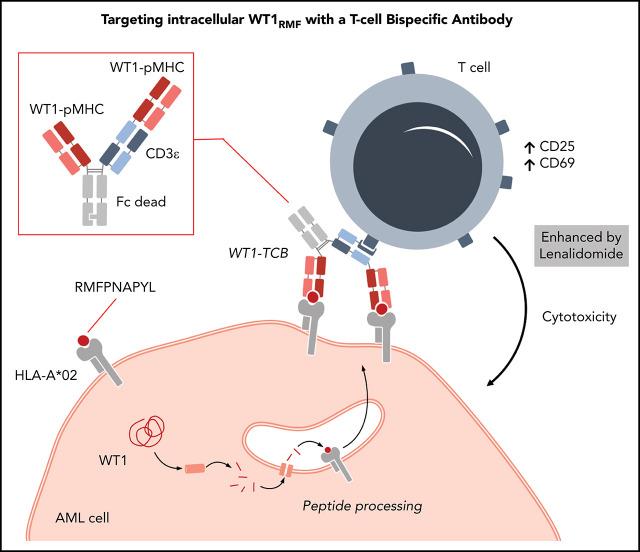
Antibody-based immunotherapy is a promising strategy for targeting chemoresistant leukemic cells. However, classical antibody-based approaches are restricted to targeting lineage-specific cell surface antigens. By targeting intracellular antigens, a large number of other leukemia-associated targets would become accessible. In this study, we evaluated a novel T-cell bispecific (TCB) antibody, generated by using CrossMAb and knob-into-holes technology, containing a bivalent T-cell receptor-like binding domain that recognizes the RMFPNAPYL peptide derived from the intracellular tumor antigen Wilms tumor protein (WT1) in the context of HLA-A02. Binding to CD3ε recruits T cells irrespective of their T-cell receptor specificity. WT1-TCB elicited antibody-mediated T-cell cytotoxicity against AML cell lines in a WT1- and HLA-restricted manner. Specific lysis of primary acute myeloid leukemia (AML) cells was mediated in ex vivo long-term cocultures by using allogeneic (mean ± standard error of the mean [SEM] specific lysis, 67 ± 6% after 13-14 days; n = 18) or autologous, patient-derived T cells (mean ± SEM specific lysis, 54 ± 12% after 11-14 days; n = 8). WT1-TCB-treated T cells exhibited higher cytotoxicity against primary AML cells than an HLA-A02 RMF-specific T-cell clone. Combining WT1-TCB with the immunomodulatory drug lenalidomide further enhanced antibody-mediated T-cell cytotoxicity against primary AML cells (mean ± SEM specific lysis on days 3-4, 45.4 ± 9.0% vs 70.8 ± 8.3%; P = .015; n = 9-10). In vivo, WT1-TCB-treated humanized mice bearing SKM-1 tumors exhibited a significant and dose-dependent reduction in tumor growth. In summary, we show that WT1-TCB facilitates potent in vitro, ex vivo, and in vivo killing of AML cell lines and primary AML cells; these results led to the initiation of a phase 1 trial in patients with relapsed/refractory AML (#NCT04580121).
基于抗体的免疫疗法是一种针对耐药性白血病细胞的有前途的策略。然而,经典的基于抗体的方法仅限于靶向谱系特异性细胞表面抗原。通过靶向细胞内抗原,可以使大量其他与白血病相关的靶点变得可及。在这项研究中,我们评估了一种新型 T 细胞双特异性 (TCB) 抗体,该抗体是使用 CrossMAb 和 knob-into-holes 技术生成的,包含一个二价 T 细胞受体样结合域,该结合域识别在 HLA-A02 背景下来源于细胞内肿瘤抗原 Wilms 肿瘤蛋白 (WT1) 的 RMFPNAPYL 肽。与 CD3ε 的结合招募 T 细胞,而与 T 细胞受体的特异性无关。WT1-TCB 以 WT1 和 HLA 限制的方式引发针对 AML 细胞系的抗体介导的 T 细胞细胞毒性。在体外长期共培养中,使用同种异体(均数 ± 标准误差 [SEM] 特异性裂解,13-14 天后为 67 ± 6%;n = 18)或自体、患者来源的 T 细胞(均数 ± SEM 特异性裂解,11-14 天后为 54 ± 12%;n = 8)介导对原发性急性髓系白血病(AML)细胞的特异性裂解。与 HLA-A02 RMF 特异性 T 细胞克隆相比,WT1-TCB 处理的 T 细胞对原发性 AML 细胞具有更高的细胞毒性。将 WT1-TCB 与免疫调节药物来那度胺联合使用进一步增强了抗体介导的 T 细胞对原发性 AML 细胞的细胞毒性(第 3-4 天的均数 ± SEM 特异性裂解,45.4 ± 9.0%对 70.8 ± 8.3%;P =.015;n = 9-10)。在体内,WT1-TCB 处理的携带 SKM-1 肿瘤的人源化小鼠表现出肿瘤生长的显著和剂量依赖性减少。总之,我们表明 WT1-TCB 促进 AML 细胞系和原发性 AML 细胞的强大体外、体外和体内杀伤;这些结果导致了复发/难治性 AML 患者的 1 期试验的启动(#NCT04580121)。
 Zotero 插件