Department of Animal Biosciences, Ontario Agricultural College, University of Guelph, Guelph, ON N1G 2W1, Canada; Campbell Centre for the Study of Animal Welfare, University of Guelph, Guelph, ON N1G 2W1, Canada.
Department of Food Science, Ontario Agricultural College, University of Guelph, Guelph, ON N1G 2W1, Canada.
Poult Sci. 2021 Sep;100(9):101309. doi: 10.1016/j.psj.2021.101309. Epub 2021 Jun 6.
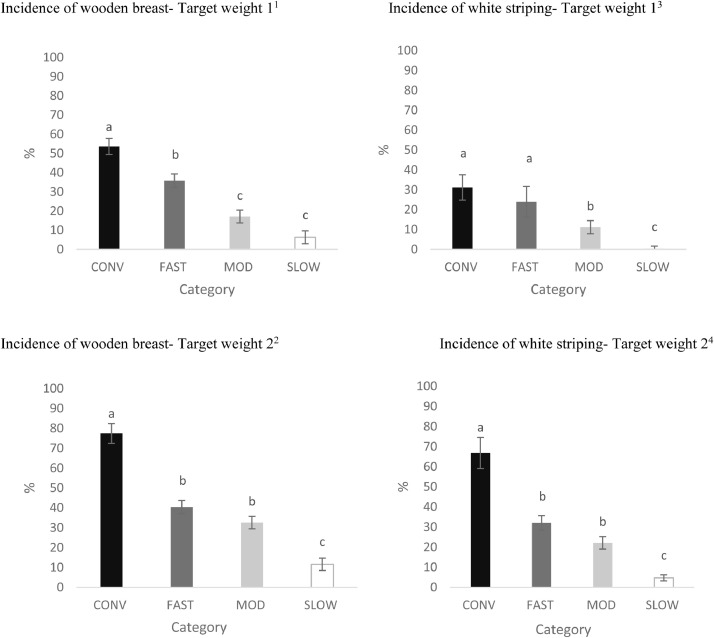
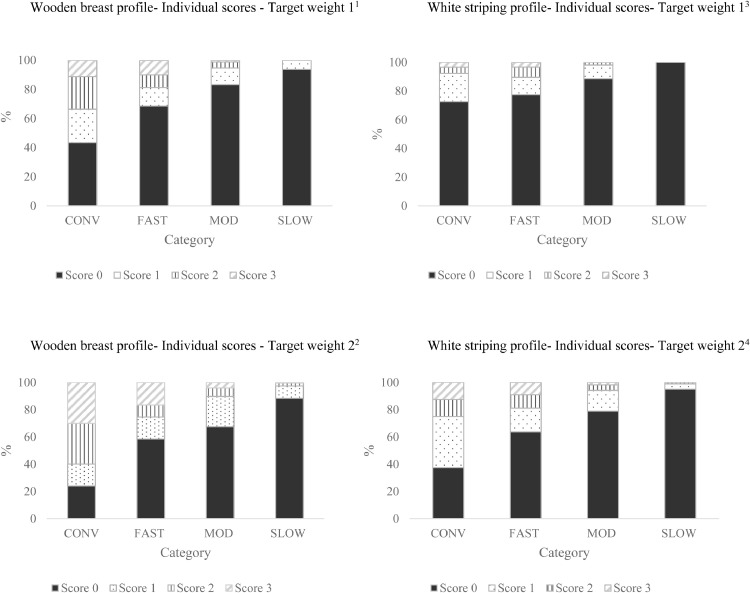
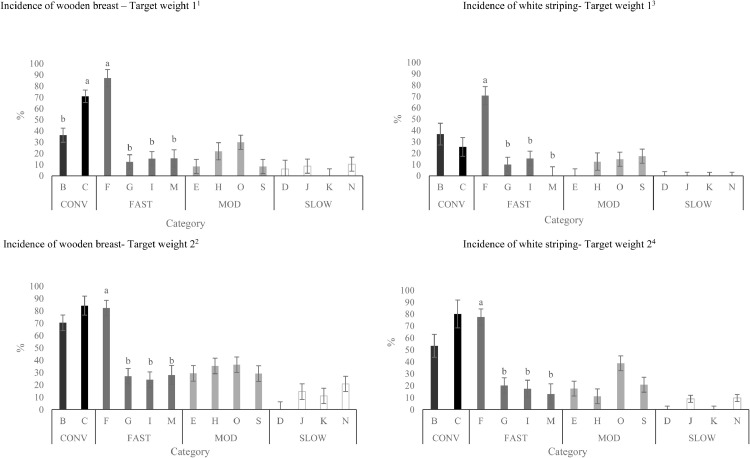
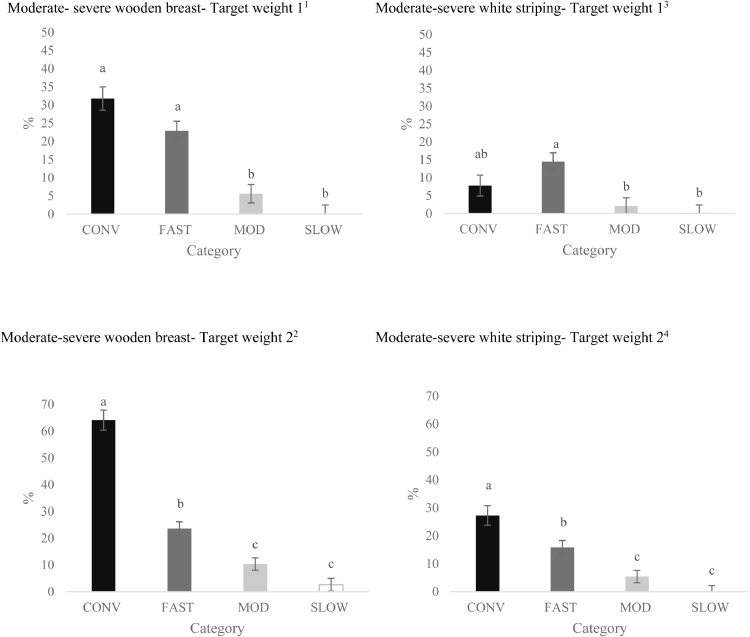
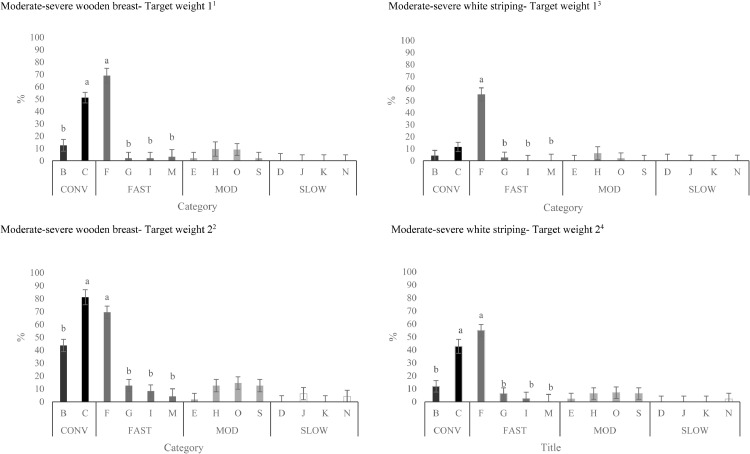
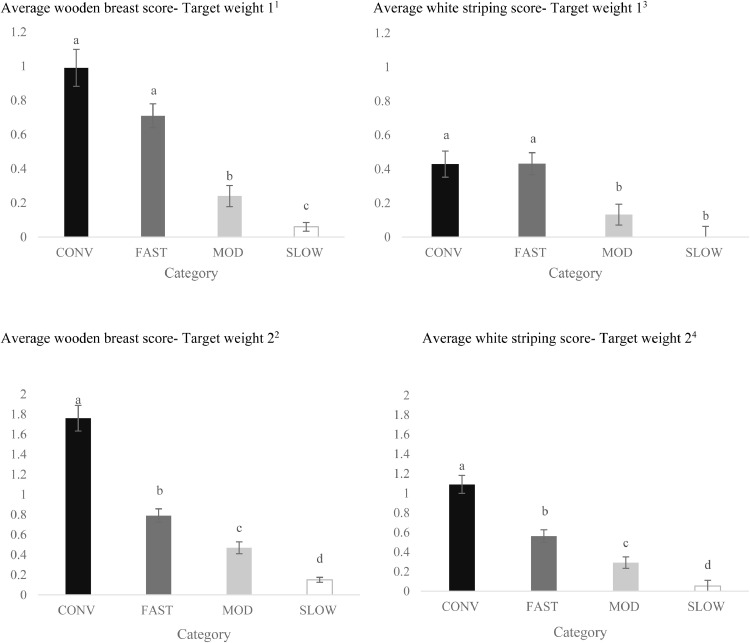
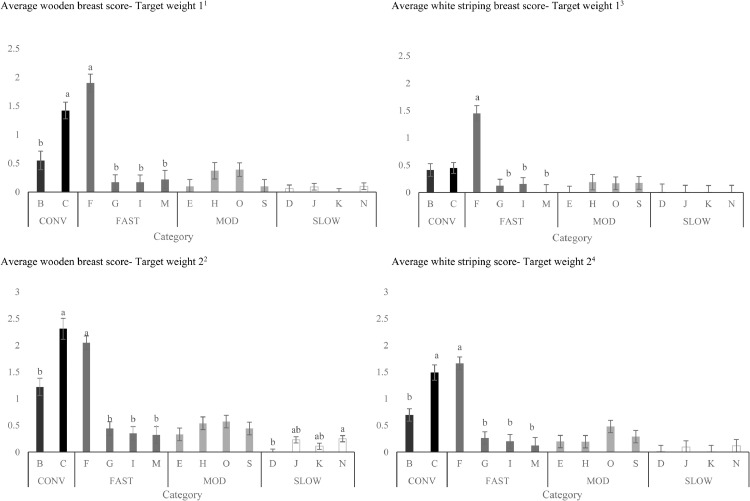
Selection for accelerated growth rate and high breast yield in broiler chickens have been associated with an increase in myopathies, including wooden breast (WB) and white striping (WS). To investigate effects of growth rate on carcass traits and incidence of myopathies, 14 strains were evaluated, encompassing 2 conventional (CONV; strains B and C: ADG > 60 g/d) and 12 slower-growing (SL) strains. The latter were categorized based on growth rate: FAST (strains F, G, I and M; ADG=53-55 g/d), MOD (strains E, H, O and S; ADG=50-51 g/d), and SLOW (strains D, J, K and N; ADG<50 g/d). In a randomized incomplete block design, 7,216 mixed-sex birds were equally allocated into 164 pens (44 birds/pen; 30 kg/m), with each strain represented in 8 to 12 pens over 2 to 3 production cycles. From each pen, 4 males and 4 females were processed at 2 Target Weights (TWs) based on their expected time to reach 2.1 kg BW (TW 1: 34 d for CONV; 48 d for SL strains) and 3.2 kg BW (TW 2: 48 d for CONV; 62 d for SL strains). Weights and yields for the carcass, breast, drumsticks, thighs, and wings were obtained; breast fillets were assessed to determine the presence and severity of WB and WS. At both TWs, breast yield was higher as growth rate increased (P < 0.001), with CONV having greater breast yield than other categories. Strain F had the greatest breast yield at both TWs (P < 0.001) within the FAST category. At TW 2, CONV had the greatest incidence of WB and WS (P < 0.001). However, within FAST, strain F had the greatest incidence of myopathies (P < 0.001) at both TWs, exhibiting values as high or as greater than CONV birds. The incidence of WB and WS in strains with differing growth rates but high breast meat yield suggests that the latter may play a major role in the occurrence of these myopathies.
选择生长速度快、产肉量高的肉鸡与肌病发生率的增加有关,包括胸肉坏死(WB)和白肌(WS)。为了研究生长速度对屠体性状和肌病发生率的影响,评估了 14 个品系,包括 2 个传统品系(CONV;品系 B 和 C:ADG>60g/d)和 12 个生长速度较慢的品系。后者根据生长速度进行分类:快速(品系 F、G、I 和 M;ADG=53-55g/d)、中速(品系 E、H、O 和 S;ADG=50-51g/d)和慢速(品系 D、J、K 和 N;ADG<50g/d)。在随机不完全区组设计中,7216 只混性别鸡被平均分配到 164 个栏(44 只/栏;30kg/m),每个品系在 2 到 3 个生产周期中代表 8 到 12 个栏。从每个栏中,选择 4 只雄性和 4 只雌性,根据它们达到 2.1kgBW 的预期时间(TW1:CONV 为 34d;SL 品系为 48d)和 3.2kgBW(TW2:CONV 为 48d;SL 品系为 62d),在 2 个目标体重(TW)下进行处理。获得屠体、胸部、鸡腿、大腿和翅膀的重量和产量;对胸肉进行评估,以确定 WB 和 WS 的存在和严重程度。在两个 TW 下,随着生长速度的增加,胸部产量增加(P<0.001),CONV 的胸部产量大于其他类别。在 FAST 类别中,品系 F 在两个 TW 下都具有最大的胸部产量(P<0.001)。在 TW2 时,CONV 的 WB 和 WS 发生率最高(P<0.001)。然而,在 FAST 中,品系 F 在两个 TW 下的肌病发生率最高(P<0.001),其值与 CONV 鸡相同或更高。具有不同生长速度但具有高胸肉产量的品系中 WB 和 WS 的发生率表明,后者可能在这些肌病的发生中起主要作用。