Clinical Epidemiology Program, Blueprint Translational Research Group, Ottawa Hospital Research Institute, 501 Smyth Road, PO Box 201B, Ottawa, Ontario K1H 8L6, Canada.
Clinical Epidemiology Program, Blueprint Translational Research Group, Ottawa Hospital Research Institute, 501 Smyth Road, PO Box 201B, Ottawa, Ontario K1H 8L6, Canada; School of Epidemiology and Public Health, University of Ottawa, Canada; Faculty of Medicine, University of Ottawa, Canada.
EBioMedicine. 2021 Aug;70:103484. doi: 10.1016/j.ebiom.2021.103484. Epub 2021 Jul 17.
'Patient engagement' involves meaningful collaboration between researchers and 'patient partners' to co-create research. It helps ensure that research being conducted is relevant to its ultimate end-users. Although patient engagement within clinical research has been well documented, the prevalence and effects of patient engagement in translational preclinical laboratory research remain unclear. The aim of this scoping review is to present current patient engagement activities reported in preclinical laboratory research.
MEDLINE, Embase, and grey literature were systematically searched from inception to April 2021. Studies that described or investigated patient engagement in preclinical laboratory research were included. Patient engagement activities where patients (i.e. patients, family members, caregivers or community members) provided input, or consultation on at least one element of the research process were eligible for inclusion. Study characteristics and outcomes were extracted and organized thematically.
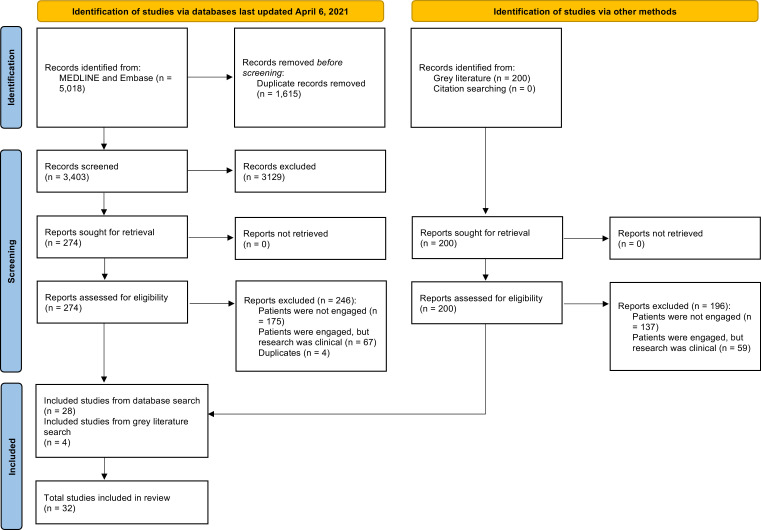
32 reports were included (30 primary studies, 1 narrative review, and 1 researcher guide). Most studies engaged patients at the education or priority setting stages (n=26). The most frequently reported benefit of patient engagement was 'providing a mutual learning opportunity'. Reported barriers to patient engagement reflected concerns around 'differences in knowledge and research experience' and how this may challenge communication and limit meaningful collaboration.
Patient engagement is feasible and beneficial for preclinical laboratory research. Future work should focus on assessing the impacts of patient engagement in this area of research.
None.
“患者参与”涉及研究人员与“患者伙伴”之间的有意义合作,共同开展研究。它有助于确保正在进行的研究与其最终的终端用户相关。尽管临床研究中的患者参与已经得到了充分的记录,但患者参与转化性临床前实验室研究的普遍性和影响仍不清楚。本综述的目的是介绍目前在临床前实验室研究中报告的患者参与活动。
从创建到 2021 年 4 月,系统地在 MEDLINE、Embase 和灰色文献中进行了搜索。纳入描述或调查临床前实验室研究中患者参与的研究。符合纳入标准的患者参与活动是指患者(即患者、家庭成员、照顾者或社区成员)至少对研究过程的一个要素提供投入或咨询。提取研究特征和结果,并进行主题组织。
共纳入 32 份报告(30 项原始研究、1 项叙述性综述和 1 项研究人员指南)。大多数研究在教育或优先设定阶段让患者参与(n=26)。患者参与的最常报告的益处是“提供共同学习的机会”。报告的患者参与障碍反映了对“知识和研究经验差异”的担忧,以及这如何挑战沟通并限制有意义的合作。
患者参与对于临床前实验室研究是可行且有益的。未来的工作应集中评估患者参与这一研究领域的影响。
无。