Cardiff University Brain Research Imaging Centre, School of Psychology, Cardiff University, UK; Biopsychology & Cognitive Neuroscience, Faculty of Psychology and Sports Science, Bielefeld University, Germany; Cognitive Neuroscience, Faculty of Biology, Bielefeld University, Germany.
Cardiff University Brain Research Imaging Centre, School of Psychology, Cardiff University, UK.
Cortex. 2021 Sep;142:221-236. doi: 10.1016/j.cortex.2021.03.033. Epub 2021 May 1.
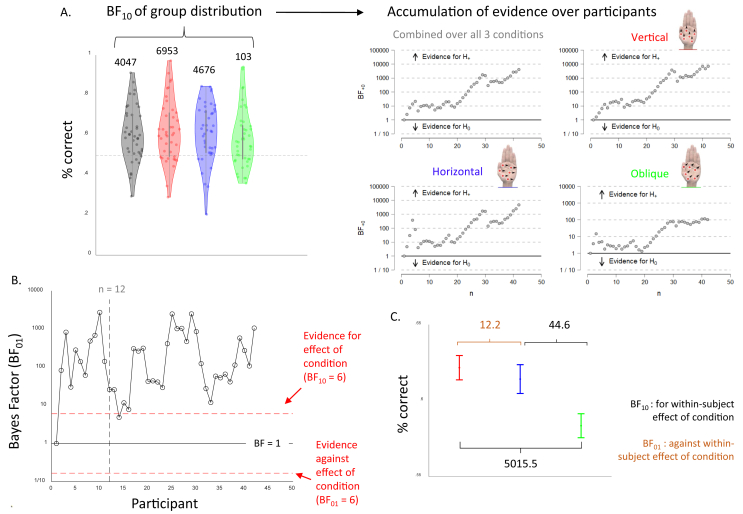
Many emerging technologies are attempting to leverage the tactile domain to convey complex spatiotemporal information translated directly from the visual domain, such as shape and motion. Despite the intuitive appeal of touch for communication, we do not know to what extent the hand can substitute for the retina in this way. Here we ask whether the tactile system can be used to perceive complex whole hand motion stimuli, and whether it exhibits the same kind of established perceptual biases as reported in the visual domain. Using ultrasound stimulation, we were able to project complex moving dot percepts onto the palm in mid-air, over 30 cm above an emitter device. We generated dot kinetogram stimuli involving motion in three different directional axes ('Horizontal', 'Vertical', and 'Oblique') on the ventral surface of the hand. Using Bayesian statistics, we found clear evidence that participants were able to discriminate tactile motion direction. Furthermore, there was a marked directional bias in motion perception: participants were both better and more confident at discriminating motion in the vertical and horizontal axes of the hand, compared to those stimuli moving obliquely. This pattern directly mirrors the perceptional biases that have been robustly reported in the visual field, termed the 'Oblique Effect'. These data demonstrate the existence of biases in motion perception that transcend sensory modality. Furthermore, we extend the Oblique Effect to a whole hand scale, using motion stimuli presented on the broad and relatively low acuity surface of the palm, away from the densely innervated and much studied fingertips. These findings highlight targeted ultrasound stimulation as a versatile method to convey potentially complex spatial and temporal information without the need for a user to wear or touch a device.
许多新兴技术都试图利用触觉领域来传递直接从视觉领域转化而来的复杂时空信息,例如形状和运动。尽管触摸在交流上具有直观的吸引力,但我们并不清楚手在多大程度上可以替代视网膜来实现这种功能。在这里,我们提出了一个问题:触觉系统是否可以用于感知复杂的整个手部运动刺激,以及它是否表现出与视觉领域中报告的相同类型的既定感知偏差。我们使用超声刺激,能够在发射器装置上方 30 厘米以上的半空中将复杂的运动点感知投射到手掌的表面上。我们在手的腹侧表面上生成涉及三个不同方向轴(“水平”、“垂直”和“倾斜”)的点运动图刺激。使用贝叶斯统计,我们发现有明确的证据表明参与者能够区分触觉运动方向。此外,运动感知存在明显的方向偏差:与那些倾斜运动的刺激相比,参与者在垂直和水平方向上的运动感知能力更强,并且更有信心进行区分。这种模式直接反映了在视觉领域中已经得到广泛报道的感知偏差,称为“倾斜效应”。这些数据表明,运动感知存在偏差,且这种偏差超越了感觉模态。此外,我们将倾斜效应扩展到整个手部规模,使用在手掌宽阔且相对低分辨率的表面上呈现的运动刺激,远离密集神经支配且研究较多的指尖。这些发现突出了靶向超声刺激作为一种灵活的方法,可以在无需用户佩戴或触摸设备的情况下传递潜在复杂的空间和时间信息。