Department of Ecology and Silviculture, Faculty of Forestry, University of Agriculture in Krakow, 29 Listopada 46, 31-425, Kraków, Poland.
Institute of Environmental Engineering, Polish Academy of Sciences, 34 M. Skłodowskiej-Curie St., 41-819, Zabrze, Poland.
Sci Rep. 2021 Jul 19;11(1):14708. doi: 10.1038/s41598-021-94299-x.
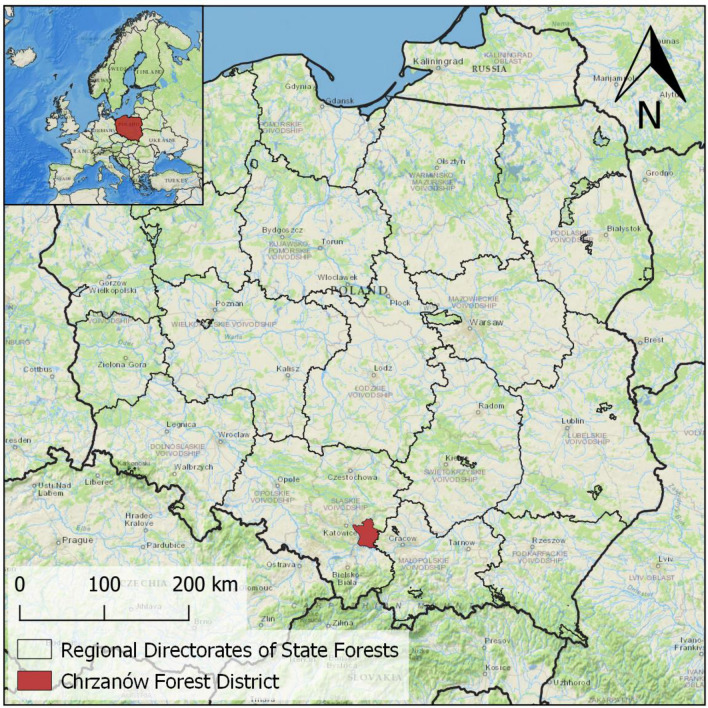
Due to the dynamic development of civilization and the increasing demand for energy, pollution by harmful chemicals, including polycyclic aromatic hydrocarbons (PAHs) compounds, is a serious threat to forest soils. The aim of the study was to determine the role of texture in the distribution of polycyclic aromatic hydrocarbons (PAHs) and trace elements in forest soils. The areas with different texture ranging from sand through sandy loam to silt loam were selected for the study. The study was carried out in the Chrzanów Forest District in southern Poland (50° 7' 18 N; 19° 31' 29 E), which in one of the most intensive industrial emission zones in Europe. The soil samples for properties determination were collected from locations distributed on a regular grid 100 × 100 m (20 points). The samples were collected from the humus horizon (0-10 cm) after removing organic horizon. Basic chemical properties, heavy metal content, polycyclic aromatic hydrocarbons (PAHs) content and magnetic susceptibility values were determined in soil samples. Additionally, enzymatic activity and microbiological biomass was determined in the samples. Our study confirmed the importance of texture in PAHs distribution. A strong correlation between PAHs content and silt content in the soils studied was noted. The regression tree analysis confirmed the importance of the silt content, followed by soil organic carbon in PAHs distribution. Organic carbon content and nitrogen content played a predominant role in controlling the microbial activity. In our study, we did not note a relationship between enzymatic activity, microbiological soil biomass and the amount of PAHs. This may be due to the effective sorption and immobilization of PAHs by particles of fine fractions, especially silt. Obtained results confirmed the usefulness of magnetic susceptibility in the assessment of heavy metals contamination of forest soils. We noted high correlation between magnetic susceptibility value and heavy metals content. Moreover, the relationship between magnetic susceptibility and soil texture of the topsoil was also observed.
由于文明的动态发展和对能源的需求不断增加,包括多环芳烃(PAHs)化合物在内的有害化学物质的污染对森林土壤构成了严重威胁。本研究的目的是确定质地在森林土壤中多环芳烃(PAHs)和微量元素分布中的作用。为此选择了质地从沙到沙壤土再到粉壤土的不同区域进行研究。该研究在波兰南部的赫龙诺夫森林地区(50°7'18 N;19°31'29 E)进行,该地区是欧洲污染最严重的工业区之一。为了确定特性,从分布在规则网格 100×100 m(20 个点)上的位置采集了用于性质测定的土壤样本。这些样本是从腐殖质层(0-10 厘米)中采集的,采集时去除了有机层。在土壤样本中测定了基本化学性质、重金属含量、多环芳烃(PAHs)含量和磁化率值。此外,还测定了样本中的酶活性和微生物生物量。我们的研究证实了质地在 PAHs 分布中的重要性。在所研究的土壤中,PAHs 含量与粉砂含量之间存在很强的相关性。回归树分析证实了粉砂含量在 PAHs 分布中的重要性,其次是土壤有机碳。有机碳含量和氮含量在控制微生物活性方面发挥了主要作用。在我们的研究中,我们没有注意到酶活性、微生物土壤生物量与 PAHs 含量之间存在关系。这可能是由于细颗粒(尤其是粉砂)对 PAHs 的有效吸附和固定。所得结果证实了磁化率在评估森林土壤重金属污染方面的有用性。我们注意到磁化率值与重金属含量之间存在高度相关性。此外,还观察到磁化率与表土质地之间的关系。