Moghimi Elnaz, Davis Caroline, Rotondi Michael
School of Kinesiology and Health Science, Faculty of Health, York University, Toronto, ON, Canada.
J Med Internet Res. 2021 Jul 20;23(7):e17874. doi: 10.2196/17874.
There has been a recent rise in the use of eHealth treatments for a variety of psychological disorders, including eating disorders.
This meta-analysis of randomized controlled trials is the first to evaluate the efficacy of eHealth interventions specifically for the treatment of binge eating disorder (characterized by compulsive overconsumption of food, in a relatively short period, and without compensatory behaviors such as purging or fasting).
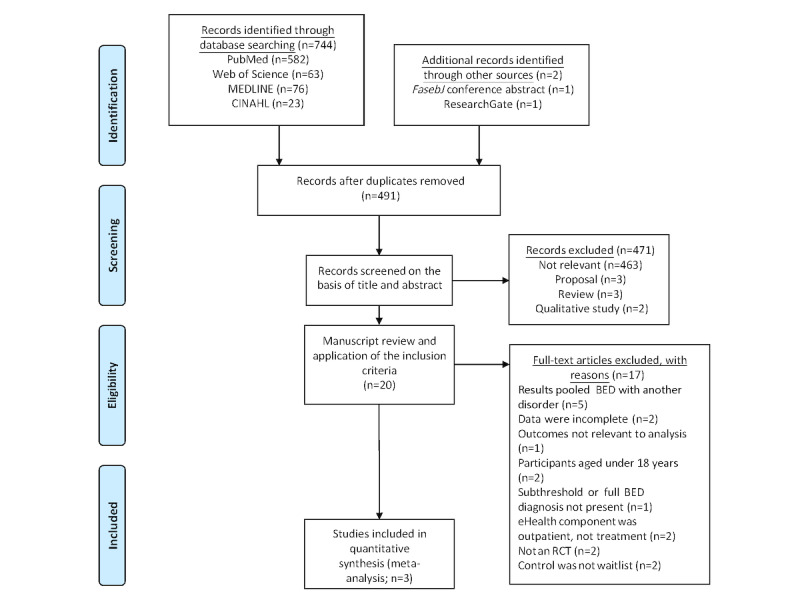
A search on the electronic databases PubMed, Web of Science, Embase, MEDLINE, and CINAHL was conducted for randomized controlled trials that compared the efficacy of eHealth treatment interventions with waitlist controls.
From the databases searched, 3 studies (298 participants in total) met the inclusion criteria. All interventions were forms of internet-based guided cognitive behavioral therapy. The results of the analysis demonstrated that when compared with waitlist controls, individuals enrolled in eHealth interventions experienced a reduction in objective binge episodes (standardized mean difference [SMD] -0.77, 95% CI -1.38 to -0.16) and eating disorder psychopathology (SMD -0.71, 95% CI -1.20 to -0.22), which included shape (SMD -0.61, 95% CI -1.01 to -0.22) and weight concerns (SMD -0.91, 95% CI -1.33 to -0.48). There was no significant difference in BMI between the eHealth interventions and controls (SMD -0.01, 95% CI -0.40 to 0.39).
These findings provide promising results for the use of internet-based cognitive behavioral therapy for binge eating disorder treatment and support the need for future research to explore the efficacy of these eHealth interventions.
近期,电子健康疗法在包括饮食失调在内的多种心理障碍治疗中的应用有所增加。
这项随机对照试验的荟萃分析首次评估了电子健康干预措施专门用于治疗暴饮暴食症(其特征为在相对较短的时间内强迫性过度进食,且无催吐或禁食等代偿行为)的疗效。
在电子数据库PubMed、科学网、Embase、MEDLINE和CINAHL中检索随机对照试验,比较电子健康治疗干预措施与候补对照组的疗效。
在所检索的数据库中,有3项研究(共298名参与者)符合纳入标准。所有干预措施均为基于互联网的指导性认知行为疗法形式。分析结果表明,与候补对照组相比,接受电子健康干预的个体在客观暴饮暴食发作次数(标准化均数差[SMD] -0.77,95%置信区间 -1.38至 -0.16)和饮食失调精神病理学(SMD -0.71,95%置信区间 -1.20至 -0.22)方面有所减少,其中包括对体型(SMD -0.61,95%置信区间 -1.01至 -0.22)和体重的担忧(SMD -0.91,95%置信区间 -1.33至 -0.48)。电子健康干预措施与对照组之间的体重指数无显著差异(SMD -0.01,95%置信区间 -0.40至0.39)。
这些发现为基于互联网的认知行为疗法用于治疗暴饮暴食症提供了有前景的结果,并支持未来开展研究以探索这些电子健康干预措施疗效的必要性。