Mi Yao, Ma Yufei
National Key Laboratory of Science and Technology on Tunable Laser, Harbin Institute of Technology, Harbin 150001, China.
Sensors (Basel). 2021 Jul 2;21(13):4548. doi: 10.3390/s21134548.
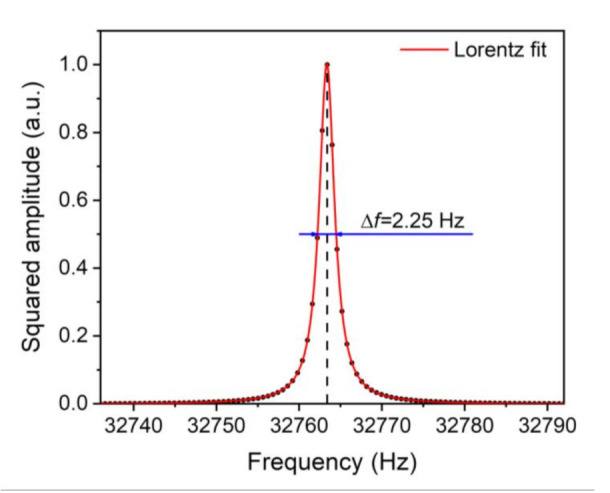
This invited paper demonstrated an ultra-highly sensitive ammonia (NH) sensor based on the light-induced thermoelastic spectroscopy (LITES) technique for the first time. A quartz tuning fork (QTF) with a resonance frequency of 32.768 kHz was employed as a detector. A fiber-coupled, continuous wave (CW), distributed feedback (DFB) diode laser emitting at 1530.33 nm was chosen as the excitation source. Wavelength modulation spectroscopy (WMS) and second-harmonic (2) detection techniques were applied to reduce the background noise. In a one scan period, a 2 signal of the two absorption lines located at 6534.6 cm and 6533.4 cm were acquired simultaneously. The 2 signal amplitude at the two absorption lines was proved to be proportional to the concentration, respectively, by changing the concentration of NH in the analyte. The calculated R-square values of the linear fit are equal to ~0.99. The wavelength modulation depth was optimized to be 13.38 mA, and a minimum detection limit (MDL) of ~5.85 ppm was achieved for the reported NH sensor.
这篇特邀论文首次展示了一种基于光致热弹性光谱(LITES)技术的超高灵敏度氨(NH)传感器。采用了一个共振频率为32.768 kHz的石英音叉(QTF)作为探测器。选择了一个在1530.33 nm处发射的光纤耦合连续波(CW)分布反馈(DFB)二极管激光器作为激发源。应用波长调制光谱(WMS)和二次谐波(2f)检测技术来降低背景噪声。在一个扫描周期内,同时获取位于6534.6 cm⁻¹和6533.4 cm⁻¹处的两条吸收线的二次谐波信号。通过改变分析物中NH的浓度,证明两条吸收线处的二次谐波信号幅度分别与浓度成正比。线性拟合计算得到的R²值约等于0.99。波长调制深度优化为13.38 mA,所报道的NH传感器实现了约5.85 ppm的最低检测限(MDL)。