Chair for Electrical Instrumentation and Embedded Systems, Department of Microsystems Engineering-IMTEK, University of Freiburg, Georges-Köhler-Allee 103, 79110 Freiburg, Germany.
Sensors (Basel). 2021 Jul 5;21(13):4599. doi: 10.3390/s21134599.
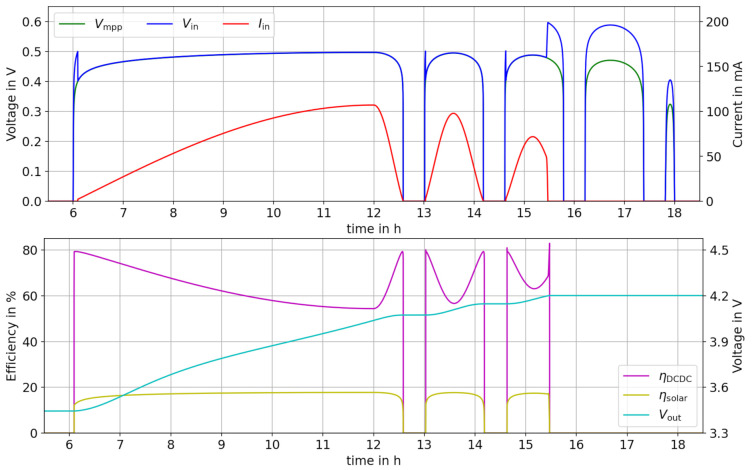
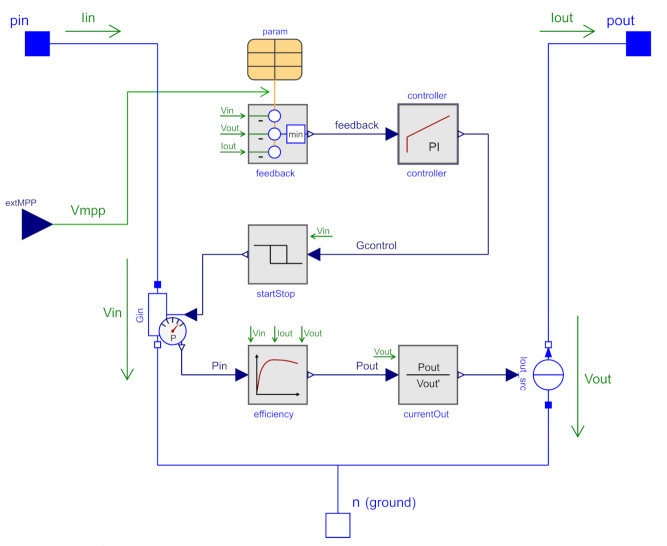
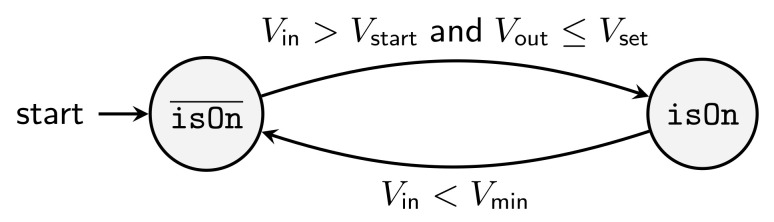
DC/DC converters are the essential component of power management in applications such as self-powered systems. Their simulation plays an important role in the configuration, analysis and design. A major drawback is the lack of behavioral models for DC/DC converters for long-term simulations (days or months). Available models are cycle-to-cycle-based due to the switch-mode nature of the converters and are therefore not applicable. In this work, we present a new behavioral model of a DC/DC power converter. The model is based on a thorough discussion of the model aspects that are relevant for self-powered systems, such as electrical representation and the causal connection if input and output. The model implementation is shown in the Modelica language and is available as an open-source library. The highlights of the model are a feedback controller for operation at the maximum power point (MPP), a loss-based efficiency function, and the start/stop behavior. The model's capabilities are demonstrated in a 24h-experiment to predict voltage levels and the conversion efficiency.
DC/DC 转换器是自供电系统等应用中电源管理的重要组成部分。它们的仿真在配置、分析和设计中起着重要作用。一个主要的缺点是,缺乏用于长期仿真(数天或数月)的 DC/DC 转换器的行为模型。由于转换器的开关模式性质,可用的模型是基于周期到周期的,因此不适用。在这项工作中,我们提出了一种新的 DC/DC 电源转换器的行为模型。该模型基于对与自供电系统相关的模型方面的深入讨论,例如电表示和输入和输出之间的因果关系。模型实现以 Modelica 语言展示,并作为开源库提供。该模型的亮点包括用于最大功率点 (MPP) 操作的反馈控制器、基于损耗的效率函数以及启动/停止行为。该模型的功能在 24 小时实验中得到了验证,以预测电压水平和转换效率。