The Centre of Inflammation and Metabolism and the Centre for Physical Activity Research, Rigshospitalet, University of Copenhagen, Blegdamsvej 9, 2100, Copenhagen, Denmark.
Department of Growth and Reproduction, Copenhagen University Hospital, Rigshospitalet, Copenhagen, Denmark.
Sci Rep. 2021 Jul 20;11(1):14750. doi: 10.1038/s41598-021-94189-2.
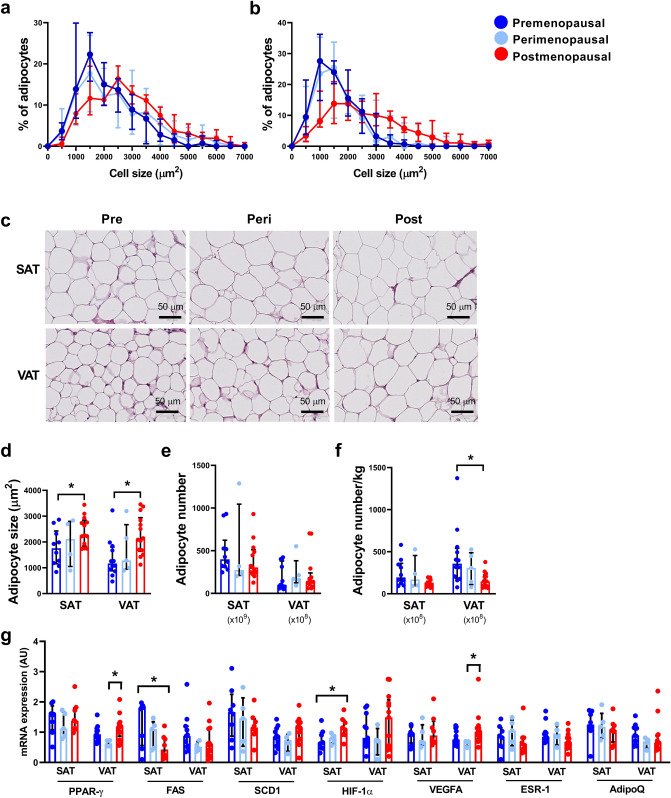
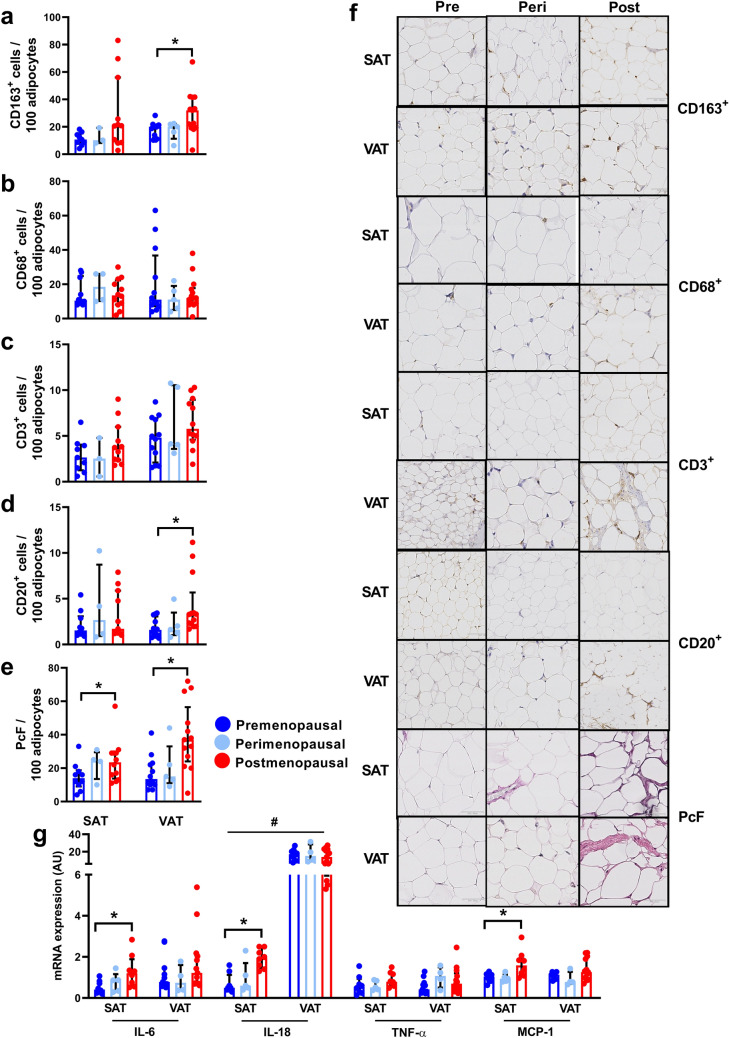
Menopause is associated with a redistribution of adipose tissue towards central adiposity, known to cause insulin resistance. In this cross-sectional study of 33 women between 45 and 60 years, we assessed adipose tissue inflammation and morphology in subcutaneous adipose tissue (SAT) and visceral adipose tissue (VAT) across menopause and related this to menopausal differences in adipose tissue distribution and insulin resistance. We collected paired SAT and VAT biopsies from all women and combined this with anthropometric measurements and estimated whole-body insulin sensitivity. We found that menopause was associated with changes in adipose tissue phenotype related to metabolic dysfunction. In SAT, postmenopausal women showed adipocyte hypertrophy, increased inflammation, hypoxia and fibrosis. The postmenopausal changes in SAT was associated with increased visceral fat accumulation. In VAT, menopause was associated with adipocyte hypertrophy, immune cell infiltration and fibrosis. The postmenopausal changes in VAT phenotype was associated with decreased insulin sensitivity. Based on these findings we suggest, that menopause is associated with changes in adipose tissue phenotype related to metabolic dysfunction in both SAT and VAT. Whereas increased SAT inflammation in the context of menopause is associated with VAT accumulation, VAT morphology is related to insulin resistance.
绝经与脂肪组织向中心性肥胖的重新分布有关,已知这会导致胰岛素抵抗。在这项对 33 名 45 至 60 岁女性的横断面研究中,我们评估了绝经前后皮下脂肪组织 (SAT) 和内脏脂肪组织 (VAT) 中的脂肪组织炎症和形态,并将其与脂肪组织分布和胰岛素抵抗的绝经差异相关联。我们从所有女性中采集了配对的 SAT 和 VAT 活检,并将其与人体测量学测量和估计的全身胰岛素敏感性相结合。我们发现,绝经与与代谢功能障碍相关的脂肪组织表型变化有关。在 SAT 中,绝经后女性表现出脂肪细胞肥大、炎症增加、缺氧和纤维化。SAT 中的绝经后变化与内脏脂肪堆积增加有关。在 VAT 中,绝经与脂肪细胞肥大、免疫细胞浸润和纤维化有关。VAT 表型的绝经后变化与胰岛素敏感性降低有关。基于这些发现,我们认为,绝经与 SAT 和 VAT 中与代谢功能障碍相关的脂肪组织表型变化有关。而绝经时 SAT 炎症增加与 VAT 堆积有关,VAT 形态与胰岛素抵抗有关。