Hannover Medical School, Department of Conservative Dentistry, Periodontology and Preventive Dentistry, Hannover, Germany.
GMS J Med Educ. 2021 Jun 15;38(5):Doc89. doi: 10.3205/zma001485. eCollection 2021.
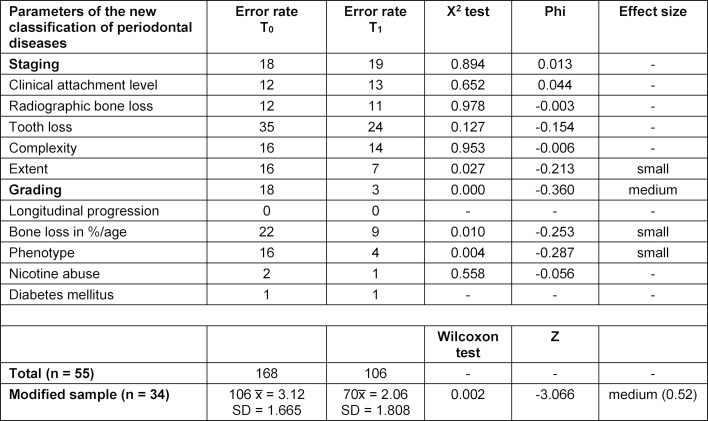
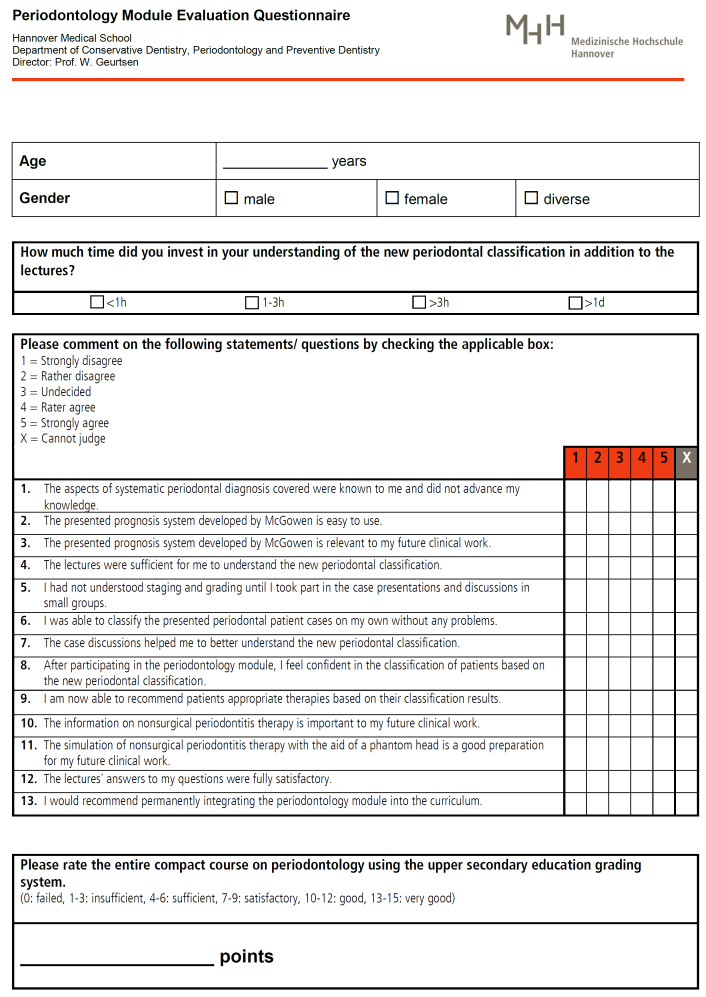
Due to the need for patient-free dental education during the COVID-19 pandemic, Hannover Medical School (MHH) implemented a new periodontology module. Its didactic structure was based on the "inverted classroom model" (ICM) in combination with elements of case-based learning. The educational objective was to increase the diagnostic confidence of dental students in the classification of periodontal patients (staging & grading), based on 33 digitized patient cases. To assess the suitability of the module for future dental curricula, this study aimed to evaluate student satisfaction and skills acquisition. The periodontology module, which was attended by final year dental students of MHH (n=55, mean age: 26.5±3.9 years, male/female ratio: 24.1%/75.9%) was evaluated in a two-tiered way. Student satisfaction was recorded using a questionnaire. Learning success was assessed by comparing error rates in patient case classifications before (T) and after (T) participation in the periodontology module. The study found a high level of student satisfaction with the ICM format and a significant reduction in error rates (T error rate=28.3%; MV±SD=3.12±1.67 vs. T error rate=18.7%; MV±SD=2.06±1.81; Δ=9.6%). However, of the 11 diagnostic decisions required, only four parameters (extent, grading, percentage of bone loss per age, phenotype) showed significant improvements, with effect sizes ranging from small to medium. The ICM-based teaching concept is definitely not an alternative to patient-based learning. However, in regard to student satisfaction and learning success, it might be superior to conventional classroom-based lectures, especially when complex topics are covered. In summary, the newly developed periodontology module may be a useful addition to traditional dental education in future curricula, even for the time after the COVID-19 pandemic.
由于在 COVID-19 大流行期间需要进行无患者的牙科教育,汉诺威医学院 (MHH) 实施了一个新的牙周病学模块。其教学结构基于“颠倒课堂模式”(ICM),结合了基于案例的学习元素。教育目标是基于 33 个数字化的患者病例,提高牙科学生对牙周病患者(分期和分级)的诊断信心。为了评估该模块对未来牙科课程的适用性,本研究旨在评估学生的满意度和技能习得。该牙周病模块由 MHH 的最后一年牙科学生(n=55,平均年龄:26.5±3.9 岁,男女比例:24.1%/75.9%)参加,并采用双层评估方法进行评估。学生满意度通过问卷记录。学习成功通过比较参与牙周病模块前后(T)患者病例分类中的错误率来评估。研究发现,学生对 ICM 格式的满意度很高,错误率显著降低(T 错误率=28.3%;MV±SD=3.12±1.67 与 T 错误率=18.7%;MV±SD=2.06±1.81;Δ=9.6%)。然而,在所需要的 11 个诊断决策中,只有 4 个参数(程度、分级、按年龄计算的骨丢失百分比、表型)显示出显著改善,其效应大小从小到大不等。基于 ICM 的教学概念肯定不能替代基于患者的学习。然而,就学生满意度和学习成功而言,它可能优于传统的课堂讲座,尤其是在涉及复杂主题时。总之,新开发的牙周病模块可能是未来课程中传统牙科教育的有用补充,即使在 COVID-19 大流行之后也是如此。