Al-Tamimi A A
Industrial Engineering Department, College of Engineering, King Saud University, Riyadh 11421 Saudi Arabia.
Int J Bioprint. 2021 Jul 1;7(3):339. doi: 10.18063/ijb.v7i3.339. eCollection 2021.
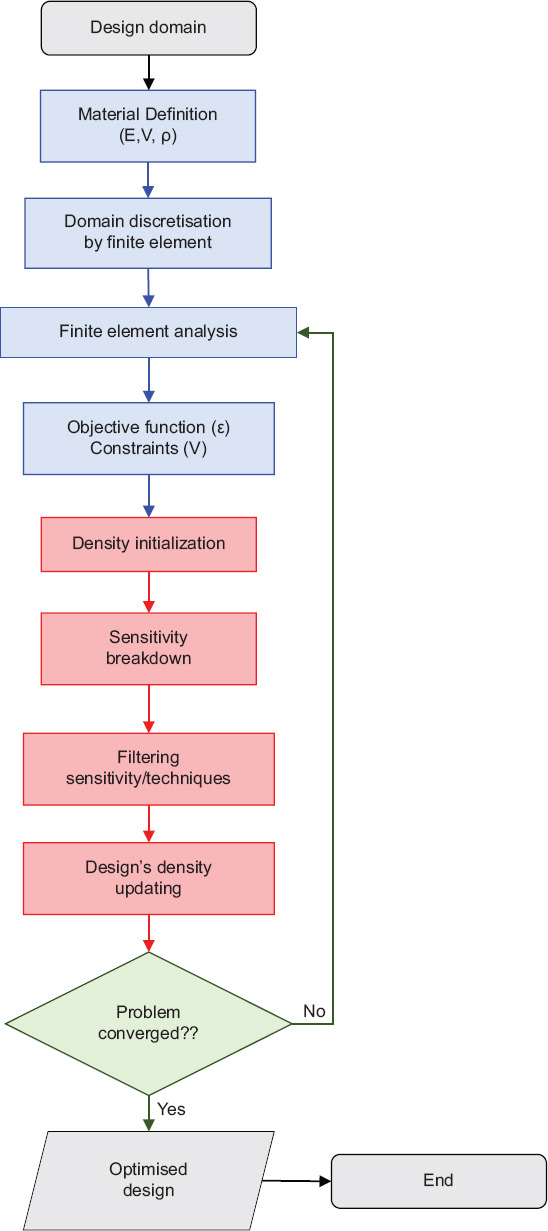
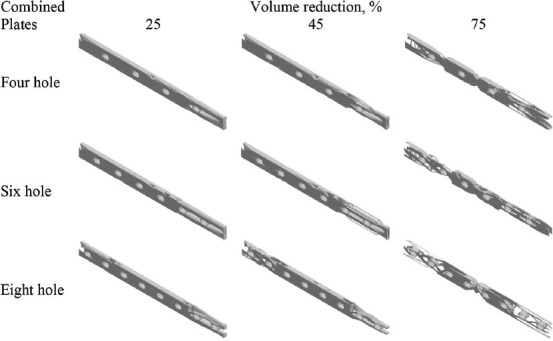
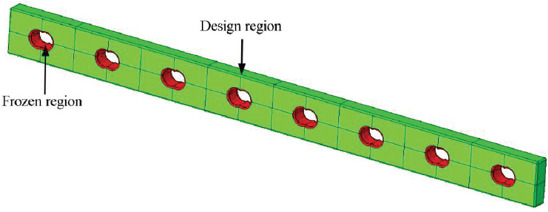
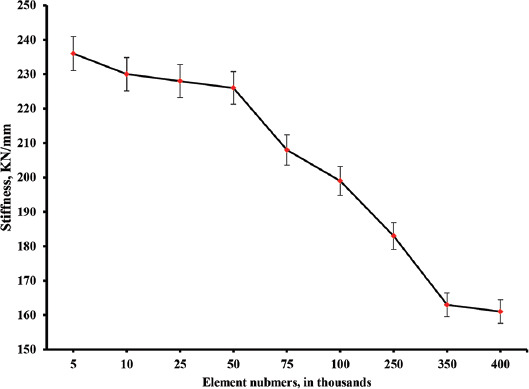
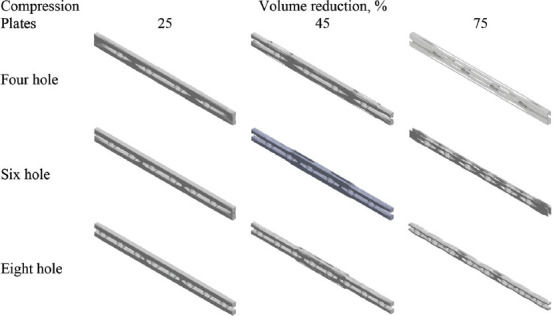
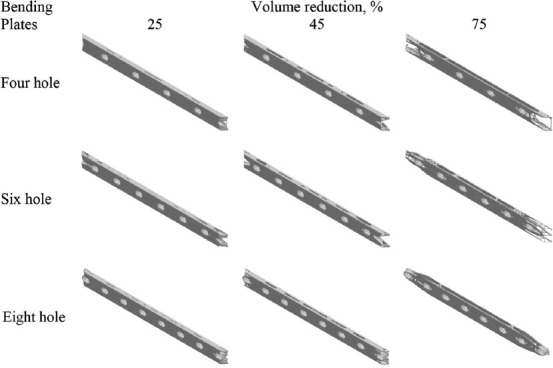
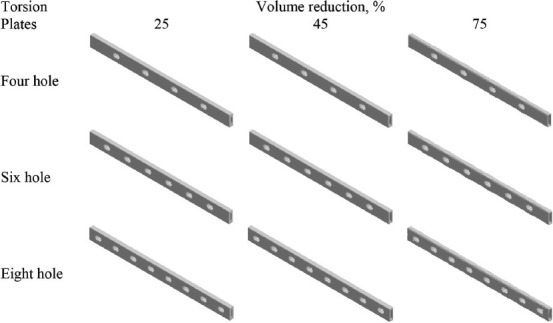
Current fixation plates for bone fracture treatments are built with biocompatible metallic materials such as stainless steel, titanium, and its alloys (e.g., Ti6Al4V). The stiffness mismatch between the metallic material of the plate and the host bone leads to stress shielding phenomena, bone loss, and healing deficiency. This paper explores the use of three dimensional topology-optimization, based on compliance (i.e., strain energy) minimization, reshaping the design domain of three locking compression plates (four-screw holes, six-screw holes, and eight-screw holes), considering different volume reductions (25, 45, and 75%) and loading conditions (bending, compression, torsion, and combined loads). A finite-element study was also conducted to measure the stiffness of each optimized plate. Thirty-six designs were obtained. Results showed that for a critical value of volume reductions, which depend on the load condition and number of screws, it is possible to obtain designs with lower stiffness, thereby reducing the risk of stress shielding.
目前用于骨折治疗的固定钢板是由不锈钢、钛及其合金(如Ti6Al4V)等生物相容性金属材料制成的。钢板的金属材料与宿主骨之间的刚度不匹配会导致应力遮挡现象、骨质流失和愈合不足。本文基于柔度(即应变能)最小化,探索使用三维拓扑优化方法,对三种锁定加压钢板(四螺孔、六螺孔和八螺孔)的设计域进行重塑,考虑不同的体积缩减率(25%、45%和75%)和加载条件(弯曲、压缩、扭转和组合载荷)。还进行了有限元研究以测量每个优化钢板的刚度。共获得了36种设计。结果表明,对于取决于载荷条件和螺钉数量的临界体积缩减值,可以获得刚度较低的设计,从而降低应力遮挡的风险。