Department of Neurology, Rheinisch-Westfälische Techische Hochschule (RWTH) Aachen University, Aachen, Germany.
Jülich Aachen Research Alliance (JARA)-BRAIN Institute of Molecular Neuroscience and Neuroimaging, Research Center Jülich and RWTH Aachen University, Aachen, Germany.
Ann Neurol. 2021 Oct;90(4):627-639. doi: 10.1002/ana.26172. Epub 2021 Aug 23.
We aimed to estimate the incidence of cerebral sinus and venous thrombosis (CVT) within 1 month from first dose administration and the frequency of vaccine-induced immune thrombotic thrombocytopenia (VITT) as the underlying mechanism after vaccination with BNT162b2, ChAdOx1, and mRNA-1273, in Germany.
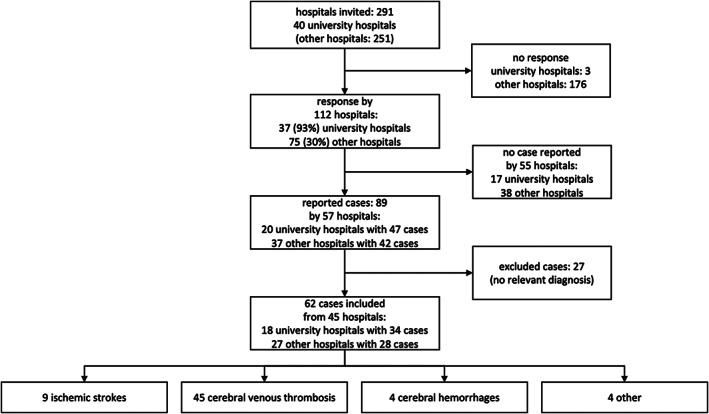
A web-based questionnaire was e-mailed to all departments of neurology. We requested a report of cases of CVT occurring within 1 month of a COVID-19 vaccination. Other cerebral events could also be reported. Incidence rates of CVT were calculated by using official statistics of 9 German states.
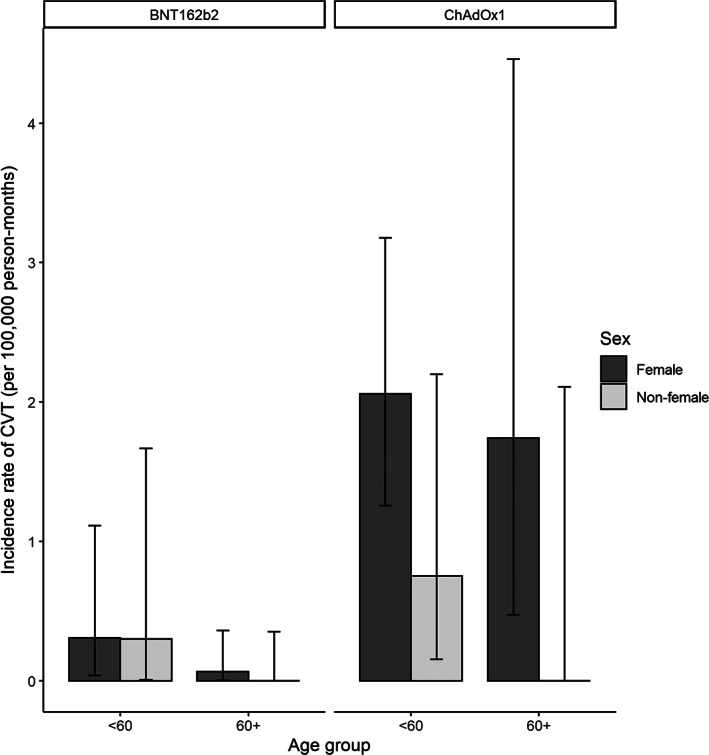
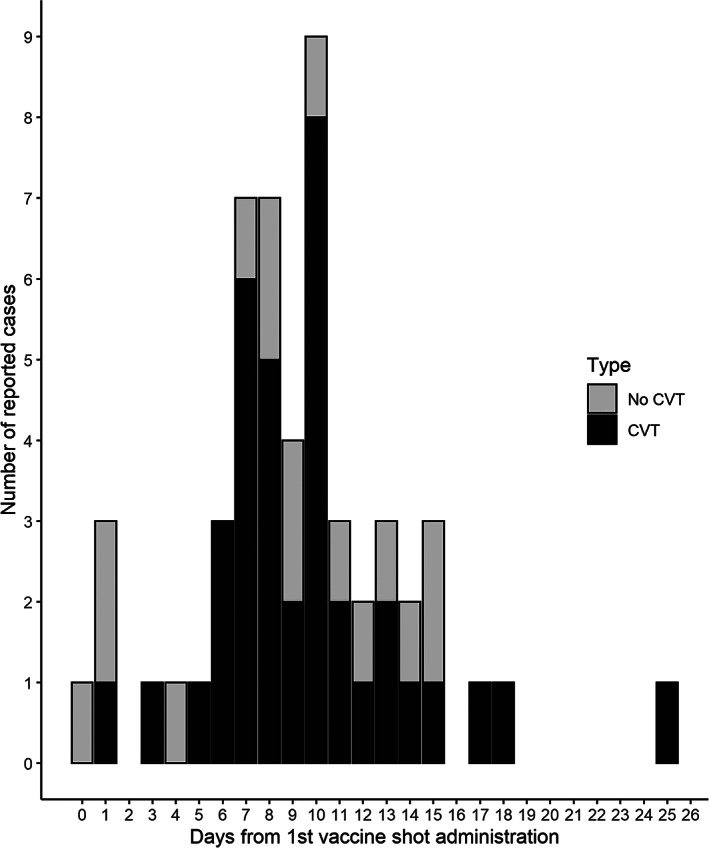
A total of 45 CVT cases were reported. In addition, 9 primary ischemic strokes, 4 primary intracerebral hemorrhages, and 4 other neurological events were recorded. Of the CVT patients, 35 (77.8%) were female, and 36 (80.0%) were younger than 60 years. Fifty-three events were observed after vaccination with ChAdOx1 (85.5%), 9 after BNT162b2 (14.5%) vaccination, and none after mRNA-1273 vaccination. After 7,126,434 first vaccine doses, the incidence rate of CVT within 1 month from first dose administration was 0.55 (95% confidence interval [CI] = 0.38-0.78) per 100,000 person-months (which corresponds to a risk of CVT within the first 31 days of 0.55 per 100,000 individuals) for all vaccines and 1.52 (95% CI = 1.00-2.21) for ChAdOx1 (after 2,320,535 ChAdOx1 first doses). The adjusted incidence rate ratio was 9.68 (95% CI = 3.46-34.98) for ChAdOx1 compared to mRNA-based vaccines and 3.14 (95% CI = 1.22-10.65) for females compared to non-females. In 26 of 45 patients with CVT (57.8%), VITT was graded highly probable.
Given an incidence of 0.02 to 0.15 per 100,000 person-months for CVT in the general population, these findings point toward a higher risk for CVT after ChAdOx1 vaccination, especially for women. ANN NEUROL 2021;90:627-639.
我们旨在评估德国首次接种 BNT162b2、ChAdOx1 和 mRNA-1273 疫苗后 1 个月内发生脑窦和静脉血栓形成(CVT)的发生率以及作为潜在机制的疫苗诱导免疫性血栓性血小板减少症(VITT)的频率。
通过电子邮件向所有神经科部门发送了一份基于网络的调查问卷。我们要求报告 COVID-19 疫苗接种后 1 个月内发生的 CVT 病例。也可以报告其他脑部事件。通过德国 9 个州的官方统计数据计算 CVT 的发病率。
共报告了 45 例 CVT 病例。此外,还记录了 9 例原发性缺血性中风、4 例原发性脑出血和 4 例其他神经事件。在 CVT 患者中,35 例(77.8%)为女性,36 例(80.0%)年龄小于 60 岁。53 例发生在接种 ChAdOx1 后(85.5%),9 例发生在接种 BNT162b2 后(14.5%),没有发生在接种 mRNA-1273 后。在接种了 7126434 剂首剂疫苗后,首次接种后 1 个月内的 CVT 发病率为每 100000 人月 0.55(95%置信区间[CI] = 0.38-0.78),这相当于所有疫苗接种后每 100000 人 31 天内 CVT 的风险为 0.55 ,ChAdOx1 为 1.52(95%CI = 1.00-2.21)(在接种了 2320535 剂 ChAdOx1 后)。与基于 mRNA 的疫苗相比,ChAdOx1 的调整发病率比为 9.68(95%CI = 3.46-34.98),与女性相比,非女性的发病率比为 3.14(95%CI = 1.22-10.65)。在 45 例 CVT 患者中(57.8%),有 26 例高度怀疑为 VITT。
鉴于普通人群中 CVT 的发病率为每 100000 人月 0.02 至 0.15,这些发现表明接种 ChAdOx1 后 CVT 的风险更高,尤其是对于女性。ANN NEUROL 2021;90:627-639。