Liu Jiuyang, Geng Xiafei, Hou Jinxuan, Wu Gaosong
Department of Thyroid and Breast Surgery, Zhongnan Hospital of Wuhan University, Wuhan, China.
Department of Ultrasound Imaging, Hubei Cancer Hospital, Wuhan, China.
Cancer Cell Int. 2021 Jul 21;21(1):389. doi: 10.1186/s12935-021-02089-2.
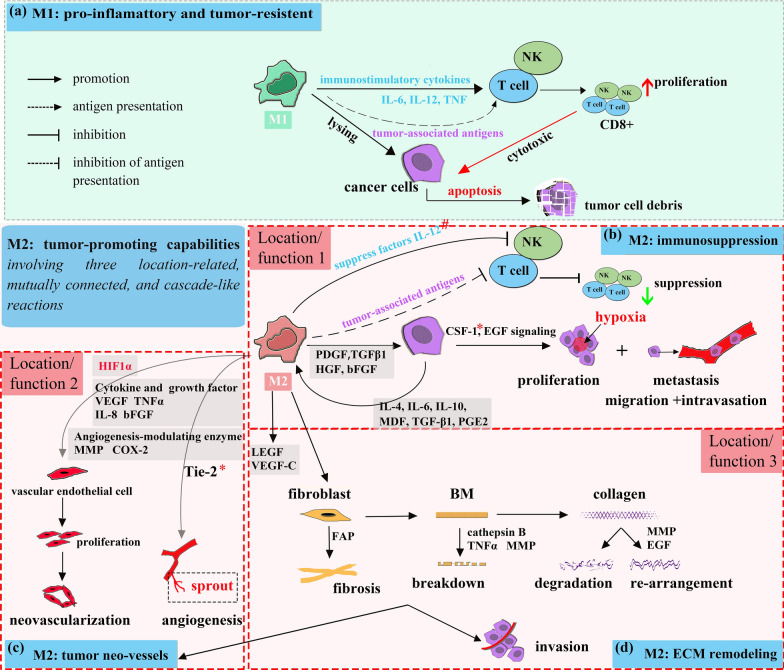
Infiltration of macrophages in and around tumor nest represents one of the most crucial hallmarks during tumor progression. The mutual interactions with tumor cells and stromal microenvironment contribute to phenotypically polarization of tumor associated macrophages. Macrophages consist of at least two subgroups, M1 and M2. M1 phenotype macrophages are tumor-resistant due to intrinsic phagocytosis and enhanced antitumor inflammatory reactions. Contrastingly, M2 are endowed with a repertoire of tumor-promoting capabilities involving immuno-suppression, angiogenesis and neovascularization, as well as stromal activation and remodeling. The functional signature of M2 incorporates location-related, mutually connected, and cascade-like reactions, thereby accelerating paces of tumor aggressiveness and metastasis. In this review, mechanisms underlying the distinct functional characterization of M1 and M2 macrophages are demonstrated to make sense of M1 and M2 as key regulators during cancer progression.
肿瘤巢及其周围巨噬细胞的浸润是肿瘤进展过程中最关键的特征之一。与肿瘤细胞和基质微环境的相互作用导致肿瘤相关巨噬细胞的表型极化。巨噬细胞至少由两个亚群组成,即M1和M2。M1表型巨噬细胞由于其内在的吞噬作用和增强的抗肿瘤炎症反应而具有抗肿瘤能力。相反,M2具有一系列促进肿瘤的能力,包括免疫抑制、血管生成和新血管形成,以及基质激活和重塑。M2的功能特征包含位置相关、相互连接和级联样反应,从而加速肿瘤侵袭和转移的进程。在本综述中,M1和M2巨噬细胞不同功能特征的潜在机制被证明有助于理解M1和M2作为癌症进展过程中的关键调节因子。