Department of Oral Maxillofacial-Head and Neck Oncology, Shanghai Ninth People's Hospital, College of Stomatology, Shanghai Jiao Tong University School of Medicine, No 639, Zhizaoju Rd, 200011, Shanghai, China.
National Clinical Research Center for Oral Diseases, 200011, Shanghai, China.
Cell Death Dis. 2021 Jul 21;12(8):725. doi: 10.1038/s41419-021-03990-4.
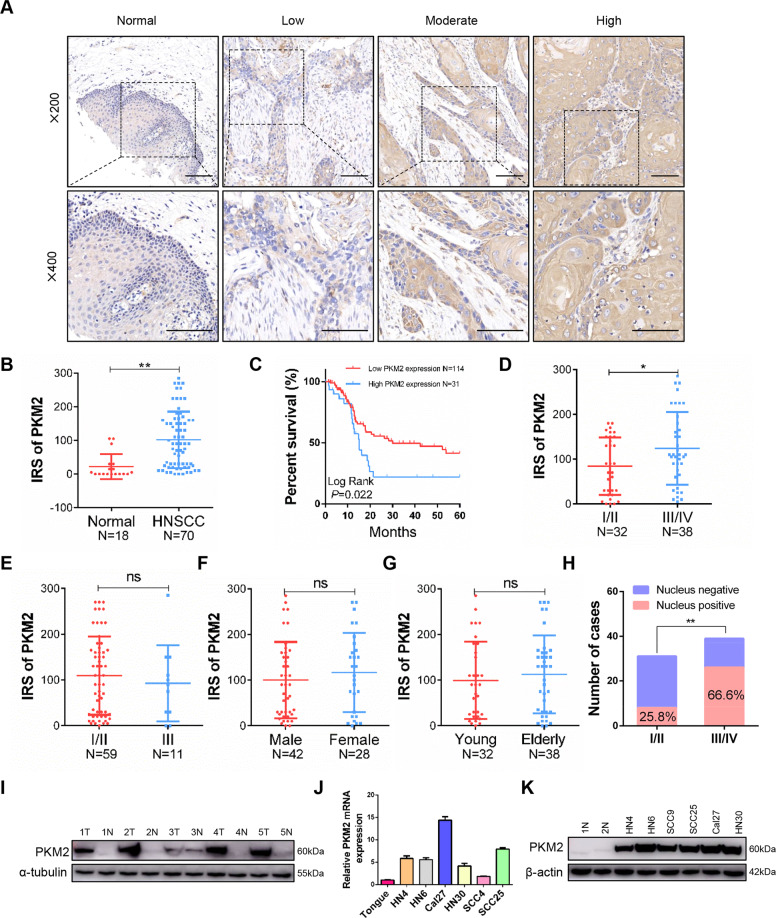
Pyruvate kinase M2 as a key rate-limiting enzyme in glycolysis, it plays a critical role in metabolic reprogramming and carcinogenesis. However, whether PKM2 can promote immunosuppressive microenvironment formation remains unknown in head and neck squamous cell carcinoma (HNSCC). PKM2 expression was detected using immunohistochemical staining. The biological functions of PKM2 were investigated in vitro and in vivo. Lactate production and the expression of Galectin-9, a critical immunosuppression molecule, were detected after PKM2 knockdown and overexpression in HNSCC cells. The mechanism of lactate regulating Galectin-9 expression through NF-κB signaling was explored in vitro. Overexpression of PKM2 correlates with poor prognosis in HNSCC patients. Silencing PKM2 markedly inhibits proliferation and metastasis capacity in vivo and in vitro, and vice versa. The glycolysis and glycolytic capacity are significantly decreased after PKM2 silencing. Lactate secretion induced by PKM2 significantly promotes migration and invasion capacity. Furthermore, a positive correlation between PKM2 and Galectin-9 expression is observed in HNSCC tissues. The induction of Galectin-9 expression by PKM2 can be affected by a lactate transporter inhibitor. Mechanically, lactate impeded the suppressive transcriptional complex formation of NF-κB and histone deacetylase 3 (HDAC3), which released the transcription of Galectin-9 mediated by NF-κB signaling. Our findings demonstrate that lactate produced by PKM2 upregulation promotes tumor progression and Galectin-9-mediated immunosuppression via NF-κB signaling inhibition in HNSCC, which bridges metabolism and immunosuppression. The novel PKM2-lactate-Galectin-9 axis might be a potential therapeutic target in HNSCC.
丙酮酸激酶 M2(PKM2)作为糖酵解中的关键限速酶,在代谢重编程和致癌作用中发挥着关键作用。然而,在头颈部鳞状细胞癌(HNSCC)中,PKM2 是否能促进免疫抑制微环境的形成尚不清楚。本研究采用免疫组织化学染色检测 PKM2 的表达。在体外和体内研究了 PKM2 的生物学功能。在 HNSCC 细胞中敲低和过表达 PKM2 后,检测了乳酸的产生和关键免疫抑制分子半乳糖凝集素-9(Galectin-9)的表达。在体外探讨了乳酸通过 NF-κB 信号调节 Galectin-9 表达的机制。PKM2 的过表达与 HNSCC 患者的不良预后相关。沉默 PKM2 可显著抑制体内和体外的增殖和转移能力,反之亦然。沉默 PKM2 后,糖酵解和糖酵解能力明显降低。PKM2 诱导的乳酸分泌显著促进迁移和侵袭能力。此外,在 HNSCC 组织中观察到 PKM2 与 Galectin-9 表达之间存在正相关。PKM2 诱导的 Galectin-9 表达可被乳酸转运体抑制剂所影响。机制上,乳酸阻碍了 NF-κB 和组蛋白去乙酰化酶 3(HDAC3)抑制性转录复合物的形成,从而释放了 NF-κB 信号介导的 Galectin-9 的转录。本研究表明,在 HNSCC 中,PKM2 上调产生的乳酸通过 NF-κB 信号抑制促进肿瘤进展和 Galectin-9 介导的免疫抑制,这将代谢和免疫抑制联系起来。新型 PKM2-乳酸-Galectin-9 轴可能是 HNSCC 的潜在治疗靶点。