
使用单个耦合分子自旋增加希尔伯特空间维度。
Increasing the Hilbert space dimension using a single coupled molecular spin.
作者信息
Biard Hugo, Moreno-Pineda Eufemio, Ruben Mario, Bonet Edgar, Wernsdorfer Wolfgang, Balestro Franck
机构信息
CNRS, Grenoble INP, Institut Néel, Univ. Grenoble Alpes, Grenoble, France.
Depto. de Química-Física, Escuela de Química, Facultad de Ciencias Naturales, Exactas y Tecnología, Universidad de Panamá, Panamá, Panamá.
出版信息
Nat Commun. 2021 Jul 21;12(1):4443. doi: 10.1038/s41467-021-24693-6.
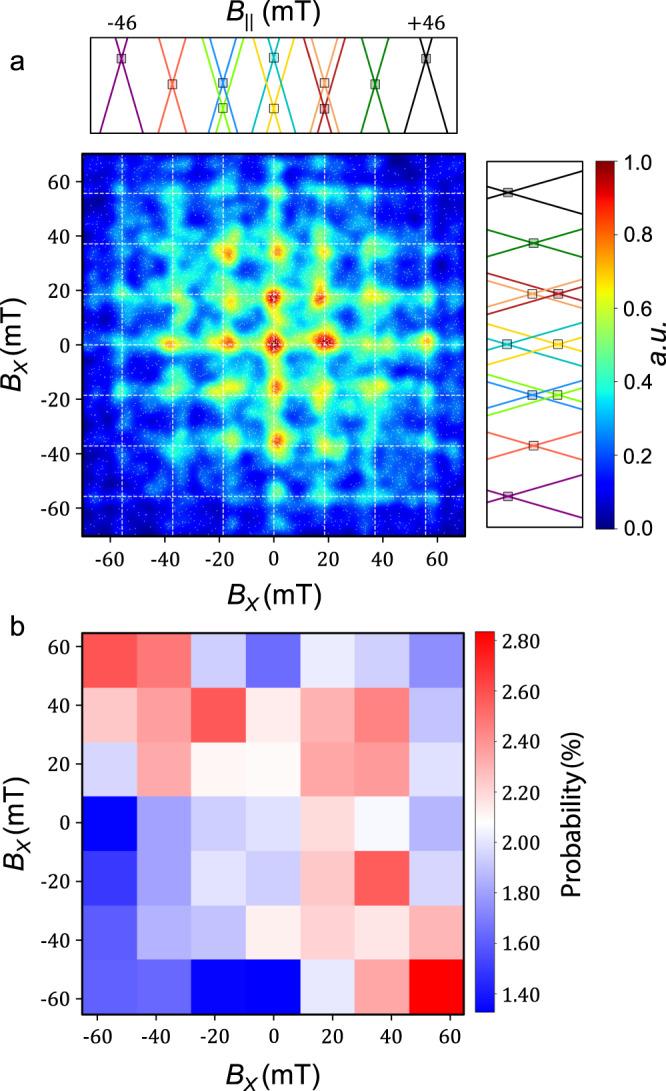
Quantum technologies are expected to introduce revolutionary changes in information processing in the near future. Nowadays, one of the main challenges is to be able to handle a large number of quantum bits (qubits), while preserving their quantum properties. Beyond the usual two-level encoding capacity of qubits, multi-level quantum systems are a promising way to extend and increase the amount of information that can be stored in the same number of quantum objects. Recent work (Kues et al. 2017), has shown the possibility to use devices based on photonic integrated circuits to entangle two qudits (with "d" being the number of available states). In the race to develop a mature quantum technology with real-world applications, many possible platforms are being investigated, including those that use photons, trapped ions, superconducting and silicon circuits and molecular magnets. In this work, we present the electronic read-out of a coupled molecular multi-level quantum systems, carried by a single TbPc molecular magnet. Owning two magnetic centres, this molecular magnet architecture permits a 16 dimensions Hilbert space, opening the possibility of performing more complex quantum algorithms.
预计量子技术将在不久的将来给信息处理带来革命性变化。如今,主要挑战之一是能够处理大量量子比特(qubit),同时保持它们的量子特性。除了量子比特通常的两能级编码能力外,多能级量子系统是扩展和增加可存储在相同数量量子对象中的信息量的一种有前途的方式。最近的工作(Kues等人,2017年)表明,有可能使用基于光子集成电路的设备来纠缠两个qudit(“d”是可用状态的数量)。在开发具有实际应用的成熟量子技术的竞赛中,正在研究许多可能的平台,包括那些使用光子、捕获离子、超导和硅电路以及分子磁体的平台。在这项工作中,我们展示了由单个TbPc分子磁体承载的耦合分子多能级量子系统的电子读出。这种分子磁体结构拥有两个磁中心,允许一个16维的希尔伯特空间,为执行更复杂的量子算法开辟了可能性。


 Zotero 插件