Department of Psychiatry, Boston University School of Medicine, Boston, MA, 02118, USA.
Boston Attention and Learning Laboratory, VA Boston Healthcare System, Boston, MA, 02130, USA.
Sci Rep. 2021 Jul 21;11(1):14883. doi: 10.1038/s41598-021-94161-0.
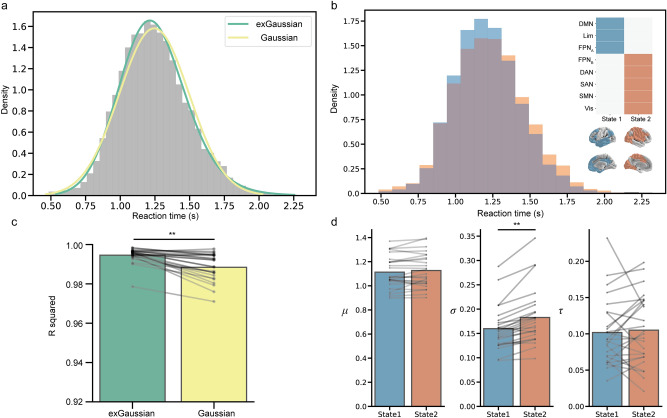
A common behavioral marker of optimal attention focus is faster responses or reduced response variability. Our previous study found two dominant brain states during sustained attention, and these states differed in their behavioral accuracy and reaction time (RT) variability. However, RT distributions are often positively skewed with a long tail (i.e., reflecting occasional slow responses). Therefore, a larger RT variance could also be explained by this long tail rather than the variance around an assumed normal distribution (i.e., reflecting pervasive response instability based on both faster and slower responses). Resolving this ambiguity is important for better understanding mechanisms of sustained attention. Here, using a large dataset of over 20,000 participants who performed a sustained attention task, we first demonstrated the utility of the exGuassian distribution that can decompose RTs into a strategy factor, a variance factor, and a long tail factor. We then investigated which factor(s) differed between the two brain states using fMRI. Across two independent datasets, results indicate unambiguously that the variance factor differs between the two dominant brain states. These findings indicate that 'suboptimal' is different from 'slow' at the behavior and neural level, and have implications for theoretically and methodologically guiding future sustained attention research.
注意焦点最佳状态的一个常见行为标记是更快的反应或减少反应变异性。我们之前的研究发现,在持续注意期间存在两种主导的大脑状态,这些状态在行为准确性和反应时间 (RT) 变异性方面有所不同。然而,RT 分布通常呈正偏态分布,长尾较长(即,偶尔反映较慢的反应)。因此,较大的 RT 方差也可能是由这个长尾解释的,而不是假定正态分布周围的方差(即,反映基于更快和更慢反应的普遍反应不稳定)。解决这种歧义对于更好地理解持续注意的机制非常重要。在这里,我们使用了一个包含超过 20000 名参与者的大型数据集,他们执行了一项持续注意任务,首先展示了可以将 RT 分解为策略因素、方差因素和长尾因素的外高斯分布的效用。然后,我们使用 fMRI 研究了两个大脑状态之间的哪个因素不同。在两个独立的数据集上,结果明确表明,方差因素在两个主导的大脑状态之间不同。这些发现表明,在行为和神经水平上,“次优”与“慢”不同,这对理论和方法上指导未来的持续注意研究具有意义。