Department of Community Medicine, College of Medicine and Sagore Dutta Hospital, Kolkata, India.
COVID Patient Admission Cell, Swasthya Bhawan, Kolkata, India.
Front Public Health. 2021 Jul 5;9:678566. doi: 10.3389/fpubh.2021.678566. eCollection 2021.
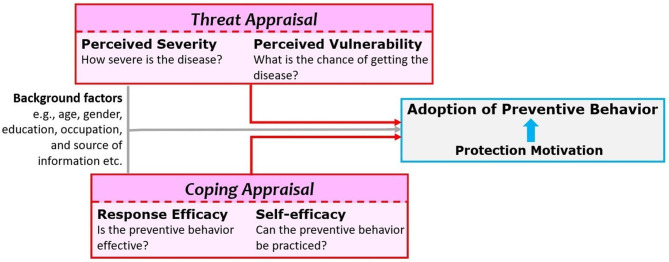
With more than 100 million cases and over 2 million deaths globally, the COVID-19 pandemic continues to remain a major threat. Identifying the behavioral factors influencing preventive behaviors for COVID-19 are crucial in devising public health policies to promote essential strategies to combat the pandemic in an efficient manner. The current study was therefore conducted to estimate the prevalence of COVID-19 preventive behaviors and measure their association with behavioral constructs like threat perception, response efficacy, and self-efficacy, as per socio-demographic background. A region-stratified online survey focusing on the constructs of protection motivation theory, for example, threat and coping appraisal for preventive health practices against COVID-19, was carried out among adult users of social media in India. Generalized linear models with cluster-adjusted-robust standard errors were used to analyze the responses and model the preventive practices among the study population. Analysis of a total 2,646 responses revealed that proper perceptions regarding cause, symptoms, and transmission of COVID-19 were prevalent in the majority of the respondents. The majority of the participants reported frequent use of face masks (93.20%), followed by frequent washing of hands with soap and water (84.90%). The majority of the respondents affirmed that, though not frequently but sometimes, they avoid touching the face with unclean hands. Frequently covering mouth with the crook of the elbow while sneezing and coughing, and maintaining physical distance when outside was noted among 74.14 and 83.84%, respectively. The proportion of participants frequently using sanitizers to clean hands and those infrequently practicing the same were comparable. Self-efficacy for preventive practices and threat-appraisal of COVID-19 illness were identified as important determinants of the selected COVID-19 preventive behaviors, independently. The analysis confirmed that practices of the behaviors were mostly synergistic to each other. Current findings highlight that formulation of precise risk communication strategies to improve perceptions regarding threat appraisal and self-efficacy could facilitate desirable practices, which are also effective in the prevention of airborne infections and, hence, may contribute toward broader policy directions. The evidence urges the implementation of precision-driven risk communication and diffusion of these practices to attain behavioral herd immunity.
全球有超过 1 亿例病例和超过 200 万人死亡,COVID-19 大流行仍然是一个主要威胁。确定影响 COVID-19 预防行为的行为因素对于制定公共卫生政策以有效促进对抗大流行的基本策略至关重要。因此,本研究旨在估计 COVID-19 预防行为的流行率,并根据社会人口背景衡量其与行为结构的关联,例如威胁感知、应对效能和自我效能。一项针对印度社交媒体成年用户的区域分层在线调查,重点关注保护动机理论的结构,例如针对 COVID-19 的预防保健实践的威胁和应对评估。使用广义线性模型和聚类调整稳健标准误差来分析反应并对研究人群中的预防实践进行建模。对总共 2646 份回应的分析表明,大多数受访者对 COVID-19 的原因、症状和传播有正确的认识。大多数参与者报告经常使用口罩(93.20%),其次是经常用肥皂和水洗手(84.90%)。大多数受访者肯定,虽然不是经常,但有时他们会避免用不干净的手触摸脸部。打喷嚏和咳嗽时经常用肘部弯曲处捂住嘴,外出时保持身体距离,分别为 74.14%和 83.84%。经常使用消毒剂清洁双手的参与者比例与不经常使用消毒剂的参与者比例相当。预防实践的自我效能和 COVID-19 疾病的威胁评估被确定为选定 COVID-19 预防行为的重要决定因素,彼此独立。分析证实,这些行为的实践大多是协同作用的。目前的研究结果表明,制定精确的风险沟通策略以提高对威胁评估和自我效能的认识,可以促进理想的实践,这些实践在预防空气传播感染方面也很有效,因此可能有助于更广泛的政策方向。这一证据促使实施精准驱动的风险沟通和这些实践的传播,以实现行为群体免疫。