Department of Epidemiology, Mailman School of Public Health, Columbia University, 722 W 168th St, Suite 700, New York, NY, 10032, USA.
U.S. Military HIV Research Program, Walter Reed Army Institute of Research, Silver Spring, New York, MD, USA.
AIDS Res Ther. 2021 Jul 22;18(1):43. doi: 10.1186/s12981-021-00363-x.
Persons living with HIV (PLWH) who are members of sero-discordant and sero-concordant relationships may experience psychological stressors or motivators that affect HIV care. We assessed the association between sero-discordance status, antiretroviral therapy (ART) uptake, and viral suppression in the African Cohort Study (AFRICOS).
AFRICOS enrolls PLWH and HIV-uninfected individuals at 12 sites in Uganda, Kenya, Tanzania, and Nigeria. At enrollment, we determined ART use through self-report. Viral suppression was defined as HIV RNA < 1000 copies/mL. We analyzed PLWH who were index participants within two types of sexual dyads: sero-discordant or sero-concordant. Binomial regression models were used to estimate prevalence ratios (PRs) and 95% confidence intervals (95% CIs) for factors associated with ART use and viral suppression at study enrollment.
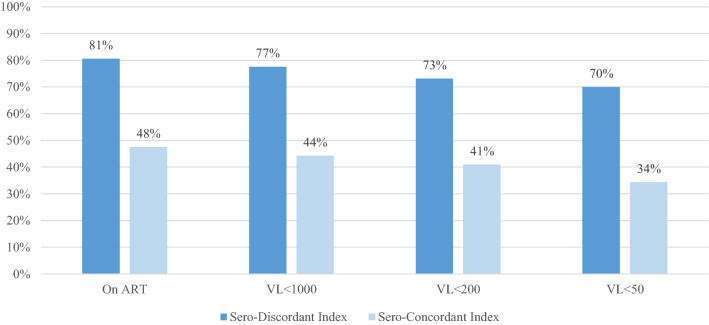
From January 2013 through March 2018, 223 index participants from sero-discordant dyads and 61 from sero-concordant dyads were enrolled. The majority of the indexes were aged 25-34 years (50.2%), female (53.4%), and married (96.5%). Sero-discordant indexes were more likely to disclose their status to partners compared with sero-concordant indexes (96.4% vs. 82.0%, p < 0.001). After adjustment, sero-discordant index participants were more likely to be on ART (aPR 2.8 [95% CI 1.1-6.8]), but no more likely to be virally suppressed. Results may be driven by unique psycho-social factors and global implementation of treatment as prevention.
PLWH in sero-discordant sexual partnerships demonstrated improved uptake of ART compared with those in sero-concordant partnerships. Interventions are needed to increase care engagement by individuals in sero-concordant relationships to improve HIV outcomes.
艾滋病毒感染者(PLWH)如果是血清不一致或血清一致关系的成员,可能会经历影响艾滋病毒护理的心理压力源或动机。我们评估了血清不一致状态、抗逆转录病毒治疗(ART)的采用以及在非洲队列研究(AFRICOS)中的病毒抑制之间的关联。
AFRICOS 在乌干达、肯尼亚、坦桑尼亚和尼日利亚的 12 个地点招募 PLWH 和未感染 HIV 的个体。在入组时,我们通过自我报告确定 ART 的使用情况。病毒抑制定义为 HIV RNA<1000 拷贝/mL。我们分析了作为两种类型性伴侣关系中的索引参与者的 PLWH:血清不一致或血清一致。二项回归模型用于估计与研究入组时 ART 使用和病毒抑制相关的因素的患病率比(PR)和 95%置信区间(95%CI)。
从 2013 年 1 月至 2018 年 3 月,共招募了来自血清不一致的对偶的 223 名索引参与者和来自血清一致的对偶的 61 名索引参与者。大多数索引参与者年龄在 25-34 岁(50.2%),女性(53.4%)和已婚(96.5%)。与血清一致的对偶索引参与者相比,血清不一致的对偶索引参与者更有可能向伴侣透露自己的状况(96.4%对 82.0%,p<0.001)。调整后,血清不一致的索引参与者更有可能接受 ART(aPR 2.8 [95%CI 1.1-6.8]),但病毒抑制的可能性没有增加。结果可能是由独特的心理社会因素和治疗即预防的全球实施驱动的。
与血清一致的性关系中的 PLWH 相比,血清不一致的性关系中的 PLWH 更有可能接受 ART。需要采取干预措施,通过提高血清一致关系中个体的护理参与度来改善 HIV 结局。