Goff Peter H, Bhakuni Rashmi, Pulliam Thomas, Lee Jung Hyun, Hall Evan T, Nghiem Paul
Department of Radiation Oncology, University of Washington, Seattle, WA 98195, USA.
Division of Dermatology, Department of Medicine, University of Washington, Seattle, WA 98109, USA.
Cancers (Basel). 2021 Jul 8;13(14):3415. doi: 10.3390/cancers13143415.
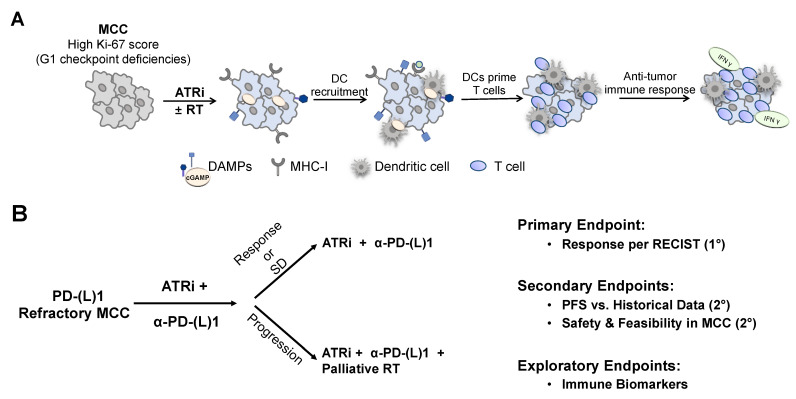
Metastatic cancers resistant to immunotherapy require novel management strategies. DNA damage response (DDR) proteins, including ATR (ataxia telangiectasia and Rad3-related), ATM (ataxia telangiectasia mutated) and DNA-PK (DNA-dependent protein kinase), have been promising therapeutic targets for decades. Specific, potent DDR inhibitors (DDRi) recently entered clinical trials. Surprisingly, preclinical studies have now indicated that DDRi may stimulate anti-tumor immunity to augment immunotherapy. The mechanisms governing how DDRi could promote anti-tumor immunity are not well understood; however, early evidence suggests that they can potentiate immunogenic cell death to recruit and activate antigen-presenting cells to prime an adaptive immune response. Merkel cell carcinoma (MCC) is well suited to test these concepts. It is inherently immunogenic as ~50% of patients with advanced MCC persistently benefit from immunotherapy, making MCC one of the most responsive solid tumors. As is typical of neuroendocrine cancers, dysfunction of p53 and Rb with upregulation of Myc leads to the very rapid growth of MCC. This suggests high replication stress and susceptibility to DDRi and DNA-damaging agents. Indeed, MCC tumors are particularly radiosensitive. Given its inherent immunogenicity, cell cycle checkpoint deficiencies and sensitivity to DNA damage, MCC may be ideal for testing whether targeting the intersection of the DDR checkpoint and the immune checkpoint could help patients with immunotherapy-refractory cancers.
对免疫疗法耐药的转移性癌症需要新的治疗策略。几十年来,包括共济失调毛细血管扩张症和Rad3相关蛋白(ATR)、共济失调毛细血管扩张症突变蛋白(ATM)和DNA依赖性蛋白激酶(DNA-PK)在内的DNA损伤反应(DDR)蛋白一直是很有前景的治疗靶点。特异性、强效的DDR抑制剂(DDRi)最近已进入临床试验。令人惊讶的是,临床前研究现已表明,DDRi可能会刺激抗肿瘤免疫以增强免疫疗法。DDRi促进抗肿瘤免疫的机制尚未完全了解;然而,早期证据表明,它们可以增强免疫原性细胞死亡,以募集和激活抗原呈递细胞来启动适应性免疫反应。默克尔细胞癌(MCC)非常适合测试这些概念。它具有内在免疫原性,因为约50%的晚期MCC患者持续受益于免疫疗法,这使MCC成为反应最灵敏的实体瘤之一。与神经内分泌癌的典型情况一样,p53和Rb功能失调以及Myc上调导致MCC生长非常迅速。这表明存在高复制应激以及对DDRi和DNA损伤剂敏感。事实上,MCC肿瘤对放疗特别敏感。鉴于其内在免疫原性、细胞周期检查点缺陷以及对DNA损伤的敏感性,MCC可能是测试靶向DDR检查点和免疫检查点的交叉点是否有助于免疫疗法难治性癌症患者的理想选择。