Moriya Taiki, Kitagawa Kurumi, Hayakawa Yuuki, Hemmi Hiroaki, Kaisho Tsuneyasu, Ueha Satoshi, Ikebuchi Ryoyo, Yasuda Ippei, Nakanishi Yasutaka, Honda Tetsuya, Matsushima Koji, Kabashima Kenji, Ueda Mizuki, Kusumoto Yutaka, Chtanova Tatyana, Tomura Michio
Laboratory of Immunology, Faculty of Pharmacy, Osaka Ohtani University, Tondabayashi, Osaka 584-8540, Japan.
Department of Immunology, Institute of Advanced Medicine, Wakayama Medical University, Graduate school of Medicine, Wakayama, Wakayama 641-8509, Japan.
iScience. 2021 Apr 14;24(5):102424. doi: 10.1016/j.isci.2021.102424. eCollection 2021 May 21.
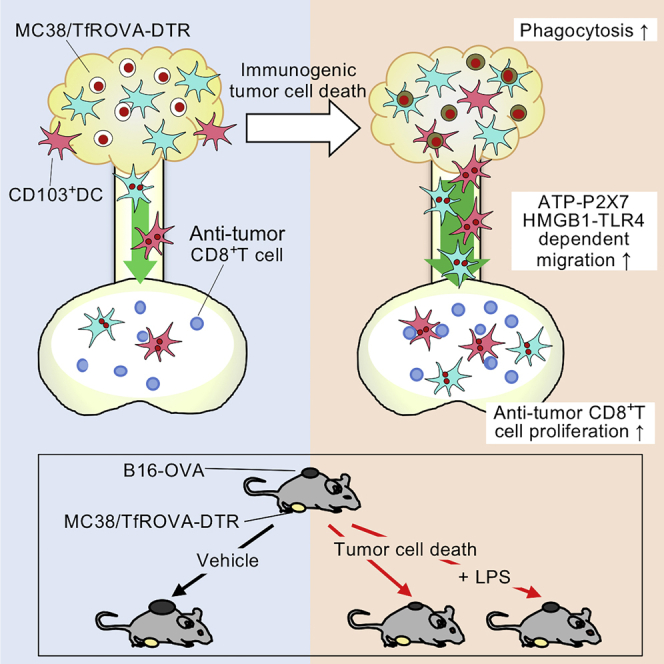
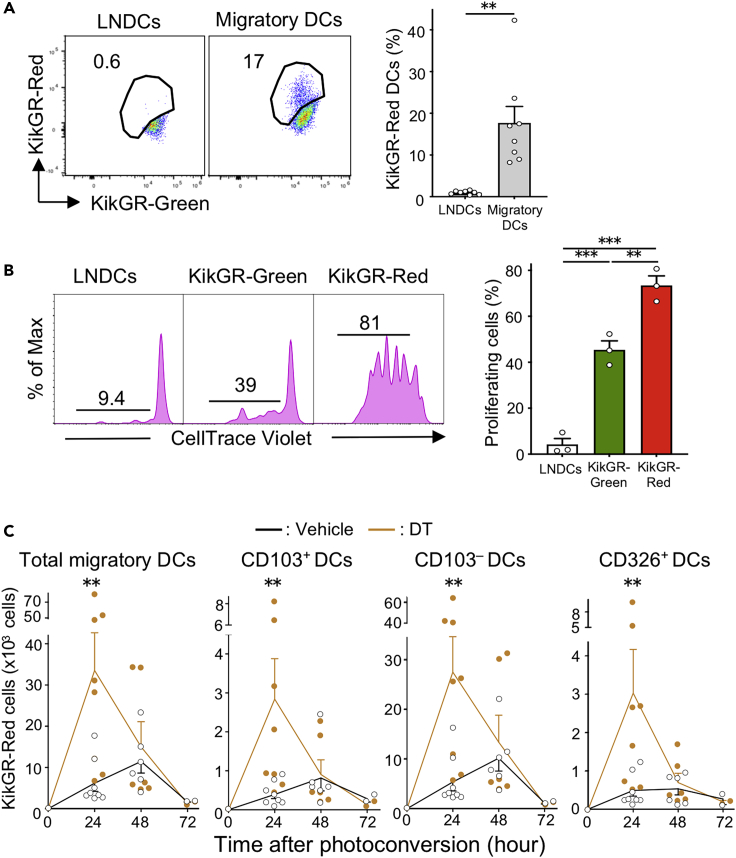
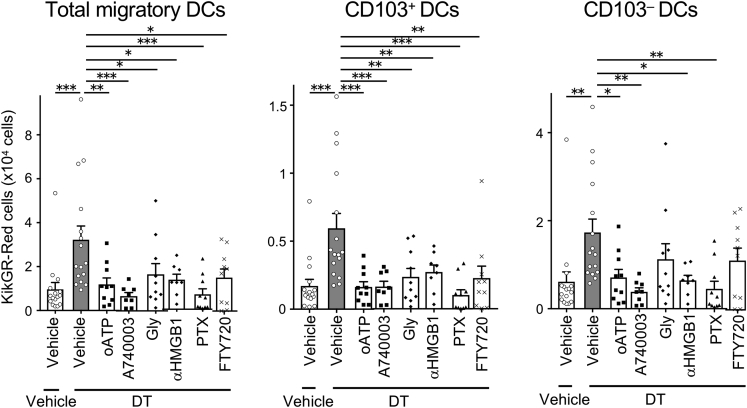
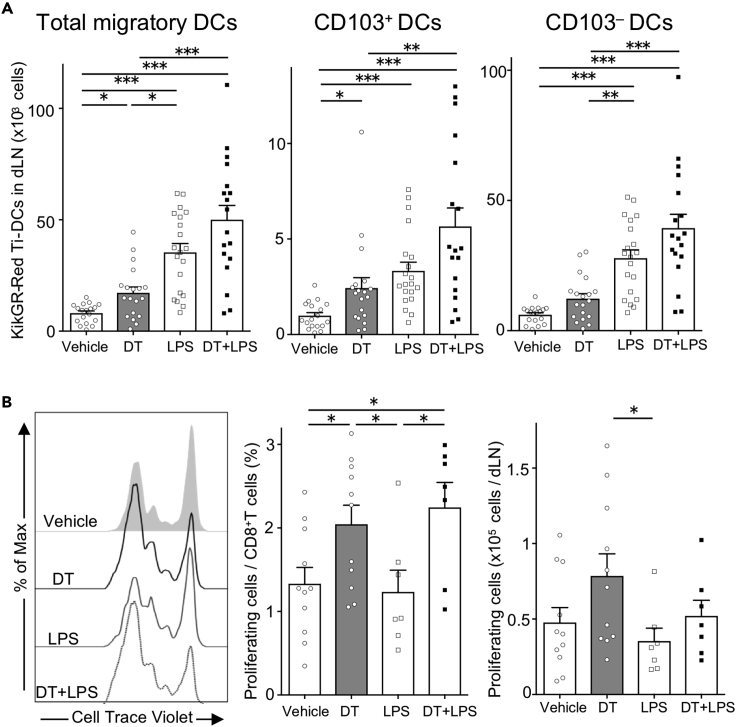
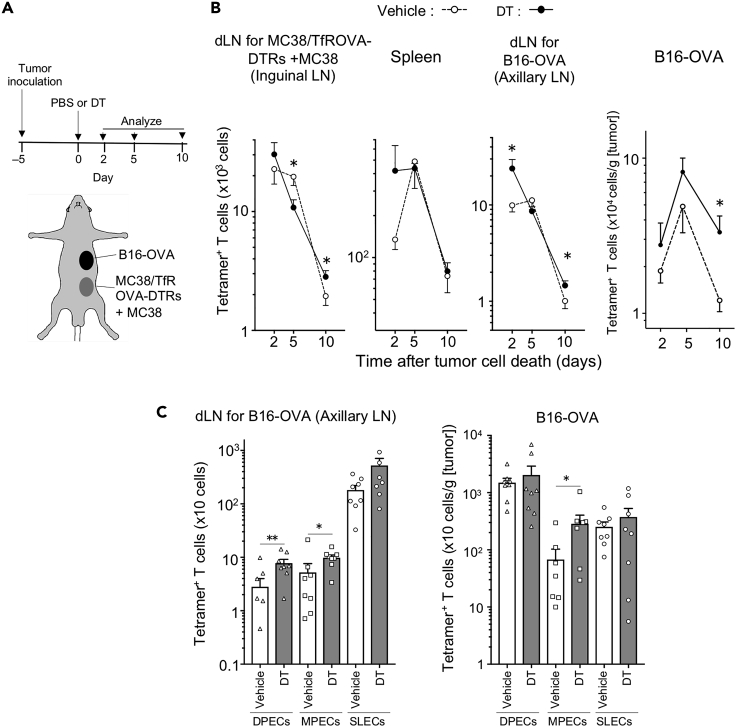
Immunogenic tumor cell death enhances anti-tumor immunity. However, the mechanisms underlying this effect are incompletely understood. We established a system to induce tumor cell death and investigated its effect on dendritic cell (DC) migration and T cell responses using intravital photolabeling in mice expressing KikGR photoconvertible protein. We demonstrate that tumor cell death induces phagocytosis of tumor cells by tumor-infiltrating (Ti)-DCs, and HMGB1-TLR4 and ATP-P2X7 receptor signaling-dependent Ti-DC emigration to draining lymph nodes (dLNs). This led to an increase in anti-tumor CD8 T cells of memory precursor effector phenotype and secondary tumor growth inhibition in a CD103 DC-dependent manner. However, combining tumor cell death induction with lipopolysaccharide treatment stimulated Ti-DC maturation and emigration to dLNs but did not improve tumor immunity. Thus, immunogenic tumor cell death enhances tumor immunity by increasing Ti-DC migration to dLNs where they promote anti-tumor T cell responses and tumor growth inhibition.
免疫原性肿瘤细胞死亡可增强抗肿瘤免疫力。然而,这种效应背后的机制尚未完全明确。我们建立了一种诱导肿瘤细胞死亡的系统,并利用活体光标记技术,在表达KikGR光转换蛋白的小鼠体内研究了其对树突状细胞(DC)迁移和T细胞反应的影响。我们证明,肿瘤细胞死亡可诱导肿瘤浸润性(Ti)DC吞噬肿瘤细胞,并通过HMGB1-TLR4和ATP-P2X7受体信号依赖的方式促使Ti-DC迁移至引流淋巴结(dLN)。这导致记忆性前体效应表型的抗肿瘤CD8 T细胞增加,并以CD103 DC依赖的方式抑制继发性肿瘤生长。然而,将肿瘤细胞死亡诱导与脂多糖治疗相结合,虽可刺激Ti-DC成熟并迁移至dLN,但并未改善肿瘤免疫。因此,免疫原性肿瘤细胞死亡通过增加Ti-DC向dLN的迁移来增强肿瘤免疫,在dLN中,Ti-DC可促进抗肿瘤T细胞反应并抑制肿瘤生长。