Department of Experimental and Clinical Biomedical Sciences, University of Florence, Viale Pieraccini 6, 50139 Florence, Italy.
F.I.R.M.O., Italian Foundation for the Research on Bone Diseases, Via Reginaldo Giuliani 195/A, 50141 Florence, Italy.
Int J Mol Sci. 2021 Jul 8;22(14):7352. doi: 10.3390/ijms22147352.
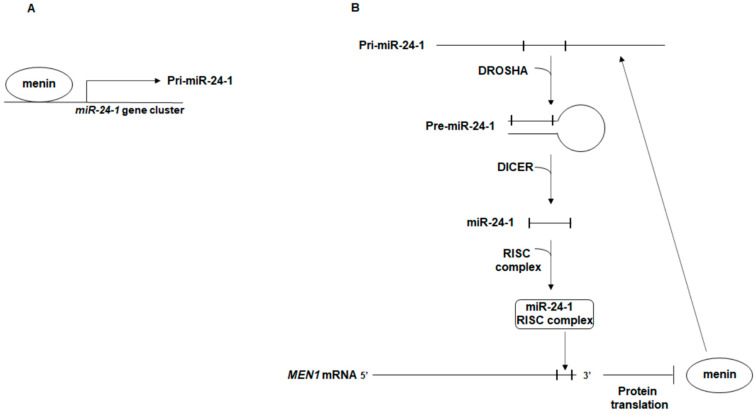
Multiple endocrine neoplasia type 1 (MEN1) is a rare autosomal dominant inherited multiple cancer syndrome of neuroendocrine tissues. Tumors are caused by an inherited germinal heterozygote inactivating mutation of the tumor suppressor gene, followed by a somatic loss of heterozygosity (LOH) of the gene in target neuroendocrine cells, mainly at parathyroids, pancreas islets, and anterior pituitary. Over 1500 different germline and somatic mutations of the gene have been identified, but the syndrome is completely missing a direct genotype-phenotype correlation, thus supporting the hypothesis that exogenous and endogenous factors, other than specific mutation, are involved in MEN1 tumorigenesis and definition of individual clinical phenotype. Epigenetic factors, such as microRNAs (miRNAs), are strongly suspected to have a role in MEN1 tumor initiation and development. Recently, a direct autoregulatory network between miR-24, mRNA, and menin was demonstrated in parathyroids and endocrine pancreas, showing a miR-24-induced silencing of menin expression that could have a key role in initiation of tumors in MEN1-target neuroendocrine cells. Here, we review the current knowledge on the post-transcriptional regulation of and menin expression by miR-24, and its possible direct role in MEN1 syndrome, describing the possibility and the potential approaches to target and silence this miRNA, to permit the correct expression of the wild type menin, and thereby prevent the development of cancers in the target tissues.
多发性内分泌肿瘤 1 型(MEN1)是一种罕见的常染色体显性遗传性神经内分泌组织多癌综合征。肿瘤是由肿瘤抑制基因的遗传生殖杂合子失活突变引起的,随后在靶神经内分泌细胞中发生基因的体细胞杂合性丢失(LOH),主要发生在甲状旁腺、胰岛和垂体前叶。已经鉴定出超过 1500 种不同的 基因胚系和体细胞突变,但该综合征完全缺失直接的基因型-表型相关性,这支持了这样一种假说,即除了特定的突变之外,外源性和内源性因素参与了 MEN1 肿瘤发生和个体临床表型的定义。表观遗传因素,如 microRNAs(miRNAs),强烈怀疑在 MEN1 肿瘤发生和发展中起作用。最近,在甲状旁腺和内分泌胰腺中证明了 miR-24、mRNA 和 menin 之间的直接自调节网络,显示了 miR-24 诱导的 menin 表达沉默,这可能在 MEN1 靶神经内分泌细胞肿瘤的起始中起关键作用。在这里,我们综述了 miR-24 对 和 menin 表达的转录后调控的最新知识,及其在 MEN1 综合征中的可能直接作用,描述了靶向和沉默这种 miRNA 的可能性和潜在方法,以允许野生型 menin 的正确表达,从而防止靶组织中癌症的发展。