Health Innovation Laboratory, Institute of Tropical Medicine "Alexander Von Humboldt", Universidad Peruana Cayetano Heredia, Lima, Peru.
Scripps Institution of Oceanography, University of California, San Diego, CA, USA.
Sci Rep. 2021 Jul 23;11(1):15121. doi: 10.1038/s41598-021-94601-x.
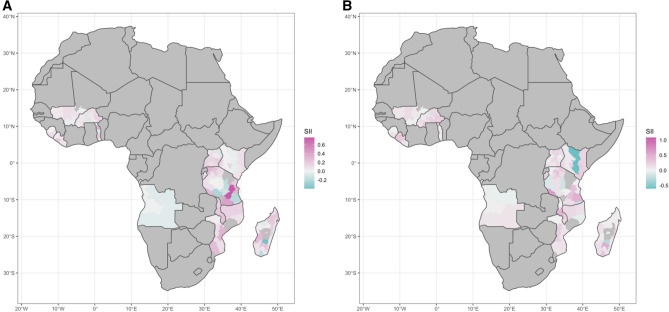
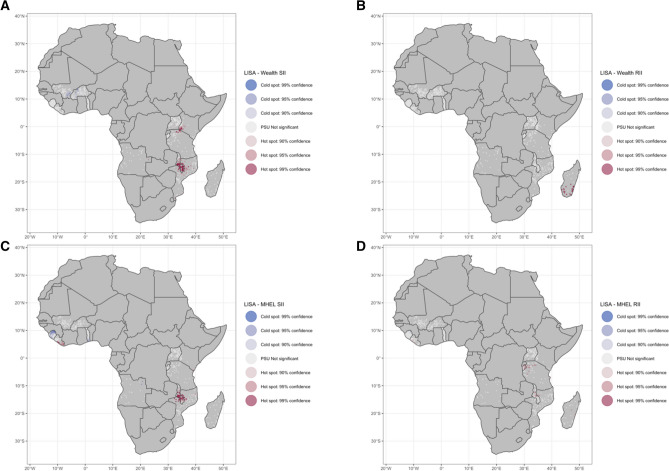
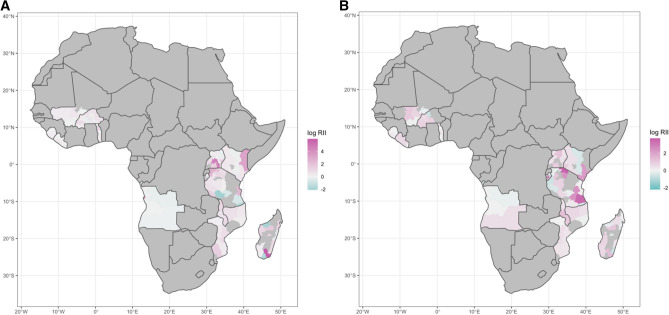
Despite reductions in malaria incidence and mortality across Sub-Saharan (SSA) countries, malaria control and elimination efforts are currently facing multiple global challenges such as climate and land use change, invasive vectors, and disruptions in healthcare delivery. Although relationships between malaria risks and socioeconomic factors have been widely demonstrated, the strengths and variability of these associations have not been quantified across SSA. In this study, we used data from population-based malaria indicator surveys in SSA countries to assess spatial trends in relative and absolute socioeconomic inequalities, analyzed as social (mothers' highest educational level-MHEL) and economic (wealth index-WI) inequalities in malaria prevalence. To capture spatial variations in socioeconomic (represented by both WI and MHEL) inequalities in malaria, we calculated both the Slope Index of Inequality (SII) and Relative Index of Inequality (RII) in each administrative region. We also conducted cluster analyses based on Local Indicator of Spatial Association (LISA) to consider the spatial auto-correlation in SII and RII across regions and countries. A total of 47,404 participants in 1874 Primary Sampling Units (PSU) were analyzed across the 13 SSA countries. Our multi-country assessment provides estimations of strong socioeconomic inequalities between and within SSA countries. Such within- and between- countries inequalities varied greatly according to the socioeconomic metric and the scale used. Countries located in Eastern Africa showed a higher median Slope Index of Inequality (SII) and Relative Index of Inequality (RII) in malaria prevalence relative to WI in comparison to countries in other locations across SSA. Pockets of high SII in malaria prevalence in relation to WI and MHEL were observed in the East part of Africa. This study was able to map this wide range of malaria inequality metrics at a very local scale and highlighted the spatial clustering patterns of pockets of high and low malaria inequality values.
尽管撒哈拉以南非洲(SSA)国家的疟疾发病率和死亡率有所下降,但疟疾控制和消除工作目前正面临着多个全球性挑战,如气候变化和土地利用变化、入侵性媒介以及医疗保健服务中断。尽管疟疾风险与社会经济因素之间的关系已得到广泛证明,但这些关联的强度和可变性在 SSA 国家中尚未得到量化。在这项研究中,我们使用 SSA 国家基于人群的疟疾指标调查数据,评估了疟疾与社会经济不平等的空间趋势,分析了疟疾患病率的社会(母亲最高教育程度-MHEL)和经济(财富指数-WI)不平等。为了捕捉疟疾的社会经济不平等(由 WI 和 MHEL 共同表示)的空间变化,我们在每个行政区域计算了不平等斜率指数(SII)和相对不平等指数(RII)。我们还基于空间局部关联指标(LISA)进行了聚类分析,以考虑区域和国家之间 SII 和 RII 的空间自相关。共分析了 13 个 SSA 国家的 1874 个初级抽样单位(PSU)中的 47404 名参与者。我们的多国评估提供了 SSA 国家内部和国家之间存在强烈社会经济不平等的估计。这些国家内部和国家之间的不平等差异很大,具体取决于社会经济指标和使用的规模。与 SSA 其他地区的国家相比,位于东非的国家在疟疾流行率方面的不平等斜率指数(SII)和相对不平等指数(RII)的中位数相对较高。在东非部分地区观察到与 WI 和 MHEL 相比,疟疾流行率的 SII 较高的疟疾高度不平等的“热点”。本研究能够在非常小的尺度上绘制出这种广泛的疟疾不平等指标,并突出了疟疾高值和低值的热点的空间聚类模式。