Department of Pediatrics, University of Cincinnati College of Medicine, Cincinnati, OH, USA.
Division of Immunobiology, Cincinnati Children's Hospital Medical Center, Cincinnati, OH, USA.
Int J Obes (Lond). 2021 Nov;45(11):2377-2387. doi: 10.1038/s41366-021-00902-6. Epub 2021 Jul 23.
The risks of excess sugar intake in addition to high-fat diet consumption on immunopathogenesis of obesity-associated metabolic diseases are poorly defined. Interleukin-4 (IL-4) and IL-13 signaling via IL-4Rα regulates adipose tissue lipolysis, insulin sensitivity, and liver fibrosis in obesity. However, the contribution of IL-4Rα to sugar rich diet-driven obesity and metabolic sequelae remains unknown.
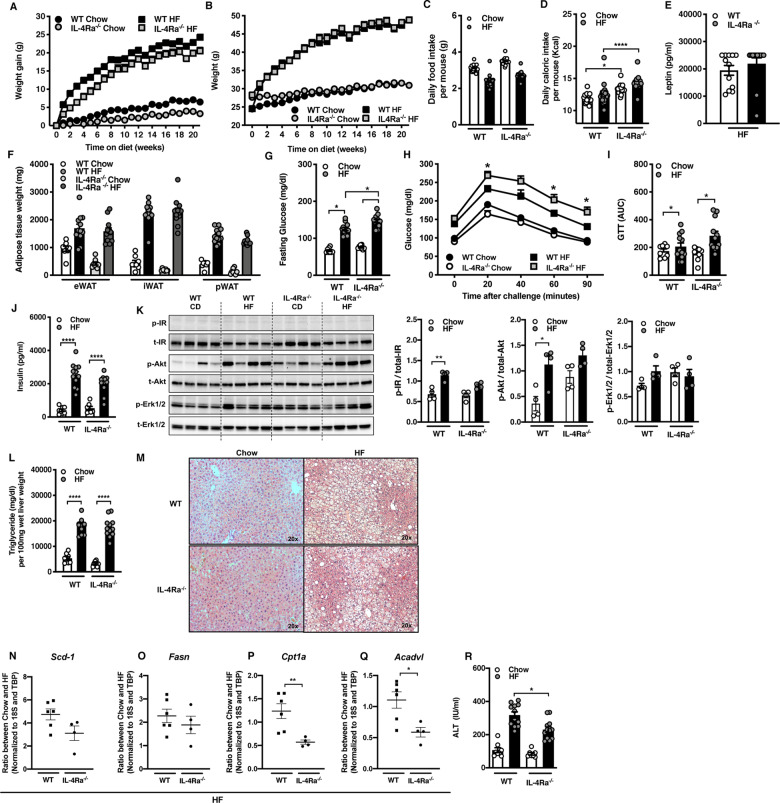
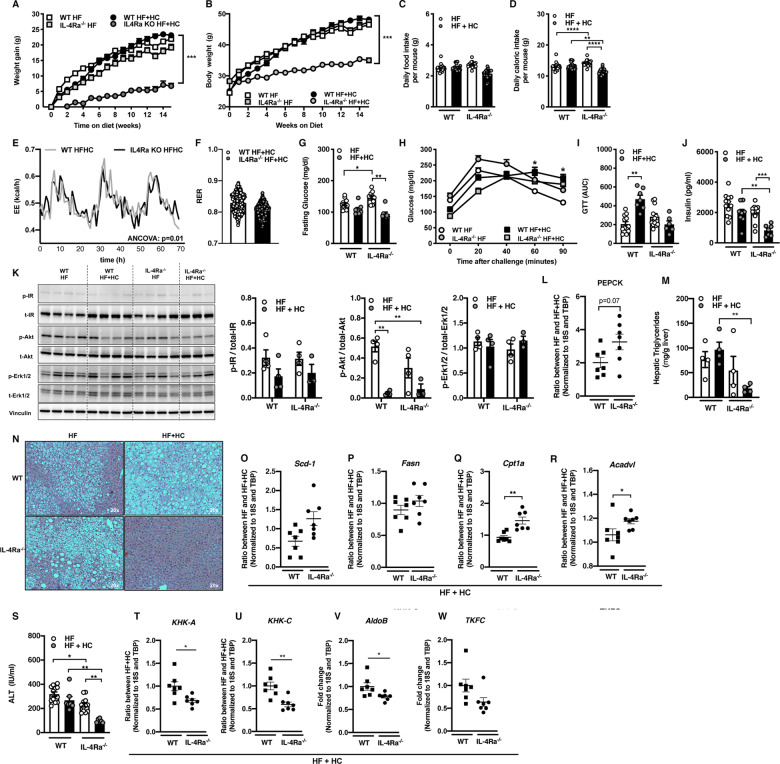
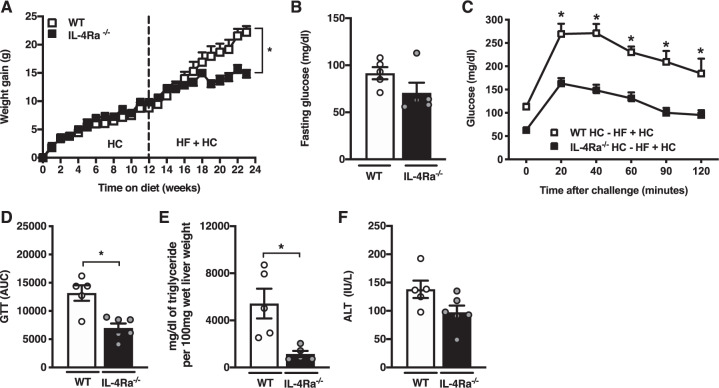
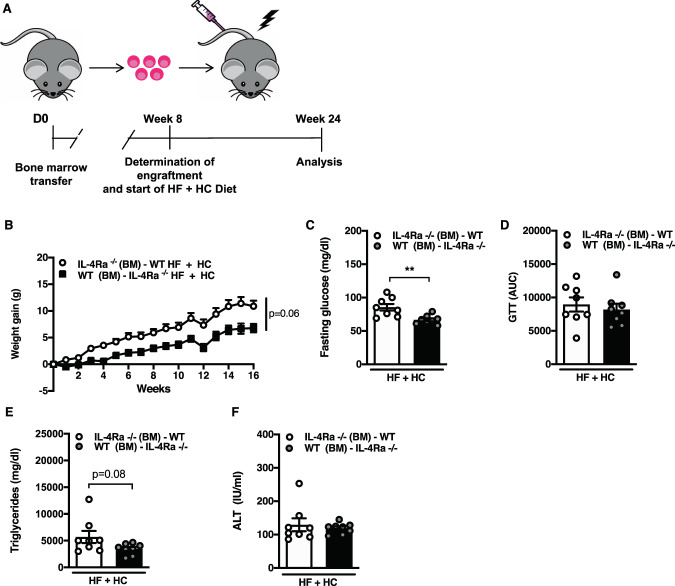
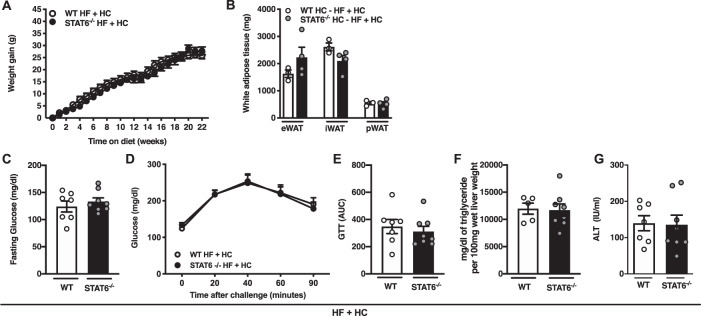
WT, IL-4Rα-deficient (IL-4Rα) and STAT6-deficient mice (STAT6) male mice were fed low-fat chow, high fat (HF) or HF plus high carbohydrate (HC/fructose) diet (HF + HC). Analysis included quantification of: (i) body weight, adiposity, energy expenditure, fructose metabolism, fatty acid oxidation/synthesis, glucose dysmetabolism and hepatocellular damage; (ii) the contribution of the hematopoietic or non-hematopoietic IL-4Rα expression; and (iii) the relevance of IL-4Rα downstream canonical STAT6 signaling pathway in this setting.
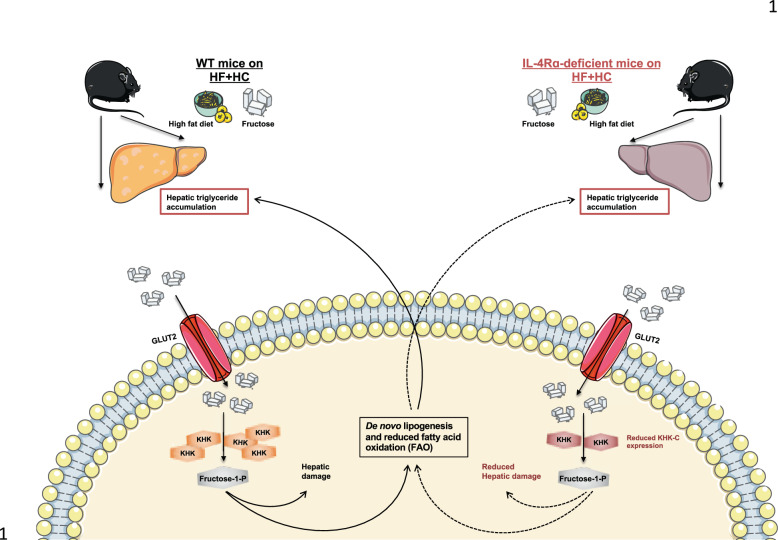
We show that IL-4Rα regulated HF + HC diet-driven weight gain, whole body adiposity, adipose tissue inflammatory gene expression, energy expenditure, locomotor activity, glucose metabolism, hepatic steatosis, hepatic inflammatory gene expression and hepatocellular damage. These effects were potentially, and in part, dependent on non-hematopoietic IL-4Rα expression but were independent of direct STAT6 activation. Mechanistically, hepatic ketohexokinase-A and C expression was dependent on IL-4Rα, as it was reduced in IL-4Rα-deficient mice. KHK activity was also affected by HF + HC dietary challenge. Further, reduced expression/activity of KHK in IL-4Rα mice had a significant effect on fatty acid oxidation and fatty acid synthesis pathways.
Our findings highlight potential contribution of non-hematopoietic IL-4Rα activation of a non-canonical signaling pathway that regulates the HF + HC diet-driven induction of obesity and severity of obesity-associated sequelae.
除高脂肪饮食摄入外,过量糖摄入对肥胖相关代谢性疾病的免疫发病机制的风险尚不清楚。白细胞介素-4(IL-4)和白细胞介素-13(IL-13)通过 IL-4Rα 信号转导调节肥胖症中的脂肪组织脂解、胰岛素敏感性和肝纤维化。然而,IL-4Rα 对富含糖的饮食驱动的肥胖和代谢后果的贡献尚不清楚。
WT、IL-4Rα 缺陷(IL-4Rα)和 STAT6 缺陷(STAT6)雄性小鼠分别喂食低脂饲料、高脂肪(HF)或高脂肪加高碳水化合物(HF+HC/果糖)饮食(HF+HC)。分析包括:(i)体重、肥胖程度、能量消耗、果糖代谢、脂肪酸氧化/合成、葡萄糖代谢障碍和肝细胞损伤;(ii)造血或非造血 IL-4Rα 表达的贡献;(iii)在这种情况下 IL-4Rα 下游经典 STAT6 信号通路的相关性。
我们表明,IL-4Rα 调节 HF+HC 饮食驱动的体重增加、全身肥胖、脂肪组织炎症基因表达、能量消耗、运动活性、葡萄糖代谢、肝脂肪变性、肝炎症基因表达和肝细胞损伤。这些影响可能部分取决于非造血 IL-4Rα 表达,但与直接 STAT6 激活无关。在机制上,肝酮己激酶-A 和 C 的表达依赖于 IL-4Rα,因为它在 IL-4Rα 缺陷型小鼠中减少。KHK 活性也受到 HF+HC 饮食挑战的影响。此外,IL-4Rα 小鼠中 KHK 的表达/活性降低对脂肪酸氧化和脂肪酸合成途径有显著影响。
我们的研究结果强调了非造血 IL-4Rα 激活非经典信号通路的潜在作用,该信号通路调节 HF+HC 饮食驱动的肥胖诱导及其与肥胖相关的严重程度。